Dead Battery vs Bad Alternator: How to Tell the Difference in 5 Minutes (And Avoid a $900 Mistake)

A replacement car battery costs $120 to $200. A replacement alternator averages $757 to $1,032 at an car repair shop. A dead battery costs $150. A bad alternator costs $900. Do not waste $600 on the wrong fix. Car electrical systems divide labor clearly. Batteries start the engine. Alternators power the vehicle once it runs. Spotting key sounds, dash cues, and multimeter numbers reveals the bad part in five minutes.
Dead Battery or Bad Alternator? How to Tell in 30 Seconds Before Spending a Dime
A dead battery causes failures during startup. It produces rapid clicking, slow cranking, or complete silence at key-turn. A bad alternator causes breakdowns on the road. It triggers battery warning lights. Headlights dim, radios die, and the engine stalls. If a jumped car continues running, the battery failed. If it stalls immediately, the alternator failed.
| Diagnostic Check | Dead Battery | Failing Alternator | Failing Starter Motor |
|---|---|---|---|
| Primary failure timing | Startup attempt | Engine running or idling | Key-turn attempt |
| Starter sound at key-turn | Rapid machine-gun clicking | Normal start, then dies | Single loud metallic clunk |
| Headlight behavior | Normal or dim before start | Dims at idle, brightens at speed | Normal brightness |
| Dashboard battery light | Off before failure | Lights up while driving | Off |
| Power windows and radio | Sluggish before starting | Cuts out while driving | Normal work |
| Jump start response | Starts and stays running | Starts, then dies quickly | Will not crank at all |
| Engine idle stability | Stable once started | Stumbles, surges, or stalls | Stable once running |
| Engine bay odor | Sulfur or rotten egg smell | Burning rubber or hot wire | Mild electrical burning smell |
| Hardware noise | None | Whining or grinding bearings | Clicking solenoid only |
| Average part cost (2026) | $120 to $200 | $220 to $450 | $150 to $300 |
| Pro shop repair | $160 to $260 | $757 to $1,032 | $350 to $650 |
| DIY installation time | 15 to 30 minutes | 1 to 3 hours | 1 to 2 hours |
This matrix isolates the failing circuit. Battery problems concentrate on ignition. Alternator problems disrupt active vehicle work.
Dead Battery Signs: Clicking Sounds, Slow Cranks, and What Happens at Key-Turn
Dead battery symptoms appear almost exclusively before or during engine ignition. A dead battery lacks enough cold cranking amps to turn the starter flywheel. The starter solenoid chatters with a rapid machine-gun click. The engine may also groan or stay fully silent. Jump the car. A healthy alternator keeps it running.
Car batteries store chemical energy to spin the starter motor. Below 12.0 volts, power collapses. The battery cannot push the 200 amps needed to crank the motor.
Key-turn sounds identify specific voltage drops:
- Rapid machine-gun clicking: This rapid staccato chatter occurs when voltage sits between 10.0 and 11.5 volts. The battery holds enough charge to energize the starter solenoid coil. This motion pulls the plunger forward. When starter contacts touch, heavy load drops battery voltage. The solenoid releases. Voltage rebounds slightly. The cycle repeats rapidly.
- Single heavy metallic click: The starter solenoid engages the flywheel, but available current cannot rotate the motor. A single click also signals burned starter solenoid contacts. Check what a failing starter sounds like to differentiate between depleted battery voltage and worn starter brushes.
- Sluggish dragging crank: The engine turns over with a sluggish groaning rhythm. This sound means the battery charge is low (11.8 to 12.1 volts). Internal plates suffer from heavy sulfation.
- Total electrical silence: Turning the key produces no sound, no dashboard light, and no dome lights. This points to a battery resting below 9.0 volts, heavily corroded cable clamps, or a severed ground strap. Review common causes of car starter motor failure to confirm hardware integrity before purchasing replacement parts.
Physical clues provide extra confirmation. Inspect the battery casing under bright light. Bulging or swollen side walls show excessive heat exposure or overcharging that boiled internal electrolyte plates. White, blue, or green crust around the lead terminals shows acid vapor leakage that restricts electrical current. A sharp rotten egg odor shows venting hydrogen sulfide gas. Replace the battery at once.
Bad Alternator Symptoms: Flickering Dash Lights, Engine Stalling, and Whining Bearings
Failing alternator symptoms appear while the engine runs. The charging system cannot generate enough current. The dashboard battery icon lights up when charging voltage drops below 13.0 volts. Headlights dim at idle and brighten on acceleration. Electronics shut off to protect engine computers. Worn rotor bearings emit a high-pitched whine.
The alternator functions as the vehicle electrical power plant. Once the engine starts, the alternator powers the car. It feeds ignition coils, fuel injectors, computers, and climate fans. Surplus current flows back to recharge the battery.
Failing alternators display distinct working patterns:
- The dashboard battery warning light: Most motorists assume the red battery icon shows a dead battery. In reality, this warning light monitors charging system voltage balance. The dash light turns on when charging drops below 13.0 volts. It also lights up if voltage rises above 15.0 volts. If this indicator glows while driving, the alternator charging system has failed.
- Dimming or pulsing lights: Headlights may flicker or dim at stoplights. They may brighten when you hit the gas. This reveals a failing alternator. A healthy charging system maintains consistent light regardless of engine RPM.
- Electrical cascading failures: When the alternator fails, the battery drains fast. It struggles to run key engine systems. System voltage drops below 11.0 volts. Onboard computers cut power to non-essential accessories. The radio shuts down first. Then the AC blower quits. ABS lights flash. The digital dash goes black, and the transmission shifts roughly. Drivers experience sudden vehicle shutdowns when the car battery dies while driving.
- Engine stumbling and misfiring: Spark plugs need strong voltage from ignition coils. This burns fuel cleanly. Low system voltage causes weak spark generation. This leads to rough idling, hesitation, and sudden engine stalls. Understand how a weak battery causes rough running when the charging system fails to support injector work.
- Growling or whining noises: Alternator rotors spin on sealed needle bearings. They spin three times faster than engine speed. Worn internal bearings produce a high-pitched hardware whine that tracks engine acceleration. Shorted stator coils make an electrical hum under heavy accessory loads.
The 20-Minute Jump Start Test: What Your Car Does When the Cables Come Off
The jump start test isolates charging capability by using a secondary power source to start the engine. Disconnect the booster cables at once after the engine starts and observe vehicle work for twenty minutes. If the car stays running, the alternator works. If the engine dies within minutes of disconnecting cables, the alternator has failed.
Booster cables deliver power directly to the starter motor. Once the engine runs, unhook the cables. This shifts the full load onto the alternator.
Execute this test in four controlled steps:
- Connect booster cables to the dead car. Clamp positive to positive. Connect the black clamp to bare engine metal.
- Start the donor vehicle, then crank the disabled car until the engine catches and idles smoothly.
- Disconnect the jumper cables in reverse order (ground clamp first, then positive clamps). Never let metal clamps touch vehicle body panels.
- Let the car idle in park for twenty minutes. Watch the dash gauges and engine idle.
The test produces two distinct hardware outcomes:
Outcome A: The car runs smoothly for twenty minutes. All lights and accessories work without hesitation. This proves the alternator works well. It supplies plenty of electrical current. The initial no-start originated from a dead battery, loose terminal connection, or parasitic drain. Turn off the engine. Try to restart it. If it will not crank, the battery cannot hold charge. Replace the battery.
Outcome B: The engine stumbles. Dash lights dim. The car shuts off within seconds of removing the cables. This proves the alternator makes zero power. The engine ran only on borrowed jump charge. Once unhooked, the car burned through surface charge and died. You need a new alternator.
Mechanic warning: Never use an alternator as an industrial battery charger. Drivers often jump a dead battery and drive for thirty minutes. This forces the alternator into maximum amperage output. Alternators top off five percent of battery charge after starting. They cannot charge a dead 60-amp-hour battery safely. This steady thermal strain burns out the internal diode bridge within weeks. Always charge a dead battery on a dedicated smart plug-in bench charger before driving.
The 5-Minute Multimeter Test: Exact Resting and Charging Voltage Numbers
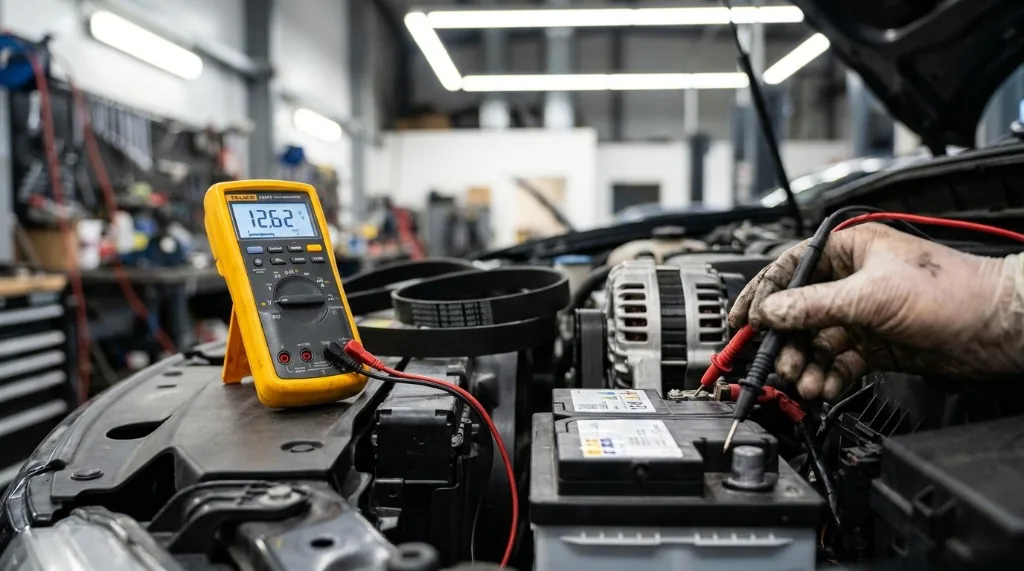
A digital multimeter delivers definitive proof by measuring DC voltage across battery terminals. A healthy battery reads 12.60 to 12.72 volts with the engine off. At fast idle, a healthy alternator outputs 13.70 to 14.70 volts. Readings below 13.20 volts indicate undercharging, while readings exceeding 15.00 volts confirm voltage regulator failure.
Multimeters remove all guesswork from electrical tests. Set a digital meter to Direct Current Voltage (DCV) on the 20-volt scale. Compare your testing methods using our guide to test light vs multimeter for car diagnostics.
Step 1: Static Battery State-of-Charge Test (Engine Off)
Turn off the engine and all lights. Let the car park for thirty minutes. This clears surface charge. Place the red meter probe on the positive (+) terminal post and the black probe on the negative (-) terminal post.
| Multimeter Reading (Engine Off) | Battery Charge Level | Working Status |
|---|---|---|
| 12.60V to 12.72V | 100% Charged | Battery healthy. Strong charge |
| 12.40V to 12.50V | 75% Charged | Enough to start; mild drain |
| 12.20V to 12.30V | 50% Charged | Dead; vulnerable to cold weather failure |
| 12.00V to 12.10V | 25% Charged | Severely dead; slow cranking likely |
| Below 11.90V | 0% (Dead) | Dead or shorted cell; cannot crank starter |
If the battery registers below 12.0 volts, recharge it fully on a plug-in bench charger before evaluating the alternator.
Step 2: Starter Cranking Voltage Test
Keep the multimeter probes connected to the battery terminals while an assistant cranks the engine for five seconds. Observe the lowest voltage displayed during active cranking.
A healthy battery stays above 9.60 volts during cranking at room temperature. If cranking voltage drops below 9.60 volts, the battery is weak. Replace it if starter draw tests normal.
Step 3: Alternator Output Test (Engine Running)
Start the engine and bring the idle speed up to roughly 1,500 to 2,000 RPM. Measure voltage across the battery terminals with the multimeter set to DC volts.
| Multimeter Reading (Engine Running) | Charging System Condition | Required Action |
|---|---|---|
| 13.70V to 14.70V | Optimal Charging | Alternator and voltage regulator healthy |
| 13.20V to 13.60V | Marginal Charging | Inspect belt tension and terminal cables |
| Below 13.20V | Undercharging Failure | Alternator failing; cannot sustain electrical load |
| Above 15.00V | Overcharging Failure | Bad regulator. Battery boil risk |
Next, apply full electrical load. Turn on high beams. Run the heater blower on high. Turn on the rear defroster. A good alternator holds at least 13.50 volts under load. If voltage drops below 13.0 volts, stator coils or diodes are failing. Apply this method across your systematic car diagnostic process to verify circuit integrity.
Modern smart alternator note: Vehicles built after 2015 often feature computer-controlled Battery Management Systems (BMS). To improve fuel economy, the engine control module decouples the alternator during highway cruising or steady idling. System voltage floats between 12.60 and 12.90 volts during this phase. Turning on headlights and the rear defroster forces the engine computer to override fuel-economy mode and command full 14.2-volt alternator output. Always test late-model vehicles with heavy electrical accessories active.
The Hidden Drain: Testing Leaky Alternator Diodes When Batteries Die Overnight
A damaged rectifier diode within an alternator allows alternating current to leak into direct current vehicle circuits. This flaw drains battery reserve overnight. Mechanics detect this flaw by switching a multimeter to alternating current voltage with the engine running. Any alternating current reading above 0.05 volts confirms diode failure requiring complete alternator replacement.
Alternators produce three-phase Alternating Current (AC). Car electronics require Direct Current (DC). An internal rectifier bridge uses silicon diodes to convert AC into smooth DC. When a diode overheats, it breaks down. Current begins leaking in both directions.
This failure causes two major problems. It leaks raw AC voltage into computer networks while driving. It also creates a direct short that drains battery power to ground while parked.
How to Run the Multimeter AC Ripple Test
- Switch your digital multimeter selector dial to AC Volts (VAC). Set the scale to the lowest millivolt or 2-volt range.
- Start the engine and hold idle speed at 2,000 RPM with headlights switched on.
- Touch the black meter probe to the negative battery post. Touch the red probe to the positive post or the B+ alternator stud.
- Read the display. A healthy rectifier bridge outputs clean direct current with less than 0.050 volts AC (50 millivolts AC) ripple.
- If the reading exceeds 0.080 volts AC, a diode has cracked. Readings exceeding 1.50 volts AC show a blown diode trio, which destroys sensitive engine sensors and drains the battery within hours of parking.
The Overnight B+ Terminal Isolation Test
If your battery dies overnight, isolate the alternator. Use this proven shop test:
- Park the vehicle for the evening and turn off the ignition.
- Disconnect the negative battery terminal clamp first for safety.
- Unbolt the heavy output wire connected to the B+ terminal stud on the rear of the alternator.
- Wrap the exposed wire ring terminal with electrical tape so it cannot contact any engine metal.
- Reconnect the negative battery terminal clamp and measure resting battery voltage.
- Leave the car parked overnight (ten to twelve hours).
- Measure battery voltage the next morning.
Does the battery stay at 12.60 volts with the alternator unhooked? If yes, bad alternator diodes caused the drain. Does the battery still go flat with the alternator unhooked? An interior module or stuck relay caused the drain. Normal car standby draw stays under 50 milliamps (0.05A). Review typical accessory battery drain durations to evaluate dark current consumption.
The Deadly Disconnect Test: Why Pulling a Battery Terminal Fries Modern ECUs
Pulling a battery terminal while the engine runs destroys car computers. It triggers violent load dump voltage spikes. Lead-acid batteries act as electrical dampening capacitors. Removing the terminal severs that buffer. Unregulated alternator spikes leap past 60 to 100 volts. These high-voltage surges melt sensitive microprocessors in seconds.
Years ago, mechanics pulled the negative cable on idling old cars. If the engine kept running, they thought the alternator was good.
Using this trick on any modern car causes instant electrical damage.
Alternators produce power based on rotor field excitation. The battery acts as a huge shock absorber for electricity. Without a battery to absorb voltage spikes, sudden load changes cause an inductive load dump. Voltage surges from 14 volts to over 100 volts in milliseconds.
Modern vehicle CAN-bus computer networks contain delicate silicon microprocessors engineered for a maximum operating ceiling of 16 to 18 volts. An 80-volt spike burns out Engine Control Modules (ECM). It destroys body computers, digital dash screens, and transmission solenoids. Never disconnect battery cables while the engine runs. Always read about the severe risks of running a car without a battery before attempting unauthorized diagnostic shortcuts.
Battery vs Alternator Replacement Costs (2026): Parts, Labor, and How to Avoid Overpaying
Car battery replacement costs $120 to $200 for parts. It takes fifteen minutes of basic hand-tool labor. Pro alternator replacement averages $757 to $1,032 in 2026. Parts cost $400 to $650. Labor adds $180 to $350 based on engine bay clearance and belt setup.
The big cost gap between these two repairs proves the value of an accurate diagnosis:
| Repair Category | DIY Parts Cost | Pro Shop Labor | Total Pro Cost | Typical Replacement Interval |
|---|---|---|---|---|
| Standard Flooded Battery | $120 to $170 | $30 to $50 | $150 to $220 | 3 to 5 years |
| Premium AGM Battery | $190 to $260 | $40 to $70 | $230 to $330 | 5 to 7 years |
| Remanufactured Alternator | $180 to $350 | $180 to $320 | $650 to $850 | 7 to 10 years (100k+ miles) |
| OEM Brand-New Alternator | $380 to $650 | $220 to $380 | $757 to $1,032 | 10 to 15 years |
| Combined (Worst Case) | $320 to $520 | $250 to $450 | $900 to $1,350 | After chronic overcharging |
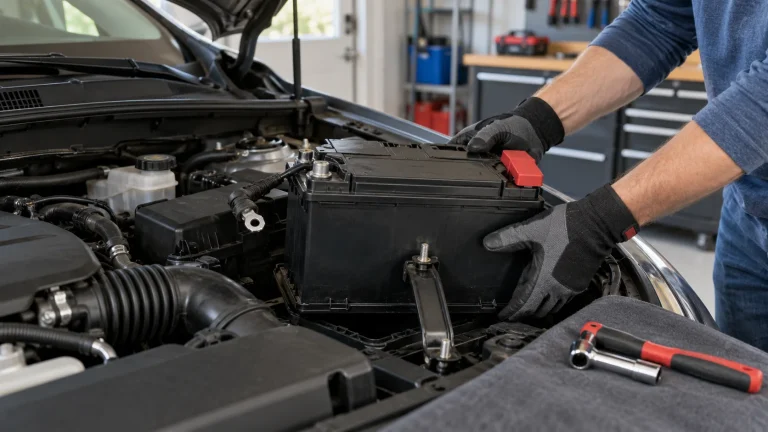
Replacing a battery takes basic DIY skill. You need a 10mm wrench and a terminal brush. Remove the hold-down bracket. Disconnect the negative clamp first, then the positive clamp. Drop in the new battery and tighten the terminals. Explore AGM vs lead-acid car battery differences to match proper battery chemistry to your vehicle charging profile.
Alternator replacement requires intermediate hardware experience. The mechanic must relieve serpentine belt tension, unbolt electrical wiring looms, and remove mounting bolts torqued into aluminum engine brackets. On rear-wheel-drive trucks, alternators sit on top. You can swap one in under an hour. On transverse front-wheel-drive cars, alternators often sit wedged beneath air compressors, pumps, or axles. This requires two to three hours of teardown labor.
Three tips to avoid overpaying at repair shops:
- Request an electrical bench test: Never buy a $900 alternator based on a jump start alone. Most auto parts stores test batteries and alternators on bench testers for free.
- Inspect wiring pigtails and ground straps. Corroded clamps and cracked 3-pin connectors drop voltage. These faults mimic alternator failure. Cleaning ground connections with a wire brush resolves twenty percent of charging complaints without replacing parts.
- Verify charging voltage after replacement. Place a multimeter on the battery posts with the engine running before leaving the shop. Confirm the fresh unit outputs 13.8 to 14.5 volts under load before paying the repair invoice.
Frequently Asked Questions: Emergency Triage and Roadside Decisions
How do I know if my battery or alternator is bad?
Battery problems prevent engine starting. Drivers notice slow cranking, rapid solenoid clicks, or dim cabin lights before starting. Alternator problems emerge after starting. Warning signs include dim headlights, a red battery light, dead radios, and sudden stalls. If the vehicle runs normally after a jump start, the battery failed. If the engine dies shortly after removing jump cables, the alternator failed.
Can a bad alternator drain a brand-new battery overnight?
Yes. A bad diode acts as a bridge. It drains battery current backward through the alternator to ground while parked. This parasitic dark current drain draws 0.5 to 2.5 amperes continuously. This dark current drain empties a brand-new battery overnight. Running the multimeter AC ripple test detects this leaking diode condition.
Will a car start if the alternator is fully dead?
Yes, exactly once, provided the battery holds enough resting charge (12.4 volts or higher). The battery powers the starter motor independently. A dead alternator makes zero charging power. The car will drain battery reserves in twenty to forty minutes. The ignition stalls once system voltage drops below 10.5 volts.
Can you jump start a car with a bad alternator to get home?
Attempting this is dangerous and unreliable. A vehicle with a fully failed alternator runs solely on residual electricity absorbed during the jump start. Modern fuel injectors, fuel pumps, and engine control computers consume fifteen to thirty amperes continuously. The vehicle will stall unexpectedly in traffic within a few miles. A sudden stall disables power steering and power brake assist in traffic.
Why is my battery warning light on if my battery is brand new?
The dashboard battery warning light monitors charging system voltage regulation, not battery state-of-charge. The light lights up whenever charging circuit voltage falls below 13.0 volts or climbs above 15.0 volts. A new battery will not fix this light. The warning stays on if a belt slips, a fuse blows, or the alternator stops charging.