AGM vs Lead-Acid Car Battery: Is the 2x Cost Worth It?

AGM batteries cost 40% to 100% more than standard flooded lead-acid batteries. Retail prices span $200 to $350 for AGM versus $80 to $180 for flooded units. Cars with start-stop tech, smart alternators, or factory AGM units must use AGM replacements. Older basic cars run fine on standard flooded batteries. They do the same job at half the yearly cost.
Check your car manual or the battery label before you buy. If your car came with an AGM battery, buy an AGM replacement. Putting a flooded battery in its place causes electrical errors and early battery failure. If your car has a standard charging system without start-stop, buy a good flooded battery. Basic cars do not need AGM features. Paying extra brings zero real benefit.
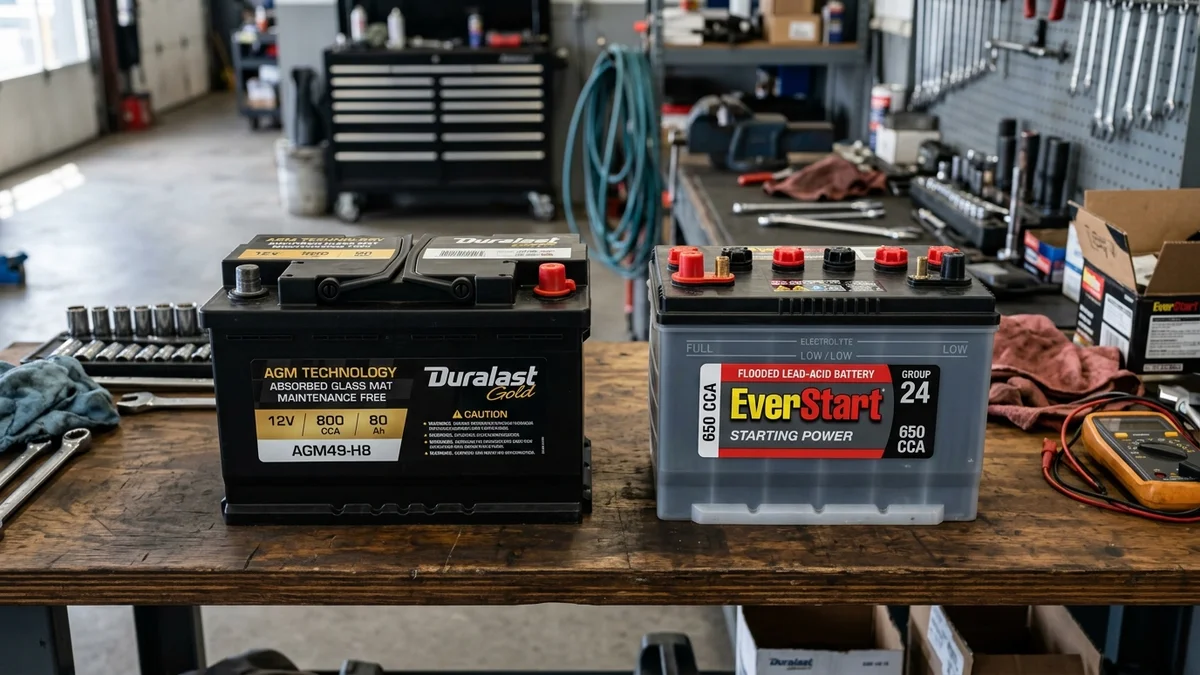
Head-to-Head Comparison: Specs, Real Cost, and Lifespan at a Glance
AGM batteries use glass mats to soak up liquid acid. This build drops internal resistance to 2% and ends upkeep. Flooded batteries dip lead plates in liquid acid. This design creates higher resistance (10% to 15%) and needs venting. AGM packs dense lead plates and thick glass mats. Review our car battery weight comparison to check group sizes before lifting one into your engine bay. Flooded batteries cost far less up front.
| Technical Metric | AGM (Absorbed Glass Mat) | Flooded Lead-Acid | Practical Driver Impact |
|---|---|---|---|
| Average Retail Price | $200 to $350 | $80 to $180 | Flooded saves $120 to $170 up front per purchase. |
| Typical Service Life | 6 to 10 years (up to 14 in trunk mounts) | 3 to 5 years | Registered AGM delivers twice the operating lifespan. |
| Internal Resistance | 2% | 10% to 15% | AGM charges faster and keeps higher cranking voltage. |
| Monthly Self-Discharge | ~1% per month | 3% to 20% per month | AGM survives winter storage without draining flat. |
| Absorption Charge Voltage | 14.4V to 14.8V (strict ceiling) | 14.1V to 14.4V | AGM needs precise voltage limits to prevent venting. |
| Vibration Tolerance | Extreme (compressed plates) | Moderate (liquid slosh) | AGM prevents plate damage on rough dirt roads. |
| Maintenance Needs | Zero (fully sealed VRLA) | Periodic terminal cleaning and water checks | AGM stops battery acid leaks and terminal corrosion. |
| Optimal Location | Trunk, cabin interior, or heat-shielded bay | Ventilated engine bay | Flooded handles hot engine bay heat better. |
How AGM Works: Why Fiberglass Mats Beat Liquid Acid Under Vibration
AGM batteries hold sulfuric acid inside glass fiber mats clamped tight between lead plates. Flooded batteries keep lead plates in liquid acid pools. This tight glass mesh locks the acid in place. It prevents spills. It stops lead particles from shaking loose on bumpy roads. It extends overall plate life.
Standard flooded batteries store power using lead plates dipped in liquid acid. The acid and water sit across six open cells. When your car hits potholes or rough gravel roads, the acid sloshes around. This shaking knocks active lead material off the plates. Over time, that loose material piles up at the bottom. Eventually, it touches the plates and shorts out the cell.
AGM design clamps glass mats between each plate. The glass fibers draw in the liquid acid like a sponge. This design brings three clear perks:
- Even Acid Mix: The acid strength stays uniform from top to bottom. Flooded batteries suffer from acid pooling at the bottom, which eats away at the lower plates.
- Sealed Gas Cycle: During normal charging, oxygen from the positive plates moves through the mat to the negative plates. It turns back into water inside the sealed case. The battery never loses water.
- Low Internal Resistance: The thin glass mats press tight against the plates. This drops electrical resistance to about 2%. As a result, AGM batteries supply strong starting bursts and take alternator charge up to five times faster.
What About EFB (Enhanced Flooded Batteries)?
Enhanced Flooded Batteries (EFB) sit between basic flooded batteries and AGM batteries. Carmakers often install EFBs in entry-level start-stop cars like Mazda, Toyota, and Volkswagen. An EFB uses thicker lead plates and a poly-fleece scrim to handle moderate stop-start cycling. If your car came with an EFB, you can upgrade to an AGM battery for longer life. You must never downgrade an EFB car to a basic flooded battery.
The Cost Breakdown: Why Flooded Batteries Deliver Cheaper Cost-per-Year
A flooded battery costs about $120 and lasts 4 years. That equals $30 per year. A quality AGM battery costs $250. When properly registered in a modern car, an AGM lasts 8 years and costs $31.25 per year. In an older car without smart charging, an AGM often fails early and costs more per year.
Purchase price is the main hurdle for most drivers. For common group sizes like Group 35, Group 24F, and Group 48, flooded batteries from EverStart Maxx, Interstate, or DieHard cost $100 to $140. Matching AGM batteries from Optima, Bosch, Odyssey, or Duralast cost $220 to $290.
| Ownership Metric | Flooded Lead-Acid | Registered AGM (Modern Car) | Unregistered AGM (Older Car) |
|---|---|---|---|
| Purchase Price | $120 | $250 | $250 |
| Shop Installation & Scan Fee | $20 | $50 (includes BMS reset) | $20 (no reset performed) |
| Total Upfront Outlay | $140 | $300 | $270 |
| Average Operational Lifespan | 4 Years | 8 Years | 5.5 Years |
| Calculated Cost per Year | $35.00 / year | $37.50 / year | $49.09 / year |
Drivers of basic commuter cars gain no money savings from AGM batteries. If your car lacks start-stop systems, heavy audio amps, or computer charge controls, buy a good flooded battery. You save cash on day one. You also enjoy a lower cost for every mile you drive.
Before replacing your battery, calculate your vehicle electrical load with our car battery drain calculator to check whether your driving habits require AGM storage power.
The $250 Mistake: Why Skipping Battery Registration Cooks New AGM Cells
Modern cars require a battery registration reset with an OBD-II scan tool after replacement. The car computer raises charging voltage as a battery gets old. Skipping registration makes the alternator pump worn-battery voltage into your new AGM battery. This high voltage boils the sealed acid, ruins internal mats, and kills the battery within 18 months.
Modern vehicles from BMW, Audi, Mercedes, Ford, GM, and VW track battery health. An Intelligent Battery Sensor (IBS) sits on the negative terminal. When swapping cells, learn how to reset your car computer without disconnecting the battery to keep module memory alive. It tracks battery age, heat, and total power flow. As a factory battery ages over four or five years, its internal resistance goes up. The car computer reacts by raising alternator output from 14.0 volts up to 14.8 volts or higher.
When you drop in a new AGM battery without resetting the system:
- The Overcharge Trap: The alternator treats the new battery like the dead five-year-old battery. It blasts the new cells with maximum voltage right away.
- Valve Release: Excess voltage creates internal heat. The safety valves open and vent water vapor into the air.
- Permanent Dry-Out: Sealed AGM batteries cannot accept fresh water. Once the vapor vents, the glass mats dry out. The plates corrode, and your new battery dies before its time.
Recommended Scan Tools for Battery Registration
| Vehicle Make | Tool Name | Average Tool Price | Typical Shop Fee |
|---|---|---|---|
| BMW / Mini | BimmerLink (Phone App + OBD-II Dongle) | $35 to $45 | $50 to $80 |
| Ford / Lincoln | FORScan (Laptop / Phone Software) | Free / $20 license | $40 to $70 |
| Audi / VW / Porsche | OBDeleven or Ross-Tech VCDS | $65 to $120 | $60 to $90 |
| Universal / GM / Asian | Autel MaxiCheck or Innova 5610 | $80 to $160 | $30 to $60 |
The 80% Charge Rule: How Smart Alternators Protect Sealed Batteries
Smart alternators keep AGM batteries at an 80% charge level during highway travel. They avoid 100% saturation on purpose. That 20% open room absorbs power surges from braking and coasting. Older charging systems pump continuous full power. That constant high voltage builds heat inside sealed cases and shortens cell life.
Older vehicle charging systems worked on a basic rule: spin the alternator to pump out 14.2 to 14.6 volts non-stop. Flooded batteries take this charge without harm because gas bubbles escape through open caps.
Cars built for AGM batteries use smart charging logic. The main engine computer adjusts alternator output on the fly:
- During Hard Acceleration: The alternator cuts output down to 12.6 volts. This sends full engine power straight to the drive wheels.
- During Coasting and Braking: The alternator jumps to 14.8 volts. It sends kinetic energy straight into the battery pack without using extra gas.
- During Normal Cruising: The car keeps the battery between 75% and 80% full.
This 80% target stops heat buildup. Never pull battery cables while the engine runs to check alternator output. Doing so creates voltage spikes that fry onboard computers. Read our detailed guide on whether a car can run without a battery to avoid costly repairs.
Heat Kills AGM: Why Carmakers Put AGM Batteries in the Trunk
Flooded lead-acid batteries handle hot engine bays better than AGM batteries. Engine heat above 120°F (50°C) dries out sealed AGM cells. It forces pressure valves to vent precious moisture. Carmakers place AGM batteries inside the trunk, under seats, or behind heat shields to protect them from scorching engine heat.
Car designers build battery bays around heat limits. AGM batteries perform great in freezing winter cold, but high heat is their top enemy. Summer engine bay temperatures often top 160°F (71°C) near exhaust pipes.
Flooded batteries survive this heat because liquid acid moves freely. The fluid cools down through the plastic case walls. If water boils off, you simply pop the caps and add distilled water.
AGM batteries hold a strictly limited amount of acid. When high heat builds pressure past the relief valve limit (about 1.5 to 4.0 PSI), the valve opens. Every drop of vented gas is gone for good.
If your car mounts its battery right beside the radiator with no heat shield, buy a flooded battery. If your battery sits in the trunk or under the floor, buy an AGM battery. Sealed AGM batteries keep toxic acid fumes out of your cabin.
Heat damage degrades internal lead plates and drops terminal voltage. Low voltage starves fuel injectors and ignition coils. Read our field guide on whether a weak battery causes rough running before replacing expensive sensors.
Real-World Lifespan: How to Get 10 Years (and Avoid the Winter Driveway Trap)
Trunk-mounted AGM batteries registered in the car computer regularly last 8 to 14 years. In cold climates, sudden battery death happens during short drives under 15 minutes. Starting a cold engine drains massive power. Short trips do not give the alternator enough time to charge the battery back to full health.
Long-term owner reports show clear differences in AGM battery life:
[Trunk-Mounted + Registered + Long Commute]  =======>  10 to 14 Years Service Life
[Engine-Bay + Unregistered + Frequent Starts] =====>  3 to 5 Years Service Life
[Standard Flooded Battery (Any Location)]     =====>  3 to 5 Years Service Life
Freezing winter cold cuts battery power by 30% to 50%. Engine oil turns thick. The starter motor draws huge bursts of current to crank the engine. An AGM battery handles this cold snap thanks to high Cold Cranking Amps (CCA) and low internal resistance.
The big trap in winter is the quick driveway shuffle. Moving your car 30 feet to shovel snow pulls hundreds of amps to crank the engine. You shut the key off two minutes later. The alternator returns less than 1% of the lost power. Repeating this cycle three times leaves the battery flat. In freezing cold, a dead battery can freeze solid and crack its internal plates.
To get a full decade of service from your AGM battery: 1. Take a 30-minute highway drive at least once every two weeks in winter. 2. Hook up a smart trickle charger if your car sits parked for long periods. 3. Keep battery posts clean to stop voltage drops. 4. Avoid running electronics while parked. Check our test data on how long a car battery runs the radio to avoid draining starter cells flat.
The EV Dilemma: Why Electric Cars Stranded on 12V Need AGM Upgrades
Electric cars use a standard 12-volt battery to boot computers, run phone apps, and close main battery relays. Factory flooded 12V batteries in models like the Hyundai Ioniq 5 and Nissan Leaf often fail within 2 to 3 years. Upgrading to an AGM battery ends unexpected boot failures and handles constant app drain.
Electric vehicle owners often face an odd surprise. A car with a 90% full main battery can sit dead in the driveway. The car will not unlock or start. The reason is a dead 12-volt battery. The high-voltage drive battery stays locked behind safety relays until the small 12-volt battery powers up the car computers and trips the switch.
Electric cars put heavy, unique demands on 12-volt batteries:
- Always-On Telematics: The car’s cellular modem runs while parked. It talks to your phone app, checks charge timers, and runs cabin heaters. This constant draw drains wet-cell batteries fast.
- Pulsed DC-to-DC Charging: EVs lack engine alternators. They use DC-to-DC converters that turn on in short bursts to feed the 12-volt battery. Flooded batteries break down under this constant stop-and-start charging.
EV drivers who get stuck often swap the factory flooded battery for a Group 47 or Group 51R AGM unit. The AGM battery handles constant drain, charges fast during short top-up cycles, and stops dead-car surprises.
When an auxiliary 12V battery drops below critical voltage while driving, safety relays open and shut down the vehicle. Read our guide on whether a car battery can die while driving to navigate charging failures safely.
Charging Voltage Limits: Safe Thresholds to Avoid Permanent Venting
AGM batteries require smart battery chargers with a dedicated AGM setting. Safe bulk and absorption charging runs between 14.4 and 14.8 volts. Float maintenance requires 13.5 to 13.8 volts. Old manual shop chargers push past 15.0 volts. That excess voltage pops the pressure valves and permanently dries out the glass mats.
Never use an old manual battery charger on an AGM battery. Flooded batteries take high charging voltage because you can always add distilled water if fluid boils off. AGM batteries carry no spare water.
| Charging Phase | AGM Voltage Limit | Flooded Voltage Limit | Failure Mode if Exceeded on AGM |
|---|---|---|---|
| Bulk Phase | 14.4V to 14.7V | 14.4V to 14.9V | High amperage creates heat inside the plates. |
| Absorption Phase | 14.6V to 14.8V max | 14.2V to 14.5V | Voltages above 14.8V trigger VRLA pressure vents. |
| Float Maintenance | 13.5V to 13.8V | 13.2V to 13.5V | Over-voltage dries out fiberglass separators. |
Modern smart chargers from NOCO, CTEK, or Battery Tender track temperature and drop voltage as the battery gets warm. When charging an AGM battery on your workbench, set the charger to AGM mode.
The Buying Decision: When to Pay for AGM and When to Stick With Flooded
Buy an AGM battery if your car has start-stop technology, came with an AGM from the factory, holds the battery in the trunk, or runs heavy electrical gear. Buy a flooded lead-acid battery if you drive an older car with an under-hood battery tray and want the lowest cost per year.
Follow this simple checklist before you buy:
[Does your car have automatic Start-Stop?]
    ├── YES ──> BUY AGM (Flooded batteries fail within 12-18 months)
    └── NO  ──> [Did it come with AGM from the factory?]
                  ├── YES ──> BUY AGM (Alternator is tuned for AGM profiles)
                  └── NO  ──> [Is the battery mounted in the trunk/cabin?]
                                ├── YES ──> BUY AGM (Sealed design prevents toxic fumes)
                                └── NO  ──> BUY FLOODED (Lowest cost per year of ownership)
Choose an AGM Battery When:
- Start-Stop Technology: Your car turns the engine off at red lights and needs quick recharge cycles.
- Smart Alternators: Your vehicle uses computer-managed charging or regenerative braking.
- Storage Endurance: Your vehicle sits parked for weeks at a time. The low 1% monthly self-discharge preserves the charge.
- Auxiliary Electrical Draw: You run heavy accessories like winches, snow plows, big stereos, or parking dash cams.
- Interior Battery Mounting: Your battery lives inside the trunk or under a seat where acid fumes must not enter.
Choose a Flooded Lead-Acid Battery When:
- Standard Commuter Vehicles: You drive a basic vehicle built without start-stop systems.
- High-Heat Engine Bays: The battery sits directly in the engine bay next to hot exhaust pipes.
- Upfront Budget Limits: You want the lowest purchase price at the auto parts counter.
- Simple Routine Upkeep: You can check terminal clamps and water levels once or twice a year.
If your starter clicks and the engine refuses to crank, follow our troubleshooting steps on how to bypass an ignition switch and start your car to isolate starter relays from battery failures.
Frequently Asked Questions
What happens if you put a regular lead-acid battery in an AGM car?
Installing a standard flooded battery in a vehicle built for AGM causes rapid battery wear. The heavy restart demands of start-stop systems wear out flooded lead plates within 12 to 18 months. Smart alternators tuned for AGM also continuously overcharge flooded cells.
Can you charge an AGM battery with a normal battery charger?
You can charge an AGM battery with a standard charger only if the output stays strictly below 14.8 volts. Unregulated chargers that top 15.0 volts pop the internal safety valves. This permanently vents moisture from the sealed glass mats.
Do I need to register a new battery on my car?
Vehicles with smart battery sensors (BMW, Audi, Mercedes, Ford, GM, VW) require computer registration after replacing a battery. Registration tells the engine computer to reset its charging profile. This reset stops the alternator from pushing high and destructive voltage levels into the new cells.
Why do AGM batteries last longer in the trunk?
AGM batteries last longer in trunks because they stay away from engine bay heat. Operating heat above 120°F (50°C) dries out sealed cells. Trunk installation offers a cooler, steady space that extends battery life past 10 years.
Is an AGM battery worth it for an electric vehicle?
An AGM battery is a proven reliability upgrade for electric vehicles. EVs put heavy standby drains on 12-volt auxiliary batteries to run computers and phone apps. Upgrading from a factory flooded 12V battery to an AGM prevents dead-car boot failures and handles constant cycling.
What is the maximum charging voltage for an AGM car battery?
The maximum absorption charging voltage for a standard 12-volt AGM car battery is 14.8 volts at 77°F (25°C). Pushing past 14.8 volts pops safety valves and vents internal gas. This loss causes unrecoverable cell damage. Safe float maintenance spans 13.5 to 13.8 volts.