How to Reset Car Computer Without Disconnecting Battery: 3 Ways That Protect Radio Codes and Seat Memory

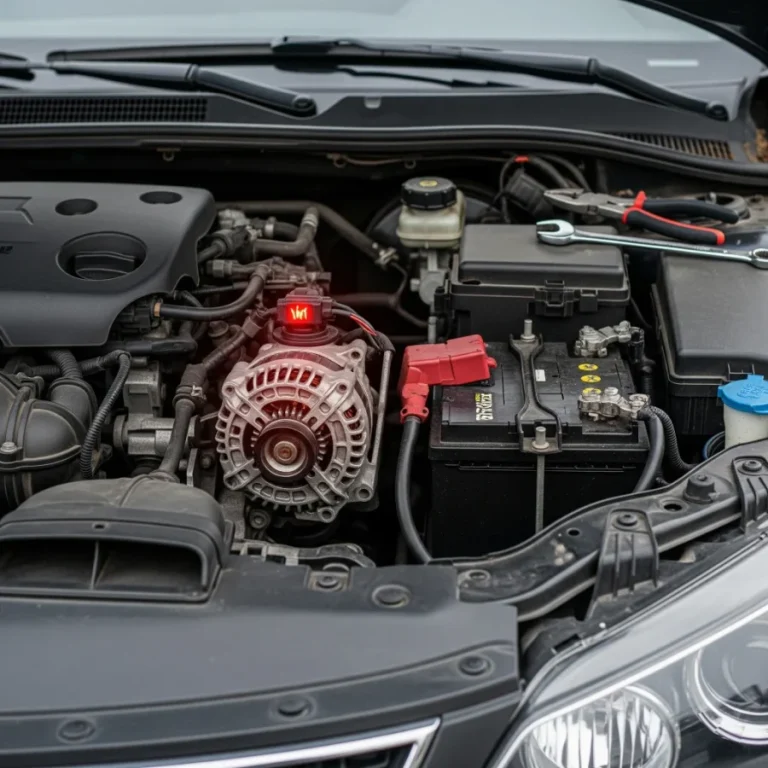
Cars use many computers. Battery cuts wipe radio presets. They erase GPS favorites. They lock touchscreens behind anti-theft PIN codes. They also erase power window pinch stops and wheel alignment data. Smart mechanics isolate single circuits. Pros send digital scan commands to clear fault codes. This trick resets fuel trims while leaving battery posts untouched.
The 60-Second Answer: Three Ways to Reset Engine Computers Without Cable Removal
Resetting a car computer without disconnecting the battery takes one of three simple paths. First, plug in an OBD-II scan tool to clear fault codes digitally. Second, pull the main engine control fuse for fifteen minutes. Third, run an ignition key cycle to drain stored voltage. Each method clears engine trouble codes. None of them erase your clock, radio presets, or power seat memory.
Each method targets different parts of the car. Pick the best method based on your tools and car symptoms.
| Reset Method | Required Equipment | Execution Time | Presets Preserved | Permanent DTC Capability |
|---|---|---|---|---|
| OBD-II Diagnostic Scanner | Handheld scan tool or dongle | 30 Seconds | 100% Retained | Reads pending, active, and permanent codes |
| ECM / PCM Fuse Isolation | Plastic fuse puller tool | 15 Minutes | 100% Retained | Clears volatile KAM and temporary codes |
| Ignition Key Drain Cycle | Vehicle ignition key | 10 Minutes | 100% Retained | Clears basic throttle and volatile tables |
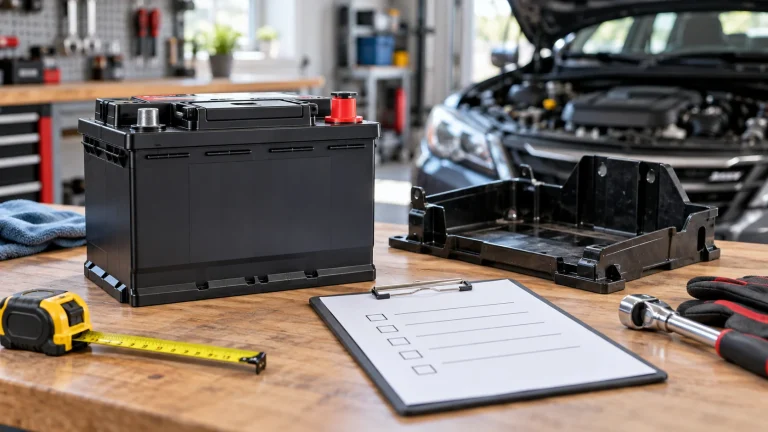
Do you need to replace your battery? Read our safe car battery removal guide. It helps you prevent accidental electrical shorts.
The Memory Trap: Why Disconnecting Battery Cables Fails on Modern Vehicles
Cutting battery power on modern cars causes big headaches. Disconnecting battery cables cuts voltage to zero across the car. Computers lose their stored memory tables. Audio units lock up behind anti-theft PIN screens. Steering sensors lose their center settings. Even worse, modern engine computers store emissions codes in flash memory chips that battery disconnects cannot erase.
Radio Security Lockouts and Lost Seat Memory Presets
Factory stereos in Honda, Ford, and BMW cars use anti-theft software. If battery voltage drops under nine volts, the stereo locks up. Turning the key shows an error. The screen asks for a 4-digit PIN code. Drivers without this code must visit a dealer. Car dealers charge high fees to unlock factory stereos.
Power loss also wipes seat memory. Side mirror angles reset. Cabin heat settings vanish. Paired phones drop offline. Drivers waste thirty minutes setting up basic options after unhooking a battery cable.
Window Pinch Calibration and Steering Angle Sensor Faults
Power window motors use pulse sensors to track glass height. This safety stop protects fingers. It reverses the motor if hands block the top frame. Cutting power wipes these learned stops. The auto roll-up feature stops working right away. Windows often bounce down halfway up.
Electric power steering systems face the same issue. The steering column uses an angle sensor for stability control. Pulling the battery cable wipes this steering calibration. This drop turns on the stability warning light on the dash. The warning light stays on until you run a steering relearn with a scan tool.
Volatile KAM vs Non-Volatile Flash EEPROM
Car computers use two memory types. The first is volatile Keep Alive Memory. It needs a small trickle of 12-volt battery power. It tracks short-term fuel tweaks. It logs long-term fuel trims, such as lean mixture faults in our P0171 diagnostic repair cost guide. It also stores shift points and idle airflow. Pulling an ECU fuse wipes this temporary memory clean.
The second memory type is permanent flash chip storage. When an engine sensor spots a real smog failure, the ECU saves a Permanent Code to flash storage. This data never dies from power loss. Cutting battery power will not clear permanent fault codes. The Check Engine Light returns as soon as the key turns on.
Does your battery lose charge overnight? Check our guide on diagnosing overnight parasitic battery drains. It helps you find power leaks fast.
Method 1: Clear Diagnostic Trouble Codes With an OBD-II Scan Tool
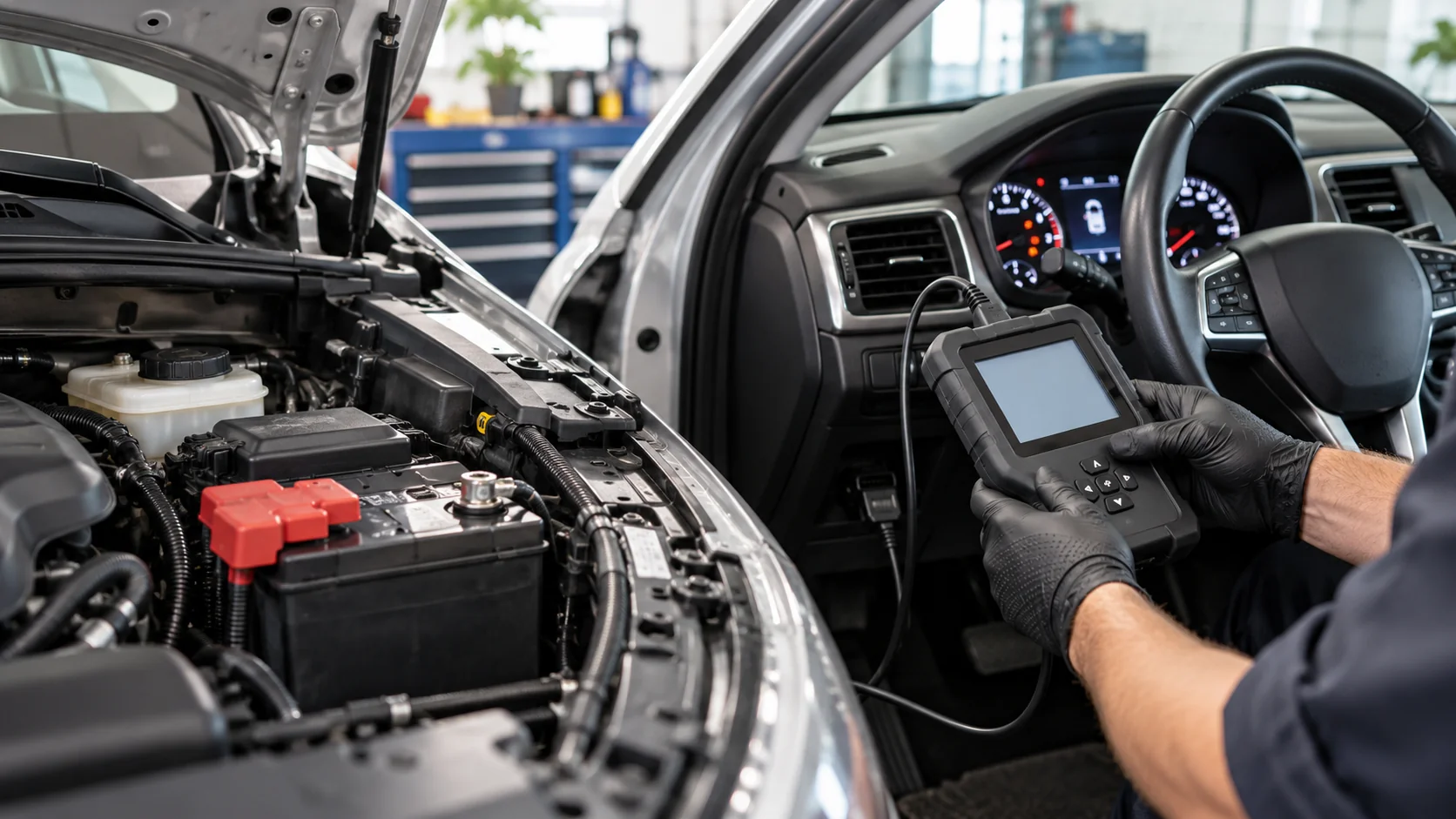
An OBD-II scan tool gives the cleanest and fastest computer reset. Scanners send a digital Mode 04 command through the car network. The tool clears trouble codes in thirty seconds. It turns off the Check Engine Light. Best of all, it never cuts power to your radio, clock, or seats.
Plug-and-Play Port Access Under the Driver Dash
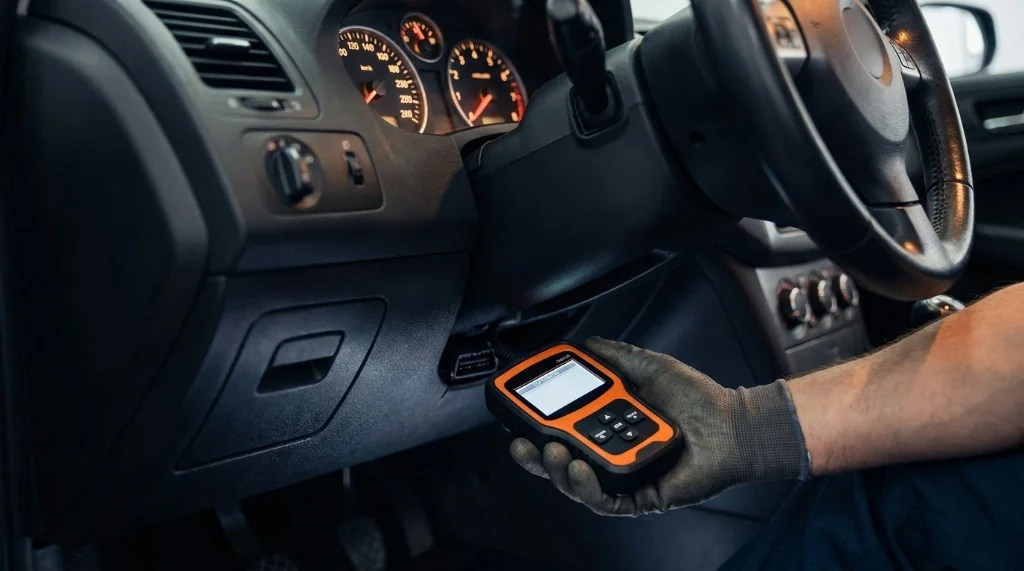
Locate the 16-pin OBD port beneath the driver dashboard. Federal law requires this port near the wheel on all cars built after 1996. Look directly above the gas pedal. You can also check below the plastic trim panel near the hood release latch.
Check the port for bent pins. Line up the scanner plug. Push until the plastic tab clicks. The scanner draws power directly from pin sixteen on the vehicle diagnostic plug.
Sending the Digital Mode 04 Clear Command in 30 Seconds
Put your key in the ignition. Turn the key to ON. This lights up the dash cluster. Do not turn the key to the START position. Keep the engine off. Vehicles with push-button starts require pressing the start button twice without pressing the brake pedal.
Navigate the scanner menu to the diagnostic section. Select the Read Codes function. Write any stored fault codes on paper. You can look up code meanings in our OBD2 repair cost database before clearing them. Once you record the codes, scroll to the Clear Codes command. Press the OK button. The scanner transmits the digital erase command. The Check Engine Light blinks and shuts off completely.
Autel AutoLink AL319 OBD2 Scanner and Code Reader
- Clears diagnostic trouble codes and resets Check Engine Lights in thirty seconds
- One-Click I/M Readiness key displays emissions test readiness status instantly
- Retrieves generic and carmaker diagnostic codes with built-in code definitions
- Bright color-coded LED screen and audible tone verify status without external software
Do you notice electrical glitches with your trouble codes? Learn testing car battery resting voltage with a multimeter. A healthy car battery shows 12.6 volts.
Method 2: The 15-Minute ECM Fuse Pull Trick (Zero Hand Tools Required)
Pulling the engine computer fuse cuts power only to the engine control module. This simple disconnect drains temporary Keep Alive Memory. At the same time, it keeps power running to your clock, radio, and power seats. Leaving the fuse out for fifteen minutes clears learned fuel trims and idle settings without using wrenches or tools.
Locating the Under-Hood Power Distribution Box and Fuse Map
Park the vehicle on level ground. Switch off the ignition. Pull the hood release latch. Secure the hood prop rod. Locate the engine bay fuse box. Carmakers mount this black plastic enclosure along the inner fender wall near the battery.
Release the two plastic retaining clips along the sides of the box cover. Lift the lid. Turn the lid upside down. The inner surface features a molded circuit diagram. This map shows the exact location, number, and amperage rating for every relay and blade fuse inside the panel.
Ford, Chevy, Toyota, and Nissan Fuse Identification Reference
Car brands use different names for the engine computer fuse. Check this quick table to find your fuse label.
| Carmaker | Circuit Label on Fuse Box Map | Standard Fuse Rating | Physical Fuse Box Location |
|---|---|---|---|
| Ford / Lincoln | PCM Relay / KAM Power (Fuse 27 or 47) | 15A or 20A Blue / Yellow | Main engine compartment junction box |
| Chevrolet / GMC | ECM 1 / ECM B (Powertrain Control) | 15A or 20A Mini-Blade | Under-hood fuse block beside master cylinder |
| Toyota / Lexus | EFI Main / ETCS (Throttle System) | 15A or 20A Blade | Under-hood relay panel near air filter box |
| Nissan / Infiniti | ENG CONT / ECM Fuse | 15A Blue Mini-Blade | IPDM E/R module behind windshield washer neck |
| Honda / Acura | FI ECU / PGM-FI Main | 15A Mini-Blade | Primary under-hood auxiliary fuse block |
Bleeding Residual Capacitor Voltage for a Clean Reset
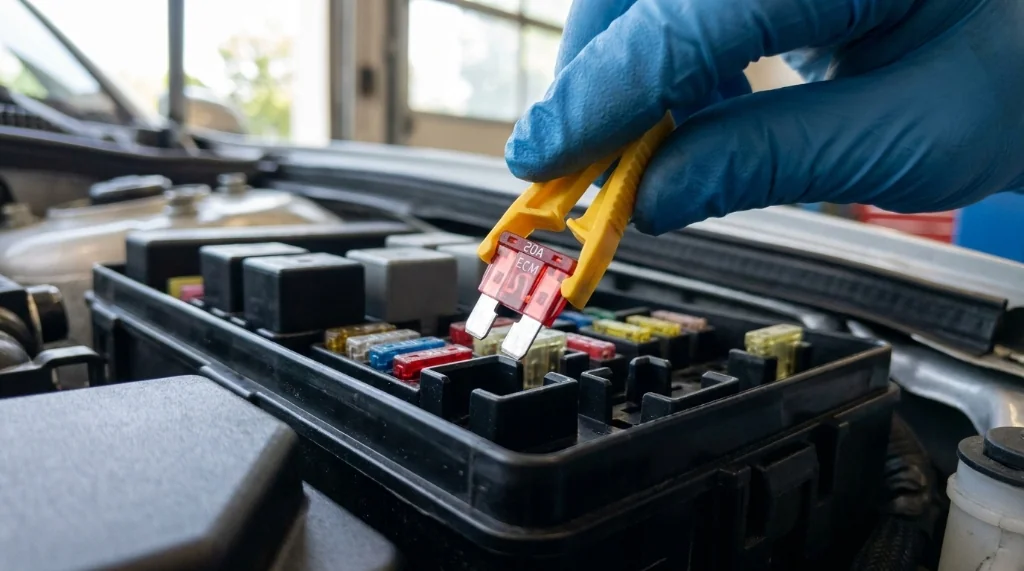
Take the plastic fuse puller stored in the spare fuse slot inside the lid. Grip the top of the designated engine control fuse with the tool jaws. Pull straight up with steady pressure. Inspect the metallic fuse element through the clear plastic body. Verify the internal wire remains unbroken.
Car computers use small capacitors. These parts store electrical power like tiny batteries. When you pull the fuse, capacitors keep powering memory chips for several minutes. Leave the fuse out for fifteen full minutes. This wait lets stored voltage drain to zero. The power drop clears learned memory tables. Reinsert the fuse firmly into its slot. Snap the fuse box cover back in place.
Heavy-Duty Automotive Fuse Puller and Assorted Blade Fuse Kit
- Precision ergonomic non-slip fuse puller extracts mini, standard, and maxi fuses safely
- Includes 120 zinc alloy replacement fuses covering 5A, 10A, 15A, 20A, 25A, and 30A ratings
- Transparent housing allows instant visual inspection of internal fuse wire continuity
- Durable organized storage case fits inside vehicle glove box for emergency field resets
Do your lights flicker after you replace the fuse? Check our guide on distinguishing a dead battery from a failing alternator. It helps you test your charging system.
Method 3: Manual Throttle Body and Accelerator Pedal Relearn Sequences
Ignition key cycles and pedal taps let drivers reset throttle bodies without tools. Car makers build calibration steps right into throttle motor circuits. These physical steps reset baseline airflow values. They calibrate throttle blade angles in five minutes.
The 5-Tap Nissan and Infiniti Pedal Relearn Sequence
Nissan and Infiniti vehicles feature an accelerator pedal reset procedure. It cycles throttle memory through the foot pedal. Warm the engine to normal run temp. Turn the vehicle off. Wait ten seconds. Follow this exact timing sequence with a stopwatch in hand.
Turn the ignition switch to ON without starting the engine. Wait exactly three seconds. Depress and release the accelerator pedal completely five times within five seconds. Wait exactly seven seconds. Press the accelerator pedal down fully. Hold it for ten seconds. The Check Engine Light begins flashing on the gauge cluster. Release the pedal. Wait ten seconds. Start the engine. Let it idle for twenty seconds to finalize the reset.
The GM and Toyota Key-On Idle Relearn Procedure
GM and Toyota cars use a simple key cycle to reset throttle memory. Turn the key to ON for three minutes without starting the engine. The car computer checks the mass airflow sensor, coolant sensor, and throttle position sensor.
Turn the key back to OFF for thirty seconds. Repeat this key-on cycle two additional times. Start the engine on the final cycle without touching the gas pedal. Allow the vehicle to idle in park for five minutes. Turn on the air conditioning system for two minutes. This step lets the computer learn compressor load offsets. Shut the vehicle off to save the new baseline.
Why Throttle Body Carbon Buildup Causes Post-Reset Stalling
Many drivers notice their car idles rough or stalls at red lights right after a computer reset. Over thousands of miles, oily carbon soot builds up around the round brass throttle blade. The computer slowly learns to hold the blade open wider to let in enough idle air.
When you reset the computer, you wipe that learned airflow setting. The computer snaps the throttle blade back to factory zero. The thick carbon ring chokes off idle air. This choke causes RPM surging and high idle trouble codes covered in our P0507 repair cost and diagnostic guide. Remove the air intake hose. Spray the bore with throttle cleaner to dissolve black soot. This step restores airflow and stops rough idle.
CRC Throttle Body and Air Intake Cleaner Spray (12 Oz)
- Dissolves stubborn carbon, gum, and varnish deposits around car throttle blades
- Eliminates rough engine idle, hard starting, and sudden stalling after computer memory resets
- Safe for modern coated throttle bodies and aluminum intake manifolds
- Restores original factory airflow clearances without requiring throttle body removal
Does your car still idle rough after cleaning? Check your spark plugs. Read our guide on checking spark plug gap specifications to match factory settings.
The Emissions Inspection Trap: The 50-Mile Smog Drive Cycle Rule
Resetting an engine computer right before a state emissions test causes an automatic failure. Every computer reset sets all internal readiness monitors to Not Ready status. State inspection tools scan these monitors through the diagnostic port. Passing the test requires completing a 50-mile drive cycle across highway and city speeds so the computer can test the catalytic converter, oxygen sensors, and EVAP fuel tank seals.
Why Cleared Computers Fail State Smog Checks Automatically
Emissions rules require modern engine computers to test smog parts on their own. These tests are called readiness monitors. Key monitors test catalytic converter health, such as catalyst issues in our P0420 repair cost guide. Monitors also test fuel tank seals, such as gross leaks in our P0455 diagnostic guide. For a full list of related fault codes, view our index of emissions and EVAP trouble codes.
A scan tool clear command turns off the warning light. Pulling an ECM fuse does the same thing. Yet both actions reset readiness monitors to Not Ready status. State smog tools scan these monitors. If the system spots incomplete checks, the car fails right away. Most state programs allow only one incomplete monitor on cars built after 2000.
The 55 MPH Highway Drive Cycle That Sets All 8 Readiness Monitors
Setting readiness monitors back to Ready takes a drive cycle test. Follow this sequence over two cool mornings to complete all readiness monitors.
Begin with a cold vehicle parked overnight. Keep the fuel tank filled between one-quarter and three-quarters full. Start the engine. Turn off the air conditioning. Idle in place for two and a half minutes with the transmission in park. This stage completes the air pump and oxygen sensor heater tests.
Drive the vehicle onto a smooth highway. Accelerate smoothly to fifty-five miles per hour. Maintain a steady speed of fifty-five miles per hour with a light foot on the gas pedal for fifteen steady minutes. Do not use cruise control. This steady cruising phase allows the computer to evaluate catalyst health and fuel trim calculations.
Take your foot off the gas pedal. Allow the vehicle to coast down from fifty-five miles per hour to twenty miles per hour without touching the brake pedal or shifting into neutral. This coasting test evaluates EGR valves. Finish the drive cycle with twenty minutes of stop-and-go city driving at speeds under thirty-five miles per hour. This city phase allows the EVAP monitor to execute its vacuum leak test.
Are you worried about battery drain before your smog test? Use our interactive car battery drain calculator. It checks your battery runtime.
Clear Answers to Common Car Computer Reset Questions
Can an ECU reset fix an underlying mechanical engine problem?
A computer reset cannot fix a broken mechanical part. Clearing the computer wipes stored diagnostic records. It does not fix vacuum leaks. It does not repair clogged fuel injectors or bad spark plugs. As soon as the computer runs its test again, the sensor spots the bad reading. This detection turns the Check Engine Light back on. Resetting the computer is a test tool, not a fix.
How many miles does a car need to relearn fuel trims after a reset?
Cars need between fifty and one hundred miles of mixed driving to rebuild accurate fuel trim maps. The computer calculates short-term fuel trims in real time from oxygen sensor feedback. It then averages these numbers into long-term fuel maps across engine load zones. Driving on highway and city streets speeds up this learning process.
Will an ECU reset alter or erase vehicle odometer mileage?
A computer reset never changes your odometer mileage. Carmakers store total miles inside a locked cluster chip. Mileage data also lives on a locked body control chip. Federal laws require locked digital circuits for mileage counters. Fuses, ignition keys, and scan tools leave total odometer mileage untouched.
What causes the Check Engine Light to return after 20 miles?
If your Check Engine Light comes back within twenty miles, you have an active sensor fault. The computer flags small issues as pending codes on the first trip. When the same part fails on the second drive, the computer confirms the fault. This action turns on the dashboard warning light. It also saves a freeze frame record of engine sensor values.
Can you reset the anti-theft passkey sensor using the ignition key?
Many GM and Chrysler cars use a key relearn sequence for anti-theft systems. Turn the key to the ON position. Leave it untouched for ten minutes until the security light stops blinking. Turn the key to OFF for ten seconds. Repeat this ten-minute cycle two more times. This key sequence syncs the ignition sensor with the powertrain computer.
Need to install a fresh battery? Follow our guide on proper car battery installation steps. It keeps your battery terminals clean and safe.