What Voltage Should a Car Battery Be? Resting vs Running Specs

Drivers asking what voltage should a car battery be need two core numbers. Check resting voltage and running voltage. A fully charged car battery reads 12.60 to 12.66 volts DC at rest. With the engine running, a healthy alternator pushes system voltage to 13.80 to 14.70 volts. A meter reading of 12.00 volts or lower indicates a discharged battery. Most starting troubles come from low charge, dirty terminals, or failing alternators. Check these exact shop numbers to test battery health in your driveway.
Cars need steady voltage to run electronic modules and turn starter motors. A basic multimeter check takes two minutes. It confirms whether your vehicle needs a quick battery charge or a new alternator.
Normal Car Battery Voltage: The 12.6-Volt Baseline
A healthy car battery reads 12.60 to 12.66 volts DC at rest. Test the battery with the engine turned off. Keep the battery at room temperature for tests. A reading of 12.45 volts indicates a 75% charge. A reading of 12.00 volts or below indicates a flat battery. Recharge a low battery right away to stop cell damage.
A standard 12-volt car battery contains six separate cells inside a plastic case. Each cell produces 2.11 to 2.12 volts of direct current when fully charged. Six cells in series produce 12.66 volts at rest. The BCI and SAE standard J537 define this resting baseline.
Many drivers think a 12-volt battery should read 12.00 volts on a meter. A lead-acid battery at 12.00 volts has lost 75 percent of its charge. Lead plates develop hard sulfate crystals at 12.00 volts. This buildup cuts engine cranking power. If a battery sits below 12.20 volts for three weeks, hard crystals ruin the plates.
Resting Voltage vs Running Voltage: What Your Alternator Should Produce
With the engine idling, a good charging system pushes battery voltage up to 13.80 to 14.70 volts DC. This higher voltage proves the alternator generates enough current to charge the battery. It also runs onboard cabin electronics. This charge cycle restores battery power after each engine start during routine driving trips.
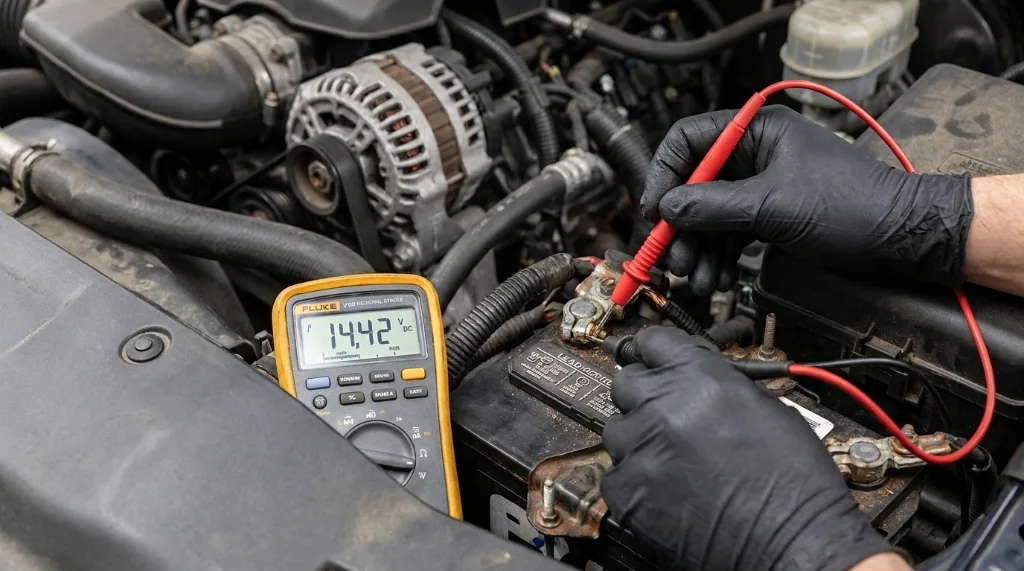
The voltage regulator feeds charging current into the plates. If running voltage falls below 13.50 volts, the alternator cannot maintain system power under load. The battery gradually drains during short city drives. This drop leads to severe alternator charging failures on highways.
Running voltage above 15.00 volts damages sensitive electronic parts. It points to a failed alternator voltage regulator. High voltage boils battery acid and warps internal lead grids. Check charging voltage at the battery posts with a meter. Do not trust dashboard cluster gauges for electrical checks.
The 13.1-Volt Smart Alternator Trap: Why Mechanics Misdiagnose Modern Cars
Modern cars with smart charging systems often drop charging voltage down to 13.00 to 13.40 volts during highway cruising. Shops often mistake these working alternators for bad units. They quote owners high replacement costs for alternators that have no mechanical fault. This common diagnostic mistake wastes money on functional vehicle parts.
Older alternator units rely on basic internal parts. They output 14.20 to 14.60 volts continuously. Modern vehicles use smart battery sensors on the negative battery post. The engine computer checks battery charge, heat, and power flow every second.
When the computer detects battery charge above 80 percent, it cuts alternator output. This drop lowers engine drag to boost gas mileage and cut emissions. When you tap the brake pedal, the system captures deceleration energy. Voltage jumps to 14.80 volts for a quick charge boost. Before replacing an alternator that reads 13.10 volts, check the commanded duty cycle with a scan tool.
The Surface Charge Trap: How to Clear False High Readings
Testing a car battery right after shutting off the engine gives a false high reading between 13.00 and 13.40 volts. Chemical charge sits on the plate surfaces after driving. Clear this surface charge first to measure true resting voltage. This prevents wrong test results on good car batteries.
Alternator charging leaves ions on the outer edges of the lead plates. This temporary surface charge takes twelve hours to dissipate naturally. If you test the battery right after parking, your meter displays surface charge instead of genuine stored electrical energy.
Clear surface charge in your driveway in two minutes. Leave the engine off and turn headlights on high beam for 60 seconds. Turn the headlights off. Wait two minutes for battery chemistry to stabilize. This quick draw removes plate charge without draining the battery. Now test the terminal posts to read true resting voltage.
Step-by-Step Multimeter Test: How to Read Battery Volts in 4 Moves
To test battery voltage, set a digital multimeter to DC volts. Touch the red probe to the positive post. Touch the black probe to the negative post. Clean metal posts and an engine at rest give you an exact direct current voltage reading every single time.
Follow these four shop steps:
- Turn off the ignition, close all doors, and wait three minutes for electronic control modules to enter sleep mode.
- Set the meter dial to DC Voltage on the 20-volt scale. Make sure the screen shows DC volts. Check our guide on multimeter DC voltage settings for clear dial diagrams.
- Clean corrosion off the posts. Press the red meter probe tip into the bare metal of the positive battery post. Keep the probe tip off painted brackets and rusty clamps.
- Press the black meter probe tip into the bare metal of the negative battery post. Read the DC voltage on the screen. For professional diagnostics, pick a shop meter like the Fluke 87V Multimeter. For home maintenance, use the affordable AstroAI Digital Multimeter.
A minus sign on the display indicates reversed test leads. Swap probe positions so red connects to positive and black connects to negative.
Cranking Voltage Under Load: Why a 12.4-Volt Battery Still Clicks in Winter
A car battery reading 12.40 volts at rest can still fail to start an engine. Under starter load, weak plates cause voltage to plunge below 9.60 volts DC. Cranking tests catch this hidden plate damage. Simple resting voltage checks in home driveways miss this internal fault.
Starter motors draw between 150 and 350 amps during an engine start. When plates shed active material or collect sulfate crystals, their working surface area shrinks. The battery shows 12.40 volts at rest because multimeter probes draw minimal current.
Starter engagement causes an instant voltage drop. If voltage drops below 9.60 volts at 70 degrees Fahrenheit, vehicle computers reset and the starter clicks rapidly. You can spot these warnings in our guide on weak battery symptoms. If you need a replacement battery, look up exact group sizes with our car battery group size finder tool.
Complete State of Charge Voltage Matrix
Resting open-circuit voltage shows true state of charge in flooded car batteries. Check these voltage numbers at 80 degrees Fahrenheit. Use our tested chart below to spot weak cells early. Charge a low battery before cold winter weather hits. This quick check stops surprise no-start failures in your driveway.
| Resting Voltage (DC) | State of Charge | Specific Gravity | Battery Condition & Required Action | Verification Standard |
|---|---|---|---|---|
| 12.66 V or higher | 100% | 1.265 | Fully charged. Battery ready for service. | SAE J537 / BCI Standard |
| 12.45 V | 75% | 1.225 | Good condition. Cranks engine reliably. Top off with smart charger. | SAE J537 Technical Spec |
| 12.24 V | 50% | 1.190 | Undercharged. Weak cold cranking. Connect to 4-amp smart charger. | BCI Lead-Acid Table |
| 12.06 V | 25% | 1.155 | Critically low. Starter solenoid clicks. Plate sulfation begins. | ASE L1 Electrical Standard |
| 11.89 V or lower | 0% (Discharged) | 1.120 | Completely dead. Deep chemical discharge. Needs desulfation cycle. | SAE J537 / BCI Standard |
Do not leave vehicle accessories on while parked. Check our guide on battery capacity drain rates. Also review safety risks in our guide on a car running without a battery.
Frequently Asked Questions About Car Battery Voltage
How much voltage should a car battery have when turned off?
A fully charged car battery should measure between 12.60 and 12.66 volts DC with the engine turned off. Any reading between 12.40 and 12.50 volts indicates a normal partial charge. A reading below 12.20 volts requires an external battery charger.
What voltage indicates a car battery is completely dead?
A car battery reading 12.00 volts or below is functionally discharged. The battery may still illuminate interior dome lamps. It lacks the cranking amperage needed to spin the heavy starter motor.
Can a car start with 12.2 volts on the battery?
A car can start with 12.20 volts in warm summer weather, but the starter motor labors under the load. In freezing winter weather, a 12.20-volt battery fails to start because thick motor oil demands twice the cranking power.
Why does my car battery read 14 volts when driving?
Your battery reads 14.00 to 14.50 volts while driving because the alternator sends charging current back into the battery plates. This higher voltage runs onboard electronics and tops off battery storage while the engine runs.
Does cold weather lower battery voltage?
Cold air slows battery chemistry. It drops resting voltage by a small margin. Freezing weather cuts available cranking power by half. A battery that reads 12.40 volts in summer can drop below the critical 9.60-volt cranking mark in winter.