How to Check the Life of a Car Battery: The Complete Voltage and Load Testing Guide

Learning how to check the life of a car battery prevents sudden no-start breakdowns. An accurate test checks resting volts. It also tracks voltage drop under starter load. A healthy battery holds 12.60 to 12.66 volts at rest. It also maintains at least 9.60 volts while the starter cranks at seventy degrees Fahrenheit.
Drivers often notice slow engine cranking or flickering dashboard lights. Catching these early physical and electrical warning signs of battery failure saves your starter from heat wear. Proper testing separates a flat battery from one with dead internal lead plates.
State of Charge vs State of Health: Why Resting Voltage Lies
Resting voltage only measures State of Charge, while dynamic load testing determines true State of Health. A weak car battery can show 12.60 volts at rest because surface charge masks plate damage. Good battery health needs solid lead plate mass to push starter amps without voltage collapse.
Car batteries store electric charge through chemical reactions inside the cells. Positive plates use lead dioxide, while negative plates use sponge lead. Both plate sets sit in liquid sulfuric acid. Voltage measures electrical pressure in the circuit. Cold cranking amperage measures actual current flow. A narrow pipe can show high water pressure with very little water flow. A worn battery behaves the same way. Plate sulfation hardens active lead and cuts current output.
Field tests by master technicians show that resting voltage often misleads drivers. In one case, a Volkswagen battery showed 12.06 volts at rest. A simple handheld meter labeled the unit good at eighty-six percent capacity. Once the driver engaged the starter, voltage dropped straight to 8.46 volts. The starter solenoid clicked rapidly and failed to turn the engine. The battery failed the 9.60-volt load test. It failed despite showing acceptable static voltage.
Low voltage sparks glitches across modern car computer networks. Digital control modules drop offline when cranking voltage dips too low. The engine computer can record false sensor signals and cause rough engine idle. You can research module fault codes in our diagnostic trouble code repair cost database. Low cranking volts can trip false ignition coil low-voltage misfire trouble codes on your engine.
Surface Charge Stripping: The 15-Second Step Before Every Test
Strip surface charge before reading open-circuit volts to avoid false test numbers. The car alternator charges at fourteen volts and leaves a temporary surface layer on the plates. Turn headlights on high beam for fifteen seconds with the engine off. Switch them off and wait two minutes before testing.
Testing a battery right after shutting off the engine gives faulty numbers. The alternator leaves residual charge across the outer plate surfaces. This layer can read 13.00 volts on a worn battery. Drivers see this high number and assume the unit is healthy. This surface charge vanishes within two seconds of starter operation.
Removing this false charge requires a brief electrical draw. Turn your vehicle headlights on high beam for fifteen seconds while the engine stays off. The bright bulbs pull immediate current from the plates. Switch the headlights off. Let the battery rest undisturbed for two full minutes. The terminal posts now show true resting voltage based on core chemistry.
Static Multimeter Testing: How to Read Open-Circuit Voltage
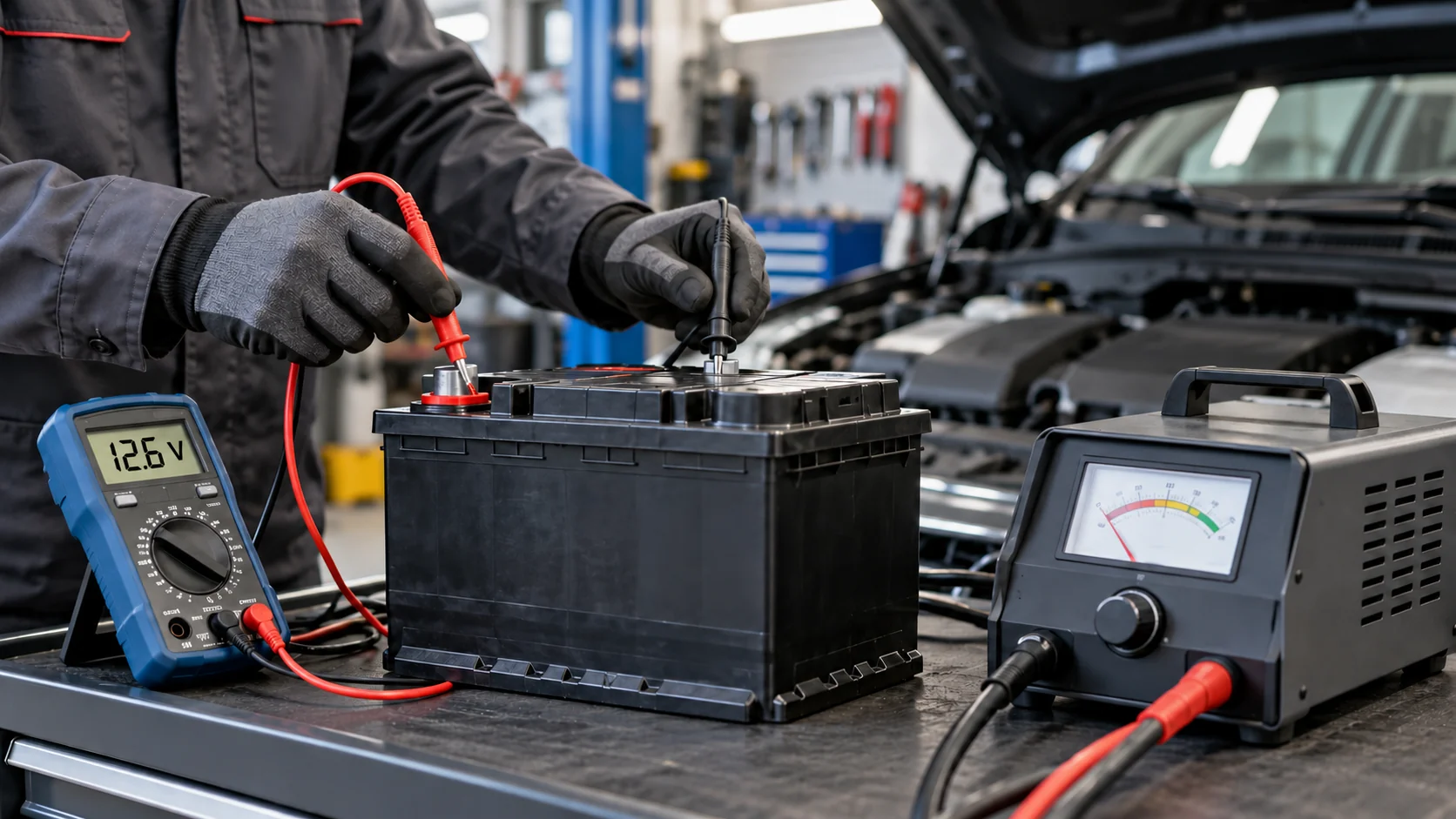
Set your digital multimeter to twenty volts direct current to check resting open-circuit voltage. Place the red meter probe on the positive battery post and the black probe on the negative post. A fully charged battery shows 12.66 volts at rest, while 12.24 volts indicates a fifty percent charge state.
Static voltage testing provides the baseline for battery checks. For detailed meter settings, read our step by step multimeter battery testing guide. Make sure the battery posts are clean before touching probe tips to metal. Corrosion on posts adds resistance. It drops your meter reading. Press each probe tip firmly into clean lead metal.
Car batteries use distinct target numbers because flooded and AGM units vary in chemistry. Standard flooded lead-acid batteries read 12.60 to 12.66 volts at full charge. Absorbed glass mat units use denser acid and read 12.80 to 12.90 volts at full charge. Read our guide on AGM versus flooded lead-acid battery specifications to verify your battery type. You can also view the Toyota Camry battery dimensions and capacity to verify original factory ratings.
Open-Circuit Voltage Chart and State of Charge Percentages
Chemical energy matches acid density at seventy degrees Fahrenheit. This table lists resting voltage levels for standard car batteries:
| Open-Circuit Voltage (OCV) | State of Charge (SoC) | Electrolyte Specific Gravity | Battery Health Assessment |
|---|---|---|---|
| 12.66 Volts or Higher | 100 Percent | 1.265 SG | Fully Charged, Optimal Condition |
| 12.45 Volts | 75 Percent | 1.225 SG | Normal Charge, Good Operational Health |
| 12.24 Volts | 50 Percent | 1.190 SG | Undercharged, Requires Bench Charging |
| 12.06 Volts | 25 Percent | 1.155 SG | Deeply Discharged, Risk of Sulfation |
| 11.89 Volts or Lower | 0 Percent | 1.120 SG | Completely Depleted, Impending Cell Failure |
The 10.5V Trap: Identifying a Dropped or Shorted Cell
A standard twelve-volt car battery contains six separate cells wired in series. Each cell adds 2.11 volts to overall terminal voltage. When a resting battery reads between 10.45 and 10.65 volts, an internal cell has failed. Trying to charge a battery with a dead cell creates heavy heat and acid fumes without restoring power.
Internal cell failure happens when active lead paste sheds from older plates. This debris settles into sediment spaces at the bottom of the case. Over time, the material piles up until it touches both plates. This creates an internal short circuit. The other five cells work fine and produce about 10.55 volts total. If your meter reads near 10.50 volts after surface charge removal, replace the battery immediately.
The 9.6V Cranking Test: Checking True Battery Health Under Load
A good twelve-volt car battery must stay at or above 9.60 volts during engine cranking at seventy degrees Fahrenheit. The starter pulls two to three hundred amps of electric current. Cranking voltage that drops below 9.60 volts confirms plate damage, high internal resistance, or lost reserve capacity.
A cranking load test checks how battery plates hold up under heavy electrical draw. The starter motor pulls heavy current straight through the battery terminal posts. If active lead material has flaked off, internal resistance rises fast. This resistance chokes current flow and causes terminal voltage to drop. You can check factory cold cranking ratings in our vehicle battery size and cold cranking amperage database.
Larger engine sizes demand more starter amperage. Full-size pickup trucks put heavy strain on battery reserves. Review the Ford F-150 factory battery group size and CCA rating to see typical truck power requirements. Big V8 engines in our Chevy Silverado battery specifications need eight hundred cold cranking amps. Cranking drops below 9.60 volts in trucks can trip transmission control module low-voltage codes and shift lags.
Using Multimeter Min/Max Mode to Capture Starter Inrush Drop
Reading fast voltage drops requires a digital meter with Min/Max mode. Basic meter screens update only twice per second. That slow refresh rate misses the lowest voltage dip when the starter engages. Hook the test leads to the battery posts. Press the Min/Max button on your meter. The device now records the lowest voltage dip automatically.
Crank the engine for three seconds using the ignition key. Turn the ignition off and look at the meter display. If the recorded minimum voltage stays above 9.80 volts, the battery remains strong. A reading between 9.20 and 9.50 volts signals worn plates and declining life. Any reading below 9.00 volts warns of near-total battery failure.
Temperature Rules: Cold Weather Voltage Limits
Freezing air slows chemical speed inside lead-acid cells. Chemical reactions inside the acid weaken as temperatures drop. Thick winter motor oil also forces the starter to work harder. Lowest safe cranking voltage changes as air temperature drops:
| Ambient Operating Temperature | Minimum Acceptable Cranking Voltage | Electrolyte Chemical Activity |
|---|---|---|
| 70 Degrees Fahrenheit (21 C) | 9.60 Volts | 100 Percent Chemical Capacity |
| 50 Degrees Fahrenheit (10 C) | 9.40 Volts | 85 Percent Chemical Capacity |
| 30 Degrees Fahrenheit (-1 C) | 9.10 Volts | 65 Percent Chemical Capacity |
| 0 Degrees Fahrenheit (-18 C) | 8.50 Volts | 40 Percent Chemical Capacity |
Digital Conductance Analyzers: Testing Cranking Amps and Cell Health
Digital analyzers test battery health with a low-frequency AC pulse through the lead plates. The tool reads plate conductance. It calculates cranking amps and milliohms. Digital testers spot plate wear without drawing heavy current or heating posts.
Older carbon pile testers place heavy resistive loads on automotive batteries. A carbon pile pulls half the battery rated cold cranking amps for fifteen continuous seconds. These tools generate high heat and pull real current from the cells. Digital conductance testers eliminate those fire and heat risks. Modern electronic tools send a mild test signal through the plates to check active surface area.
Testing smaller cars requires setting the correct factory amp rating on the tool. Compact passenger cars use smaller batteries with less cold cranking reserve. Review the Honda Civic Group 51R battery specifications to enter accurate numbers into the analyzer. Typing five hundred amps for a four-hundred-amp unit causes false fail alerts.
Reading Internal Resistance in Milliohms on Digital Tools
Internal resistance provides clear proof of plate condition. Fresh car batteries display internal resistance between 2.5 and 4.5 milliohms. As lead plates build hard sulfate crust, internal resistance climbs. High resistance blocks current flow and creates heat inside cells.
Technicians use BCI battery testing standards to grade cell life. A reading between 4.5 and 6.5 milliohms indicates normal aging and reliable function. When internal resistance passes 7.5 milliohms, the battery struggles to start engines in freezing weather. Replace any battery that measures above 8.5 milliohms even if resting voltage looks normal.
Terminal Voltage Drop: Separating Bad Cables from a Dying Battery
Voltage drop tests isolate bad cable connections from internal battery failure. Corroded clamps and loose ground straps waste electrical energy under starter current draw. The voltage loss across any battery cable connection must stay below 0.20 volts during active engine cranking.
People often scrap good batteries when dirty cable ends cause slow starts. Corrosive crust between clamps and posts restricts current flow. The starter motor cranks at low speed, and drivers assume the battery died. Measuring voltage drop pinpoints the exact loose or dirty connection in seconds.
Set your digital multimeter to the two-volt direct current scale. Place the red meter probe right on the positive lead post. Place the black probe on the metal cable clamp bolted to that post. Have a friend crank the engine for three seconds. The meter displays the voltage lost at that connection. If the screen reads over 0.20 volts, scrub the metal clean.
Run the same test between the negative battery post and the engine block. Poor ground links trigger odd faults across engine sensors. Vehicles with twin battery setups require clean ground links. See our Jeep Wrangler auxiliary and main battery sizing guide to check dual-battery ground circuits.
When to Recharge vs When to Replace: The Diagnostic Decision Matrix
Recharge a car battery if resting voltage reads between 12.00 and 12.40 volts while cranking voltage stays above 9.60 volts. Replace the battery if resting voltage drops below 10.60 volts, cranking voltage falls below 9.00 volts, or the case bulges. Technicians cannot restore a battery that has broken plates or shorted cells.
Distinguishing an undercharged battery from a worn unit saves money. Leaving interior lights on drains charge while the internal plates remain healthy. Connecting a smart multi-stage charger brings the battery back to full strength in twelve hours. If a charged unit dies overnight, track dark current draw with our overnight parasitic draw diagnostic procedure.
Weak batteries also disrupt engine idle quality during daily driving. Onboard computers need steady voltage to fire fuel injectors cleanly. Review our article on low battery voltage causing rough engine idle to recognize these signs. If your tests confirm permanent plate damage, follow our safe car battery removal sequence to detach cables without sparks. Complete the repair with our correct new car battery installation steps to lock the new unit into the tray.
| Resting Voltage (OCV) | Cranking Voltage (Load) | Internal Resistance | Physical Inspection | Diagnosis & Corrective Action |
|---|---|---|---|---|
| 12.60 to 12.66 V | 9.80 V or Higher | 2.5 to 4.5 mΩ | Clean, No Deformity | Excellent Condition. No maintenance required. |
| 12.20 to 12.45 V | 9.60 V or Higher | 4.5 to 6.0 mΩ | Normal Appearance | Undercharged Battery. Connect bench charger. |
| 12.50 to 12.65 V | 8.20 to 8.90 V | 7.5 to 9.5 mΩ | Intact Outer Case | Capacity Loss. Replace battery immediately. |
| 10.45 to 10.65 V | Collapses below 6.0 V | Above 12.0 mΩ | Discolored Vent Caps | Dead Shorted Cell. Do not charge. Replace unit. |
| Any Voltage | Untestable | Untestable | Swollen or Bulging Sides | Overheating Damage. Replace battery immediately. |
Frequently Asked Questions: How to Check the Life of a Car Battery
How can you tell if a car battery is dying or just needs a charge?
Recharge the battery with a smart charger and run a cranking load test. A discharged battery with sound plates will hold 12.60 volts and stay above 9.60 volts during engine cranking. A dying unit with plate sulfation drops below 9.60 volts under starter draw despite showing 12.60 volts before cranking.
What voltage indicates a dying car battery?
A resting voltage reading below 12.00 volts indicates deep discharge and plate sulfation. Any car battery that dips below 9.60 volts during starter cranking has lost its reserve capacity. It requires prompt replacement to prevent roadside breakdown.
Can a car battery show 12 volts and still be bad?
Yes. A battery showing 12.00 to 12.40 volts at rest can still have severe plate damage. This surface voltage drops rapidly when the starter pulls current. Run dynamic cranking load tests or digital checks to verify real starter power under load.
How do professional mechanics test battery health?
Car mechanics use digital conductance tools and carbon pile load testers. Digital meters send AC test waves to read plate resistance and cranking amps. Carbon pile tools pull half the rated cranking amps for fifteen seconds while watching terminal voltage stability.
How often should you check the health of a car battery?
Test your car battery twice each year. Test it before summer heat waves and winter freezing temperatures. When a battery reaches three years of service, test resting volts and cranking power every three months.