Signs Your Car Battery Is Dying: 8 Warning Symptoms, Acoustic Clues, and the 5-Minute Multimeter Test

A dying car battery gives distinct physical, sound, and electrical cues before failure. Sluggish morning engine cranking, rapid starter solenoid clicking, dim headlights at idle, and sudden auto-start-stop system cutouts signal severe power loss. A healthy battery holds 12.65 volts at rest and stays above 9.60 volts during engine cranking. Readings below 12.24 volts demand immediate attention.
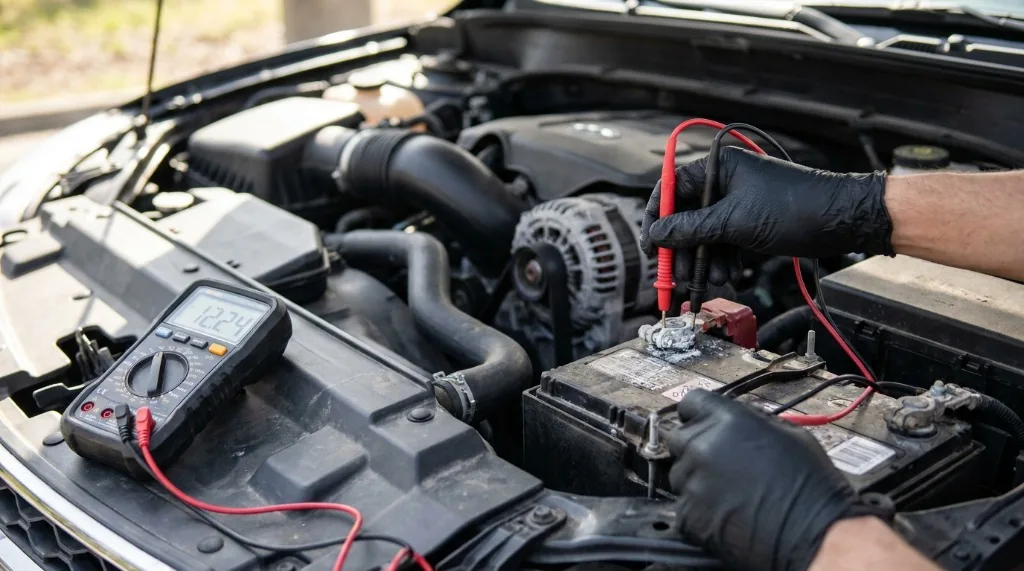
When an engine groans or hesitates during a cold start, drivers often overlook the warning until the car fails to crank completely.
Lead-acid car batteries rarely fail without early signs. Chemical wear, plate sulfation, and heat breakdown leave clear clues weeks before total failure. Learning to spot these warning signs saves money and stops unnecessary parts buying.
The 8-Point Symptom Triage: Spot Battery Failure Before You Get Stranded
A dying car battery shows eight primary symptoms across sound, electrical, and physical areas. These warning signs include slow engine cranks, rapid solenoid chatter, dim headlights at idle, dim instrument clusters, unprompted auto-start-stop cutouts, rotten egg odors, bloated casing walls, and heavy terminal crust. Spotting any two symptoms at once confirms advanced battery wear.
Car batteries store electrical energy through chemical reactions. When lead plates break down, power drops fast under load. Review this diagnostic matrix to assess your car’s risk level.
| Warning Symptom | Primary Failure Cause | Urgency Level | Immediate Action |
|---|---|---|---|
| Sluggish Moaning Crank | Low cold cranking amps (CCA) | High | Run resting and cranking multimeter voltage test |
| Rapid Solenoid Chatter | Voltage drop below 8.0V under load | Critical | Clean terminal clamps and jump-start immediately |
| Single Loud Clunk | Seized starter motor or zero battery current | Critical | Check starter relay and test battery load capacity |
| Dim Headlights at Idle | Weak battery forces alternator reliance | Moderate | Test alternator charging output at 2,000 RPM |
| Auto-Start-Stop Cutout | BMS detects State of Health below 70% | Moderate | Plan battery replacement within 30 to 60 days |
| Flickering Dash & Reset Clocks | Sudden bus voltage drop during start | High | Check battery ground straps and terminal tightness |
| Rotten Egg Sulfur Odor | Overcharging boiling liquid acid | Emergency | Stop driving immediately; disconnect charging source |
| Bulged Battery Casing | High heat damage or frozen acid | Critical | Replace battery immediately; do not jump-start |
Each warning signal points to a specific stage of wear inside your electrical system. Catching these signs early protects your starter motor and alternator from damage.
Acoustic Start-Up Cues: Rapid Chatter Solenoid Clicking vs Sluggish Moaning Crank
Starter motor sounds reveal battery condition within the first three seconds of ignition. A rapid machine-gun chatter sound indicates low battery voltage that drops under starter load. A slow, heavy groan signals low cold cranking amps or heavy plate sulfation. A single loud clunk indicates mechanical binding inside the starter motor.
The sounds produced during an attempted start tell an exact electrical story. When you turn the ignition key, the starter solenoid coil draws heavy power. It pushes the starter drive gear forward into the engine flywheel ring gear.
Rapid chatter sounds like a fast rattle. It clicks at a rate of 10 to 15 times per second. The battery holds enough rest charge to pull the solenoid in. The contacts close. Current rushes to the starter motor.
Because the battery lacks reserve power, terminal voltage drops below 8.0 volts immediately. This voltage loss weakens the solenoid magnet. The internal return spring snaps the contact back open.
With the load cut, battery voltage jumps back up at once. The coil pulls in again. The contacts close, voltage drops, and the cycle repeats. This rapid clicking proves that your battery lacks the power to turn the engine over.
A slow moaning crank sounds like a strained groan. The engine turns over with a slow, heavy pace. It fights through each compression stroke.
Cold engine oil creates heavy drag on crankshaft bearings. A healthy battery overcomes this drag by sending hundreds of amps instantly. A sulfated battery cannot supply that current, which causes the slow groan.
If you hear one loud clunk with zero engine spin, the battery may not be at fault. A single clunk shows that the solenoid moved forward, but the starter motor could not rotate. This symptom points to seized starter bearings, burned contacts, or a loose ground wire. Read our guide on what a bad starter sounds like to tell starter mechanical faults from a dead battery.
Electrical Glitches: Dimming Headlights, Flickering Dash Displays, and Wiping Presets
Car electrical glitches show that your battery cannot steady system voltage for onboard computers. Headlights that brighten when you rev the engine prove the battery cannot hold steady voltage without alternator power. Flickering dashboard screens, slow power windows, and reset radio clocks indicate severe voltage loss during engine cranking.
Your car battery does more than start the engine. It acts as an electrical cushion. It absorbs voltage spikes and fills power gaps when engine speed drops at red lights.
At idle with the car in gear, the engine runs at 650 to 750 RPM. At this low speed, the alternator makes only 30 to 50 percent of its top output. When you run headlights, cabin heat, and rear defrosters at the same time, power demand tops alternator output.
A healthy battery supplies the extra power. A weak battery cannot fill the gap. System voltage drops from 14.2 volts down to 11.5 volts. Headlights dim and cabin blower fans slow down. When you step on the gas, engine speed rises. Alternator power jumps up, and your headlights get bright again.
Modern car computers track system voltage all day. During a normal start, voltage stays above 10.0 volts. When a dying battery lets voltage drop below 9.0 volts while cranking, digital computers shut down and reboot.
Your radio clock resets to 12:00. The trip mileage counter clears to zero. The display screen reboots. In bad cases, a weak battery can cause engine hesitation or rough running because fuel injectors and spark coils misfire under unstable voltage.
If your car dies while driving, check whether your battery dies while driving on the highway due to an alternator fault instead of an internal battery failure.
Silent Digital Warnings: Why Your Car Computer Shuts Down Auto-Start-Stop First
Modern cars with smart charging and Battery Management System (BMS) sensors give silent electronic warnings before starting troubles begin. When the onboard computer detects battery State of Health dropping below 70 percent, it automatically shuts off the Auto-Start-Stop system. Electric power steering drag and stored communication trouble codes also signal weak battery reserve.
Car makers mount smart battery sensors directly onto the negative battery terminal clamp. These BMS chips track current, internal resistance, heat, and charge level every second.
The most common early sign on newer cars is the sudden loss of Auto-Start-Stop. When you stop at a red light, the engine stays running. An amber dash symbol shows that start-stop is off.
Drivers often think this means a software bug or cold weather lock. The vehicle powertrain control module detected that battery State of Health (SoH) dropped below 70 percent. The computer keeps the engine running because restarting might drain the remaining charge. When auto-start-stop stops working without reason, test your battery within 30 days.
Electric Power Assisted Steering (EPAS) systems give another clear digital clue. Modern cars do not use hydraulic pumps driven by belts. They use high-draw electric motors on the steering rack.
During tight parking turns at idle speed, an electric steering rack draws 60 to 80 amps for two to three seconds. A weak battery cannot supply this big power burst. Drivers feel sudden stiffness in the steering wheel, or see the power steering light flash during parking.
Low battery voltage during starting also triggers false error codes. Digital modules talk over high-speed CAN bus data lines. When cranking voltage drops, modules cut out for milliseconds.
The main car computer logs these brief drops as communication errors. It stores codes like U0100 or U0101. Technicians often spend hours checking wires when an old battery causing low start voltage is the real cause.
Physical Inspection: Rotten Egg Odors, Swollen Cases, and Terminal Crust Blooms
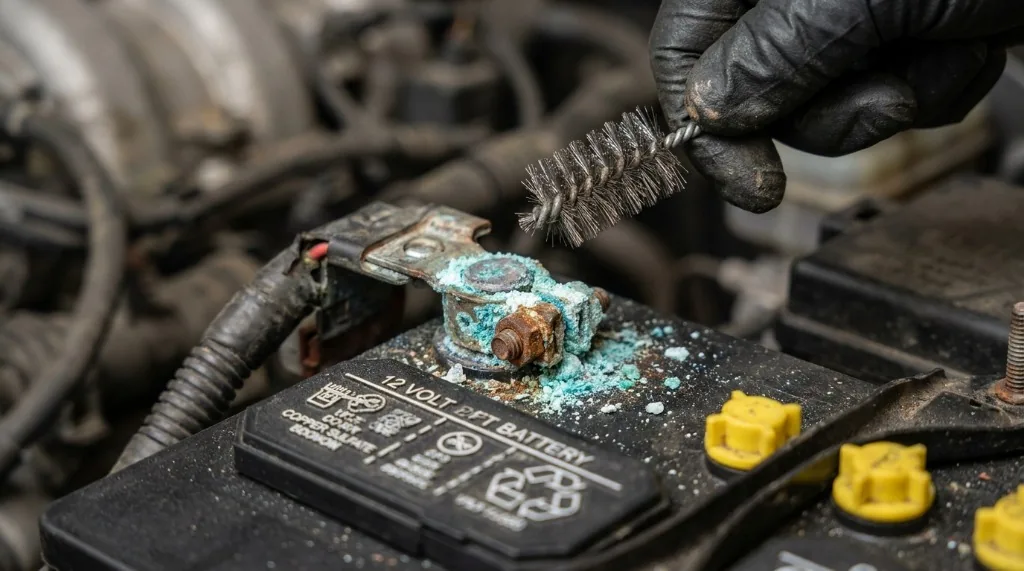
Physical inspection under the car hood reveals permanent battery case and plate damage. A rotten egg odor signals toxic hydrogen sulfide gas venting from boiling acid. Swollen, rounded battery case walls show heat damage or frozen acid expansion. Fluffy white powder on negative posts and blue-green crust on positive clamps indicate acid vapor leaks and high circuit resistance.
Open the hood and check the battery case under a bright light before running tests. Physical damage requires fast replacement to stop acid leaks and gas hazards.
A strong rotten egg smell under the hood signals an urgent hazard. Lead-acid car batteries hold water and sulfuric acid ($H_2SO_4$). When an internal cell shorts out or an alternator overcharges, the acid boils.
This reaction vents flammable hydrogen sulfide gas ($H_2S$). If you smell sulfur while the engine runs, park outside, turn off the key, and let the battery cool. Never lean over a hot battery. Never hook jumper cables to it. A spark can ignite the gas and blow up the plastic case.
Check the black plastic battery case from the top and sides. A good battery has flat, straight walls. If the sides look puffed out or round like a pillow, the battery is ruined.
In hot southern summers, engine heat warps internal lead plates and bulges the plastic walls. In cold northern winters, a flat battery freezes solid because weak acid turns to ice at 20°F (-7°C). The ice cracks the internal plates and puffs out the case. A swollen battery cannot be saved. Replace it right away.
Look closely at the lead battery posts and clamps. Dry, crusty powder often builds up around the metal base. White powder on the negative clamp is lead sulfate or sodium sulfate.
Bright blue-green crust on the positive post is copper sulfate. It forms when acid fumes react with the copper cable wire. This crust acts like an electrical insulator and chokes starter current flow.
The 5-Minute Driveway Voltage Test: Exactly What Your Multimeter Numbers Reveal
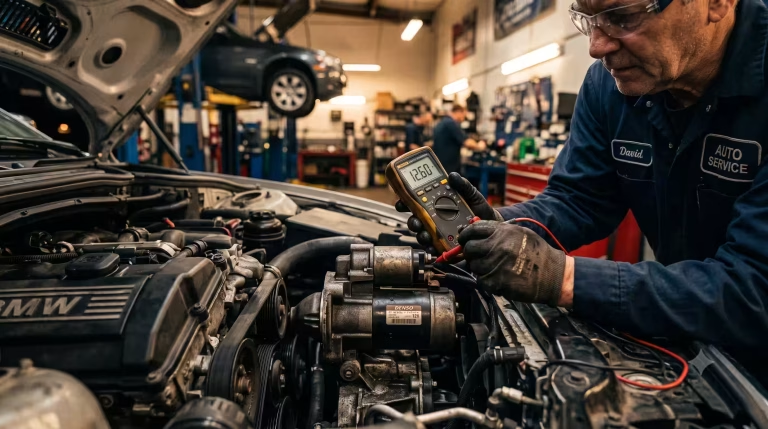
A digital multimeter gives clear proof of battery health in five minutes. Testing resting voltage with the engine off checks chemical charge level, while checking voltage drop during engine start tests power under load. A healthy battery shows 12.60 to 12.80 volts at rest and stays above 9.60 volts during a five-second engine crank.
Do not guess battery condition by sound alone. A cheap digital multimeter gives clear facts and stops you from buying parts too early. Learn why using a multimeter instead of an incandescent test light keeps modern car computers safe during testing.
Run this simple testing sequence:
- Set Up the Meter: Turn the multimeter dial to DC Volts. Choose the 20-volt scale.
- Touch Clean Metal: Place the red test probe on the positive (+) lead battery post. Place the black test probe on the negative (-) lead post.
- Read Resting Voltage: Read the digital screen with the engine and headlights off for two hours to clear surface charge.
Compare your resting voltage reading to this standard State-of-Charge table:
| Resting Multimeter Voltage | State of Charge (SoC) | Battery Condition & Diagnostic Finding |
|---|---|---|
| 12.65V to 12.80V | 100% | Full charge; prime chemical plate condition |
| 12.45V to 12.55V | 75% | Normal working state; safe starting power |
| 12.20V to 12.30V | 50% | Low charge; plate sulfation starts to build |
| 12.00V to 12.10V | 25% | Weak charge; high risk of morning starting failure |
| Below 11.90V | 0% | Dead battery; bad cell or severe parasitic draw |
Resting voltage alone does not tell the whole story. A battery can read 12.60 volts at rest, yet fail the second you try to start the car. High internal resistance causes voltage to drop under load. You must run the live cranking voltage test.
Have a helper turn the key and crank the engine for four to five seconds while you watch the meter on the battery posts.
- Good Cranking Voltage: The meter drops from 12.6V down to between 10.0V and 10.8V while the starter turns. The battery delivers full current with low internal resistance.
- Fair Cranking Voltage: The meter reads between 9.6V and 9.9V. The battery starts the car in warm weather, but will fail on a freezing morning.
- Bad Cranking Voltage: The reading plunges below 9.60V, often hitting 7.0V or 8.0V. The battery has shed plate material or holds a dead cell. Replace the battery at once.
Follow this systematic automotive diagnostic testing procedure to isolate electrical faults before purchasing replacement parts.
The 2-Minute Post-to-Clamp Voltage Drop Test: Stop Replacing Batteries with Dirty Terminals
The post-to-clamp voltage drop test isolates terminal clamp dirt from true battery failure in two minutes. Dirty, corroded, or loose clamps mimic a dead battery by choking electric current to the starter motor. Testing voltage drop across the post and clamp during engine start shows whether cleaning the terminals fixes the car without buying a replacement.
Many drivers buy a new car battery when their old battery is still good. The real problem is poor contact between the lead post and the metal clamp.
Corrosion and road dirt build a thin layer between the post and the clamp. At rest, small currents pass through, and the meter reads a full 12.6 volts. But when the starter demands 200 amps, high contact resistance turns power into heat. Voltage drops before current ever reaches the starter cable.
Run this two-minute voltage drop check:
- Keep your digital multimeter set on DC Volts (20V scale).
- Put the sharp tip of your red probe directly on the center of the lead battery post.
- Put the sharp tip of your black probe on the metal cable clamp on that same post.
- Have a helper turn the key to crank the engine while you watch the meter.
Read your test results:
- Clean Connection: The meter reads between 0.00V and 0.05V. Resistance is close to zero. Full power flows into the cable.
- Acceptable Connection: The meter reads between 0.06V and 0.20V. Minor dirt exists, but current flow stays strong enough to start.
- Bad Connection: The meter jumps above 0.20V, often spiking past 1.0V. Severe resistance chokes the metal joint.
When voltage drop tops 0.20V, do not buy a battery. Unbolt the clamp, scrub the post and clamp with a wire brush, wipe them clean, apply grease, and bolt the clamp tight. Retest. Starting speed returns at once.
Battery vs Alternator vs Starter: How to Isolate the Culprit Without Towing
Separating battery faults from alternator and starter problems requires an evaluation of failure timing, system voltage, and jump-start results. Battery failure stops the car from starting after sitting parked. Alternator failure causes stalls and dim lights while the engine runs. Starter failure prevents engine rotation even with full battery voltage and clean terminal connections.
When an engine will not start, drivers often confuse these three parts. Use this clear checklist to find the broken component:
| Diagnostic Feature | Failed Car Battery | Failed Alternator | Failed Starter Motor |
|---|---|---|---|
| Primary Symptom | Engine cranks slow or clicks in morning | Car stalls while driving; dim lights on road | Single clunk; zero engine rotation |
| Resting Voltage | Below 12.20 Volts DC | Normal if charged; drops fast under load | 12.60 to 12.80 Volts DC (Healthy) |
| Running Voltage | 13.80V to 14.50V (Charging fine) | Below 13.50V or above 15.00V | 13.80V to 14.50V (Once running) |
| Jump-Start Result | Starts fast; runs on road fine | Starts with jump; dies in minutes | Will not start; clicks once with jump |
| Dashboard Warning | Battery light on before starting | Battery light stays on while driving | No battery light; dash lamps light up fine |
| Typical Cost (2026) | $120 to $200 (DIY) | $750 to $1,050 (Shop job) | $450 to $800 (Shop job) |
Run the 20-minute jump-start test. Hook jump cables or a jump box to the car. Start the engine, take off the cables, and let the engine idle.
If the car runs for 20 minutes with headlights and heater on, your alternator works. The battery failed to hold charge. If the car dies within minutes of taking off the jump box, the alternator cannot charge the system.
For full steps on this test, read our dead battery vs bad alternator diagnostic test guide. Never unhook a battery cable while the engine runs. Modern computers require the battery to absorb transient voltage spikes. Disconnecting terminal cables while the engine runs, or running a modern car without a battery, can destroy sensitive electronic control units.
Battery Replacement Economics: When to Recharge, When to Desulfate, and When to Buy
Deciding whether to charge, recondition, or replace a dying car battery protects your repair budget. Soft lead sulfate from a single flat discharge clears with a multi-stage smart charger. Hard crystalline sulfation on batteries over three years old causes permanent plate damage that demands replacement. Budget $120 to $200 for standard flooded batteries and $220 to $350 for AGM units.
Before spending money on a new battery, check if your unit suffered a flat discharge or permanent chemical wear.
If you left an interior light on overnight, the battery drained, but the lead plates remain intact. Hooking a smart multi-stage charger at 2 to 4 amps for 12 to 24 hours dissolves soft lead sulfate back into the liquid acid.
However, if your battery is over three years old, lives in hot weather, and sees only short city trips, hard sulfation forms. Lead sulfate turns into hard crystals that block current. Pulse chargers cannot fix shed plate material sitting at the bottom of the case.
When you must buy a new battery, select the right type:
- Flooded Lead-Acid Batteries: Cost $120 to $200 in 2026. Best for older cars with simple electronics and standard charging systems.
- Absorbent Glass Mat (AGM) Batteries: Cost $220 to $350 in 2026. Required for modern cars with Auto-Start-Stop, smart alternators, and high electrical loads. Review our guide on AGM vs standard lead-acid batteries to see if upgrading fits your vehicle.
Always take your old battery back to the parts store. Stores charge a $15 to $25 core deposit at checkout, which they hand back in cash when you drop off the old battery for recycling.
Frequently Asked Questions About Dying Car Batteries
Common questions about failing car batteries focus on multimeter voltage readings, failure timelines, parasitic drains, and free shop tests. These direct answers address everyday diagnostic problems, critical testing thresholds, and smart replacement guidelines to help drivers resolve electrical issues quickly without paying for unnecessary repair shop diagnostics.
Can a car battery read 12.6 volts on a multimeter and still be bad?
Yes. A car battery can show 12.60 volts at rest and still fail to start the car. Resting open-circuit voltage checks chemical potential without load. When plate sulfation drives internal resistance above 10.0 milliohms, the battery cannot deliver the 200 amps needed by the starter. Voltage collapses below 8.0 volts the moment you turn the key. Always run a cranking voltage test under starter load.
How long does a car battery last after the first slow crank?
A car battery lasts three days to three weeks after the first slow morning crank. A slow crank shows that battery capacity fell below 50 percent in mild weather. The first cold morning drops chemical speed by another 30 to 50 percent, which causes total starting failure. Test or replace the battery right after you notice starting drag.
What causes a car battery to die repeatedly within a few months?
A battery that dies repeatedly within months suffers from a parasitic power drain, a weak alternator, or the wrong battery size. A glove box light that stays on, a stuck relay, or an aftermarket alarm drains power while parked. A weak alternator putting out under 13.50 volts leaves the battery chronically undercharged. Short city trips also prevent full charging.
Can a dying battery damage my alternator or starter motor?
Yes. Driving with a dying battery damages both the starter and the alternator. When low battery voltage drops system power, the starter pulls more amps to spin the engine. This extra draw overheats starter windings. Meanwhile, the alternator runs at full 100 percent load nonstop trying to charge a bad battery, which burns out alternator rectifier diodes.
Will AutoZone or O’Reilly test my car battery for free while it remains in the vehicle?
Yes. AutoZone, O’Reilly Auto Parts, and Advance Auto Parts test car batteries for free in the parking lot. Technicians use handheld conductance testers that measure cold cranking amps, internal resistance, and state of health in two minutes. They also test alternator charging output and starter draw without pulling parts from the car.