How to Bypass an Ignition Switch and Start Your Car

It was a cold Tuesday night when my phone rang. A client, Mark, was stranded in a nearly empty parking lot after a late shift. His car’s dashboard lit up, the radio worked, but when he turned the key… nothing. Just a dead, frustrating silence. He thought it was the battery, but the bright headlights told a different story.
Over the phone, I walked him through a few quick checks, and we quickly diagnosed the culprit: a failed ignition switch. He was miles from home, and the tow trucks were quoting a two-hour wait. In a pinch like that, knowing an old-school trick can be a lifesaver. I explained an emergency bypass procedure that got his engine running so he could get home safely.
That emergency trick is what I’m going to share with you today. As an ASE-certified Master Technician with over 15 years under the hood, I can show you how this works. But, I’ll show you how to do it safely. This is a temporary, last-resort fix, not a permanent solution.
Key Takeaways
- For Older Vehicles Only (pre-2000s): Hotwiring and solenoid jumping work on cars without immobilizers. Vehicles from 2000 onward typically have VATS, Passlock, or PATS systems that block these methods entirely.
- Safety is Paramount: You are working with a live electrical system. Always disconnect the negative battery terminal before handling wires to prevent shorts, shocks, or ECU damage.
- Modern Cars Need a Locksmith or Dealer: If your car has a transponder chip key, push-button start, or any anti-theft system, bypassing the ignition will not start the engine. Call a locksmith or tow to a shop.
- Cost to Fix It Properly: According to RepairPal, ignition switch replacement averages $238 to $311 including labor. This is a same-day repair at most shops.
- This is an Emergency Fix Only: A bypass gets you home. it does not replace the faulty switch.
Does Your Car Support an Ignition Bypass?
Before you touch any wires, find out whether your vehicle can actually be bypassed. The answer depends almost entirely on the year and whether your car has an immobilizer system installed at the factory.
| Vehicle Era | Bypass Possible? | Why | Example Makes/Models |
|---|---|---|---|
| Pre-1990 | ✅ Yes | No anti-theft electronics | Most carbureted vehicles, classic trucks |
| 1990 to 1999 | ⚠️ Sometimes | Some GM models have VATS; most others do not | Ford F-150 (pre-PATS), Toyota Camry, Honda Civic |
| 2000 to 2008 | ❌ Rarely | PATS (Ford), Passlock (GM), and factory transponder keys widespread | Ford F-150, Chevrolet Silverado, Nissan Altima |
| 2009 onward | ❌ No | Rolling codes, proximity sensors, ECU pairing required | All push-button start vehicles, most keyless entry systems |
Is It Legal to Bypass Your Own Ignition Switch? Yes, With These Conditions
Before you touch a single wire, here’s what you need to know before you start. This guide is for you, the owner of the vehicle, in an emergency situation. Using these techniques on a vehicle you do not own is illegal. Period.
Modern vehicle anti-theft systems, governed by regulations like the Federal Motor Vehicle Safety Standards on Theft Protection, are incredibly complex for a reason. Bypassing them improperly can cause expensive damage.
Your safety checklist before you start:
- Confirm you own the vehicle.
- Work in a well-lit and safe area.
- Put the car in Park or Neutral with the parking brake fully engaged.
- Disconnect the negative terminal on your car battery.
3 Signs Your Ignition Switch Has Failed (Not the Battery)
So, how can you be sure the ignition switch is the real culprit? Here are the most common signs:
- The key turns, but the car won’t start. You’ll hear a click, or more often, nothing at all, even though your lights, radio, and other accessories have power. This is different from a weak battery that causes rough running.
- Your car stalls while driving. A failing switch can lose its connection intermittently, cutting power to the ignition system and shutting off your engine. If your battery dies while driving, the cause is more likely your alternator, but a bad switch can mimic this symptom.
- The key won’t turn in the ignition. Sometimes the mechanical part of the switch, the lock cylinder, fails, preventing the key from moving at all.
If your symptoms match, and you’ve ruled out that your car won’t run without a battery, it’s time to proceed.
How to Bypass an Ignition Switch: 3 Emergency Methods
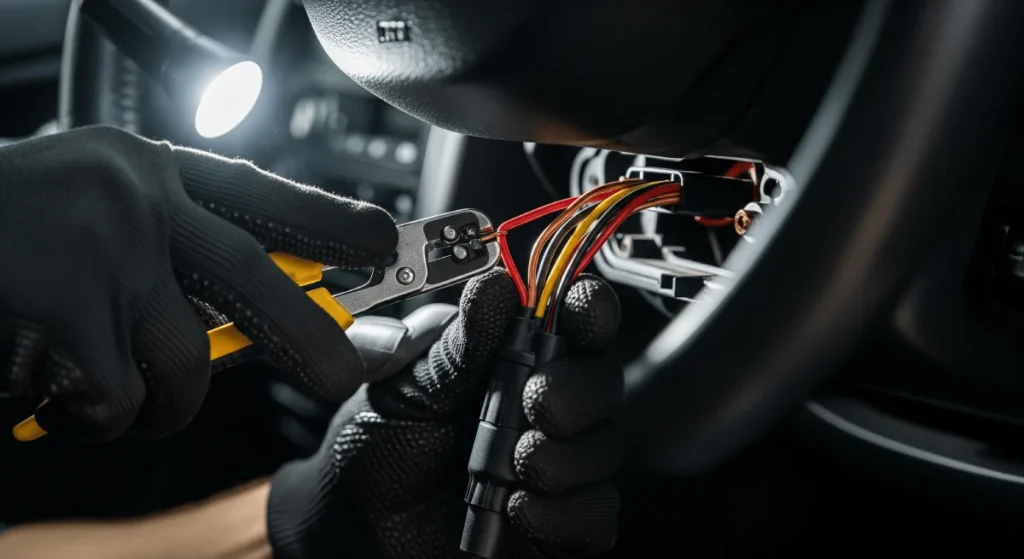
Remember, these methods are for older cars. If you’re unsure, it’s safer to assume your car is too new for this to work.
Method 1: Hotwiring at the Steering Column
This is the classic method you’ve probably seen in movies. It involves directly connecting the wires that the ignition switch normally handles.
Tools You’ll Need:
- A set of screwdrivers (Phillips and flathead)
- Wire strippers
- Electrical tape
Step-by-Step Instructions:
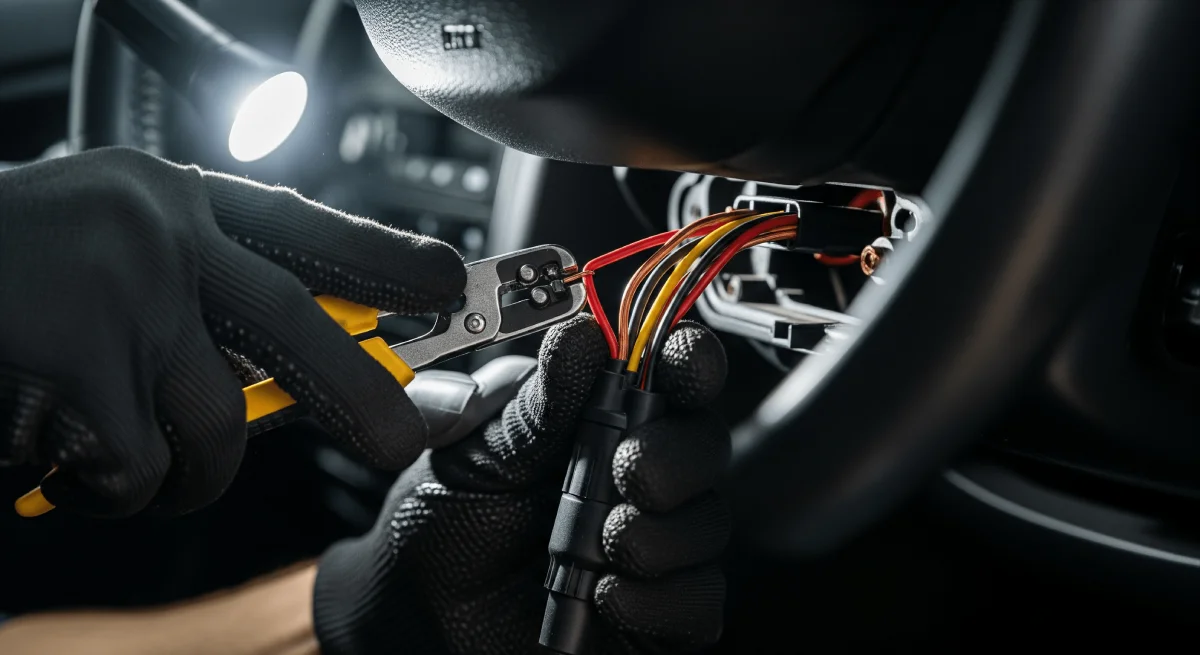
- Access the Ignition Switch Wiring: First, you need to remove the plastic covers around your steering column. There are usually a few screws on the underside. Once removed, you will see a bundle of wires leading to the back of the ignition lock cylinder.
- Identify the Key Wires: This is the hardest part. You’re looking for three main wires: the main battery power (usually a thick red wire), the ignition/accessory power (often brown or pink), and the starter solenoid wire (often purple or yellow). A vehicle-specific wiring diagram or TSB is the only way to be 100% certain.
- Power the Ignition: Carefully strip a small section of insulation from the main battery wire and the ignition wire. Tightly twist them together. At this point, you should see your dashboard warning lights turn on, just as if you turned the key to the “ON” position.
- Engage the Starter: Now, strip a small section of the starter solenoid wire. Momentarily touch this stripped end to the connected battery/ignition wires. This sends power to the starter motor, which will crank the engine. The engine should start.
- Remove the Starter Wire Immediately: As soon as the engine fires up, pull the starter wire away. Leaving it connected can destroy your starter. Use electrical tape to insulate the exposed end so it doesn’t short against anything. The engine will now stay running until you untwist the battery and ignition wires.
Method 2: Jumping the Starter Solenoid Directly
This method is a bit cruder but can be simpler if you can’t access the steering column wires. It bypasses the switch to crank the engine, but you still need to use the key to power up the ignition system.
Tools You’ll Need:
- An insulated screwdriver or a short jumper wire.
Step-by-Step Instructions:
- Turn the Key to “ON”: Insert your key and turn it to the “ON” position. This powers up your fuel pump and ignition circuits. This method will not work if the key won’t turn at all.
- Locate the Starter Solenoid: Pop your hood. The starter is a small motor attached to the side of the engine or transmission, and the solenoid is the smaller cylinder on top of it. You will see a thick cable from the battery and one or two smaller wires.
- “Jump” the Solenoid: Touch the blade of your insulated screwdriver across the two large electrical posts on the solenoid. You will see a large spark. This is normal. This action directly connects battery power to the starter motor, and the engine will begin to crank.
- Remove the Screwdriver: The instant the engine starts, pull the screwdriver away.
Method 3: Installing a Temporary Bypass Toggle Switch
This option gives you a more stable temporary setup than holding wires together by hand. It takes about 20 to 30 minutes and requires basic wiring experience. If you’ve never worked with automotive wiring before, skip this method and call a locksmith instead.
Tools and Parts You’ll Need:
- One heavy-duty toggle switch (rated for 20A or higher)
- One momentary push button (normally open, 12V rated)
- Two spools of 12-gauge wire (red for power, a second color for the starter circuit)
- Wire connectors or crimp terminals
- Wire strippers and a multimeter
Step-by-Step Instructions:
- Locate your three target wires at the steering column using a vehicle-specific wiring diagram. You need the main battery feed wire, the ignition circuit wire, and the starter solenoid wire. Do not guess. A wrong connection on any of these three wires can damage your ECU or start a fire.
- Run a new wire from the battery feed wire to one terminal of your toggle switch. Connect the other terminal of the toggle switch to the ignition circuit wire. This toggle now replaces your key’s “ON/OFF” function for the ignition circuit.
- Run a second wire from the battery feed wire to one terminal of your push button. Connect the other push button terminal to the starter solenoid wire. This button now replaces your key’s “START” function.
- Insulate every connection with electrical tape or heat-shrink tubing. No bare copper should be exposed.
- To start the car: flip the toggle switch to ON, then press and hold the push button until the engine fires. Release the button immediately once it starts.
- To stop the car: flip the toggle switch to OFF. This cuts power to the ignition circuit and shuts the engine down.
Get the ignition switch replaced properly as soon as possible. This temporary setup is not weather-sealed and should not be used long-term.
Modern Cars Cannot Be Hotwired: Here Is Why Anti-Theft Systems Block Every Method
If you drive a car made in the last 20 years, especially a Toyota, Ford, Nissan, or anything with a push-button start, you’ve likely got an immobilizer system.
Transponder Keys and Immobilizer Systems
Your car key isn’t just a piece of metal; it contains a tiny radio transponder chip. When you insert the key, the car’s computer (ECU) sends out a request signal. The chip in the key sends back a unique, encrypted code. If the code is correct, the ECU allows the engine to start. Without this digital handshake, you can hotwire the starter all day, but the ECU will never allow the engine to fire.
The Three Major Factory Anti-Theft Systems You Will Encounter
Knowing which system your car has tells you immediately whether any bypass is worth attempting.
| System Name | Manufacturer | Years Active | Bypass Possible? |
|---|---|---|---|
| VATS (Vehicle Anti-Theft System) | GM (Chevrolet, Buick, Cadillac) | 1986 to 1994 | ⚠️ Possible with resistor bypass module not simple |
| Passlock | GM (Chevrolet, GMC, Pontiac, Saturn) | 1994 to 2008 | ❌ Requires relearn procedure or bypass module |
| PATS (Passive Anti-Theft System) | Ford, Lincoln, Mercury | 1996 to present | ❌ Requires programmed key or dealer-level scan tool |
| Standard Transponder Key | Toyota, Honda, Nissan, most imports | 1998 to present | ❌ ECU will not allow fuel delivery without correct chip signal |
| Proximity / Push-Button | All manufacturers | 2005 to present | ❌ Rolling code encryption — no wiring bypass exists |
Ford introduced PATS (Passive Anti-Theft System) in 1996 on the Mustang GT and quickly expanded it across the F-150 and Explorer lineup. By the 2000 model year, nearly all Ford vehicles required a programmed transponder key to start. Source: NHTSA TSB Archive.
The Challenge with Push-Button Start Systems
These are even more complex, using rolling codes and proximity sensors. There is no simple wiring to bypass. This is purely a job for a dealer or a well-equipped automotive locksmith.
Bypass Worked But Car Will Not Start? Here Is What to Check
The Steering Wheel is Still Locked
Most steering wheel locks are mechanical and disengage when the correct key is turned in the cylinder. If your key won’t turn, you may need to carefully jiggle the steering wheel back and forth while trying to turn the key to release the pressure on the lock pin.
The Engine Cranks But Won’t Start
This is a classic sign of an active anti-theft system in a modern car. The bypass is cranking the engine, but the car’s computer is preventing fuel delivery or spark. You could also have a separate issue, like a bad fuel pump.
I Don’t Know Which Wires are Which
STOP. Guessing is a great way to fry your car’s computer, a very expensive mistake. If you can’t find a reliable wiring diagram for your specific year, make, and model online, do not proceed.
Frequently Asked Questions
How do you start a car with a bad ignition switch?
On older cars without an immobilizer, connect the battery feed wire and ignition wire at the steering column, then briefly touch the starter wire to crank the engine. This hotwiring method works on most pre-2000 vehicles. For modern cars with PATS, Passlock, or any transponder key system, you cannot bypass it. Call a locksmith or get a tow.
When the key turns but nothing happens and the lights still work, what does that mean?
A bad ignition switch, a failed starter motor, or a faulty starter solenoid is causing the problem. The battery is working because the lights are on, but power is not reaching the starter. Check the starter solenoid first by listening for a single click when you turn the key. No click at all usually points to the ignition switch or its fuse.
Can a car run without an ignition control module?
No. The ignition control module generates the spark signal that fires your cylinders. Without it, the engine cranks but will not run. A failed module is a separate problem from a bad ignition switch, though both can leave you with the same dead-car symptom. Testing the module requires a multimeter or an OBD scanner with live data.
What is the best long-term fix for a bad ignition switch?
Replace the faulty part. If the electrical switch is failing, that component costs $30 to $75 and most shops replace it in under two hours. If the mechanical lock cylinder is also worn, replace both at the same visit to save on labor. According to RepairPal, total repair costs run $238 to $311 on average.
How much does ignition switch replacement cost?
Ignition switch replacement typically costs $130 to $400 depending on your make, model, and whether the lock cylinder needs replacing too. RepairPal puts the national average at $238 to $311 including labor. Independent shops usually charge less than dealers. The repair is almost always same-day.
What Does It Cost to Properly Fix a Bad Ignition Switch?
A bypass gets you home, but the real fix is replacing the switch. The cost is lower than most drivers expect, and most shops complete it in under two hours.
| Repair Type | Parts Cost | Labor Cost | Total Range |
|---|---|---|---|
| Electrical switch only (most common) | $30 to $75 | $100 to $175 | $130 to $250 |
| Switch + lock cylinder replacement | $60 to $120 | $150 to $200 | $210 to $320 |
| Dealer average (all makes) | Varies | Higher labor rate | $238 to $311 |
According to RepairPal, the national average for ignition switch replacement across all makes and models is between $238 and $311. Independent shops typically come in at the lower end of that range. (RepairPal Ignition Switch Replacement Cost)
If the lock cylinder is also failing, replacing both together at the same visit saves labor time and is the smarter call financially.
When Should You Call a Mechanic Instead of Attempting a Bypass?
Skip the bypass entirely and go straight to a mechanic or locksmith in these situations:
- Your car was built after 2000, or you are not sure of the year
- Your key has a chip or plastic head with electronics inside it
- The engine cranks but will not start after attempting a bypass (active immobilizer)
- You cannot locate a wiring diagram for your specific year, make, and model
- The steering wheel is physically locked and the key will not turn at all
- You smell burning plastic at any point during the process
A qualified automotive locksmith can often reach you roadside, program a new key on the spot, and get you started for less than a tow and dealer visit would cost combined.
From the Mechanic’s Desk: Don’t Rely on a Bypass
Remember my client, Mark? He got home safely that night, which is exactly what an emergency bypass is for. But the very next morning, he booked an appointment to have a new ignition switch installed.
That’s the real lesson here. This bypass guide is your roadside emergency option. It’s there to get you through a crisis, but it’s not a cure. The only safe, reliable, and correct solution is a proper repair. Drive carefully, and get it to a trusted mechanic as soon as you can.