How to Tell How Old a Car Battery Is: Date Code Decoding Guide

You can tell how old a car battery is in two minutes. Check the alphanumeric date code on the plastic case. You can also inspect the round colored top sticker. Starting batteries last between three and five years under normal use. Summer heat and deep discharge cut service life to thirty-six months. Locating the date code protects you from sudden starting failure. Reading manufacturer stamps helps you replace a weak battery on time.
How to Check Car Battery Manufacture Date in 30 Seconds
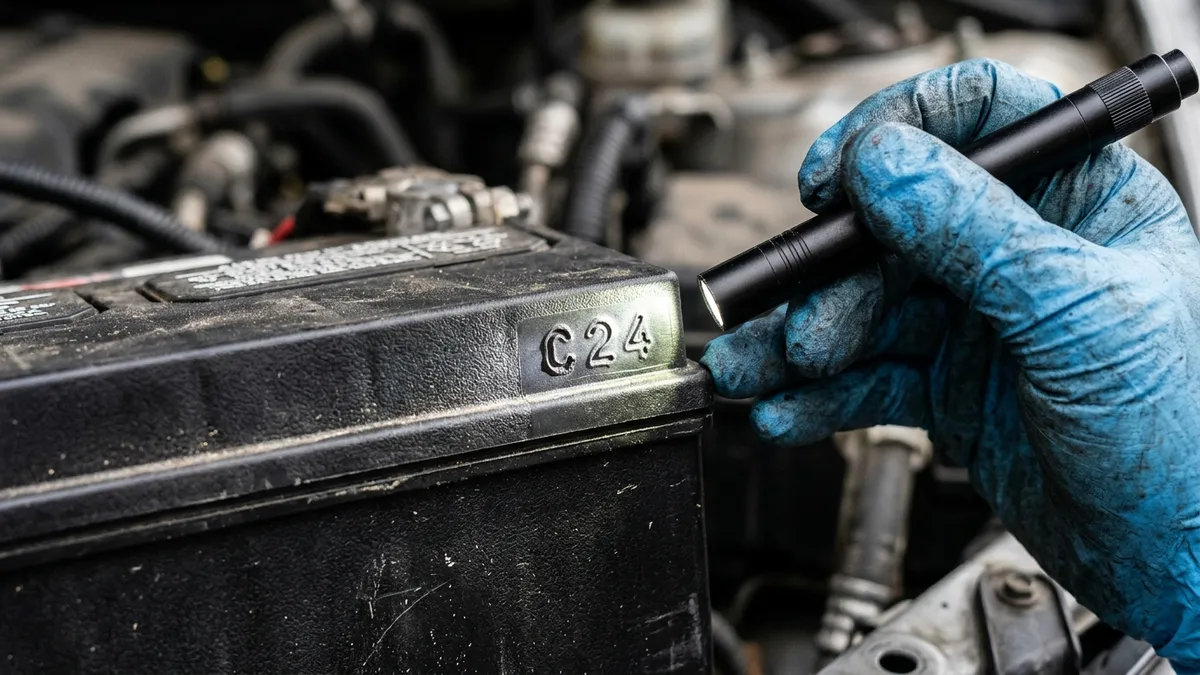
To tell how old a car battery is, inspect the two-character case stamp. You can also check the round top sticker. The letter denotes the month, such as A for January. The number denotes the production year, such as 4 for 2024. Together, these two characters identify the exact factory build date.
Follow these four direct steps to determine your battery age right now:
- Wipe road dirt off the top cover with a clean rag.
- Inspect the top cover for a round colored date sticker.
- Locate the alphanumeric code melted into the upper plastic case edge.
- Match the month letter and year digit against the reference chart.
Affiliate Disclosure: We earn commissions on qualifying purchases at zero added cost.
AstroAI Digital Multimeter
Reads resting battery voltage and alternator charging output on a clear digital screen.
Streamlight Stylus Pro LED Penlight
Compact aluminum flashlight casts oblique beam angles to make faint heat stamps readable.
Schumacher Terminal Cleaner Brush
Dual wire bristles scour oxidized lead posts and cable clamps clean of acid scale.
NOCO Battery Terminal Protector Spray
Oil-based aerosol coating seals battery posts against corrosive acid vapor leaks.
NOCO GENIUS5 Smart Battery Charger
Automated five-amp charger restores aged lead plates and monitors cell voltage levels.
OBD-II Computer Memory Saver Cable
Preserves electronic control module memory and idle settings during battery change procedures.
Where to Locate the Date Code: Stickers, Heat Stamps, and Terminal Posts
Car battery date codes appear in three distinct casing locations. First, check the round sticker on the top cover. Second, inspect the melted alphanumeric heat stamp along the upper rim. Third, examine the negative lead terminal post. European models stamp the production week and year directly into the lead metal.
Learning how to find car battery manufacture date codes saves garage time. Different battery manufacturers stamp dates in specific spots.
Top cover round stickers indicate retail stock arrival dates. Parts stores apply these labels when batteries reach regional warehouses. The sticker shows a simple code like 3/24 or C-4. These markings show when the battery arrived on store shelves.
Plastic case heat stamps show true factory build dates. Manufacturing plants melt alphanumeric codes into the plastic casing during assembly. This permanent mark sits along the top edge or upper corner. It never peels off like a paper label.
European vehicles use lead terminal stamps instead of paper labels. Original batteries in BMW, Mercedes-Benz, Audi, and Volkswagen feature post stamps. You will find two digits for the week and two for the year. A post stamped 24 22 indicates the twenty-fourth week of 2022.
Check our guide on how to check the life of a car battery. Combine visual age checks with meter testing.
How to Read Alphanumeric Date Codes: The Complete Month and Year Chart
Most car batteries use a standard two-character date code format. The first character denotes the production month. Letters run from A for January through L or M for December. The second character denotes the build year. The number reflects the final digit of the calendar year of assembly.
Knowing how to tell the manufacture date of a car battery requires charts. The Battery Council International sets common guidelines for battery date coding.
| Month Name | Standard Code (Clarios) | Skip-I Code (East Penn / Deka) | Numeric Month Format |
|---|---|---|---|
| January | A | A | 01 |
| February | B | B | 02 |
| March | C | C | 03 |
| April | D | D | 04 |
| May | E | E | 05 |
| June | F | F | 06 |
| July | G | G | 07 |
| August | H | H | 08 |
| September | I | J (Skips I) | 09 |
| October | J | K | 10 |
| November | K | L | 11 |
| December | L | M | 12 |
Battery formation charging sets the baseline chemistry inside each cell. Factory technicians fill raw lead plates with diluted sulfuric acid. Formation lines run electric current through the cells for up to forty hours. The factory brands the hot stamp into the case right after final quality inspection. This heat stamp records the exact moment active chemical life begins.
Year numbers match the final digit of the production year. A code with the digit 3 indicates 2023. A code with the digit 4 indicates 2024. Some makers use two full digits such as 24. A stamp reading D24 translates directly to April 2024.
If your battery shows low resting voltage, test plate health promptly. Check normal resting vs running car battery voltage specifications. Compare your readings before buying a new unit.
Brand Decoding Guide: Clarios, East Penn, Motorcraft, and OEM Formats
Battery date formats differ across major manufacturing brands. Clarios uses consecutive letters from A through L. East Penn skips the letter I to prevent confusion with numeral 1. Motorcraft reverses the layout entirely. Ford OEM batteries place the year digit before the month letter on the case.
Three primary manufacturers produce most car batteries sold in North America. Each manufacturer follows a distinct stamping standard.
Clarios builds batteries for Interstate, DieHard, AutoZone Duralast, and Walmart EverStart. Clarios uses standard letters from A to L for months. A stamp reading B4 indicates February 2024. Clarios also stamps longer eight-character lot codes on top covers. The first two characters still define the month and year.
East Penn produces Deka, NAPA, Duracell, and O’Reilly Super Start units. East Penn omits the letter I from their sequence. On an East Penn battery, J means September and M means December. Reading an East Penn battery with a generic chart causes an error.
Motorcraft supplies factory batteries for Ford and Lincoln vehicles. Motorcraft reverses the layout. It places the single-digit year first and the month letter second. A Motorcraft stamp reading 4K indicates 2024 and October. Many drivers mistake this reversed code for an invalid serial number.
| Battery Brand | Primary Manufacturer | Date Code Format | Example Code | Decoded Manufacture Date |
|---|---|---|---|---|
| Interstate | Clarios | Month Letter + Year Digit | C4 | March 2024 |
| Duralast (AutoZone) | Clarios | Month Letter + Year Digit | E3 | May 2023 |
| Deka / NAPA | East Penn | Month Letter (Skips I) + Year | J4 | September 2024 |
| Motorcraft (Ford) | Clarios / OEM | Year Digit + Month Letter | 4K | October 2024 |
| Optima AGM | Clarios | Julian Day + Year Digit | 1204 | Day 120 of 2024 (April 29) |
| European DIN (VARTA) | Clarios / Exide | Week Number + Year (WW/YY) | 18 23 | Week 18 of 2023 (May) |
Start-stop vehicles require AGM chemistry to support repeated cranking cycles. Internal plate design affects service life. Read our comparison of AGM vs lead-acid car battery models.
Manufacture Date vs Installation Sticker: Which Date Determines Chemical Battery Life?
The heat-stamped manufacture date determines true chemical battery life. Internal lead-acid degradation starts once electrolyte fills the casing at the factory. Round retail stickers show when a store received the unit. A battery sitting nine months on shelves develops plate sulfation before installation.
Drivers often confuse the retail punch sticker with the real factory date. Parts stores punch colored stickers when a battery enters local inventory. A technician may also punch the sale month for warranty tracking.
Chemical battery aging does not wait for a retail sale. Lead-acid batteries self-discharge about one to two percent every month on shelves. Hot summer temperatures double storage self-discharge speeds. When an uncharged battery sits six months, lead sulfate coats cell plates.
Retail stock rotation follows the first-in first-out principle in well-run shops. Careless retailers occasionally leave older stock at the back of inventory racks. A battery resting twelve months without charging develops stubborn hard sulfate crystals. Hard crystals resist normal alternator recharging. Always insist on a battery with a fresh stamp under ninety days old.
Always inspect the melted heat stamp before buying a replacement battery. Select a unit stamped within the past three months. Avoid buying batteries that rested on store shelves past six months. Degraded plates cause sudden non-starts. Check our guide on how to tell if car battery is going bad.
How to Spot the Decade: Telling a 2014 Battery from a 2024 Unit
Because most battery stamps use a single digit, 4 could mean 2014 or 2024. Separate decades by checking casing texture, terminal post weeping, and vehicle build records. Fresh batteries show dark, smooth plastic. Ten-year-old units show chalky white surface oxidation and dark, pitted terminal posts.
Drivers often ask how old is my car battery when buying vehicles. A stamp showing 3 could be a 2023 unit or a 2013 original. Use these physical inspection checks to confirm the correct decade.
Examine the black polypropylene case texture. Fresh plastic made recently retains a deep, dark shine with smooth seams. Ten-year-old plastic shows chalky white oxidation and heat fading. Engine bay heat cycles leave old plastic brittle.
Inspect the lead terminal posts. New battery terminals show bright grey metal with clear machining grooves. Ten-year-old posts show dark, pitted metal with sulfate rings around base seals. Acid leaking past post seals indicates an aged unit.
Battery label graphic redesigns offer another reliable clue for decade identification. Manufacturers refresh brand logos and color schemes every five to seven years. Interstate, Duralast, and DieHard updated top label layouts significantly between 2014 and 2024. Compare label artwork against current retail stock. This confirms whether your battery belongs to the current decade.
Check the driver door jamb certification label. The vehicle build date provides context for original equipment batteries. A 2015 car with a 5 stamp holds its original battery. Check our timeline on when should you change your car battery to schedule replacement.
Shop Trick: How to Read Faint Heat Stamps on Black Plastic Cases
Heat stamps melted into black polypropylene battery cases are often difficult to read. Rub white classroom chalk across the stamped numbers. Wipe surface dust away with a dry rag. The white chalk stays inside the indentations. Hold an LED flashlight at a low angle to read the markings.
Automotive technicians use this simple visual contrast trick every day. Stamped letters on black plastic reflect the same light as surrounding case walls. Under overhead shop lights, indented characters disappear completely.
Take a stick of white classroom chalk. Rub it firmly across the stamped area. Powder settles deep inside the melted character grooves. Wipe your thumb lightly across the surface. The flat plastic turns black again while chalk remains inside the stamp.
Hold a penlight at a low fifteen-degree angle across the cover. Grazing light casts sharp shadows behind stamped edges. The combination of chalk fill and low shadows makes faint codes clear.
Parasitic drains kill batteries overnight. Follow our guide on what drains car battery when off.
Choosing the Correct Replacement Battery: Group Size and Voltage Checks
When your battery date code reveals four years of service, test charging voltage promptly. You must also confirm correct replacement fitment. Installing an undersized battery strains lead plates during engine starts. Installing an incorrect terminal configuration creates direct short circuits against chassis ground. Always verify physical group size and cold cranking amp ratings before buying.
A battery date code shows when replacement time approaches. Before purchasing a unit, verify your vehicle group size requirements. Explore our car battery size database. Confirm exact battery dimensions, terminal layout, and cold cranking amps.
Check battery sizes for 2020 Toyota Camry or 2020 Ford F-150. Testing battery voltage at home is easy with hand tools. Learn how to take DC measurements. Read our guide on how to test car battery with multimeter tools.
If your engine refuses to crank, isolate the charging circuit. Review our troubleshooting breakdown on dead battery vs bad alternator symptoms. If weak voltage triggered trouble codes, consult our master OBD2 repair cost database. Follow our steps on how to remove a car battery. Learn safe tips on how to install a car battery.
Frequently Asked Questions: How Old Is My Car Battery?
How can I tell the exact age of my car battery without a receipt?
Inspect the plastic case for an engraved alphanumeric code near the top rim. The letter denotes the production month, where A is January and B is February. The number denotes the year. A code reading C23 indicates production in March 2023.
Does the round sticker on a car battery show the expiration date?
No, car batteries do not have expiration dates. The round colored sticker indicates when the battery arrived at the store. Internal chemical wear and driving conditions determine battery life instead of an arbitrary date.
Why do some car batteries skip the letter I in the date code?
East Penn and Exide skip the letter I. This avoids confusion with numeral 1. On these batteries, the letter J denotes September and M denotes December. Clarios batteries continue through L without skipping any letters.
How long can a car battery sit on a store shelf before going bad?
Car batteries should not sit in stores past six months without a maintenance charge. Lead plates self-discharge over time. Batteries sitting uncharged for nine months suffer from plate sulfation. Sulfation cuts useful service life.
Where is the date code located on European AGM car batteries?
European batteries on brands like BMW stamp the date on the negative terminal post. Look for four digits stamped into the lead top. The first two digits indicate the week. The last two digits show the year.