What Drains Car Battery When Off: 7 Causes & DIY Draw Test

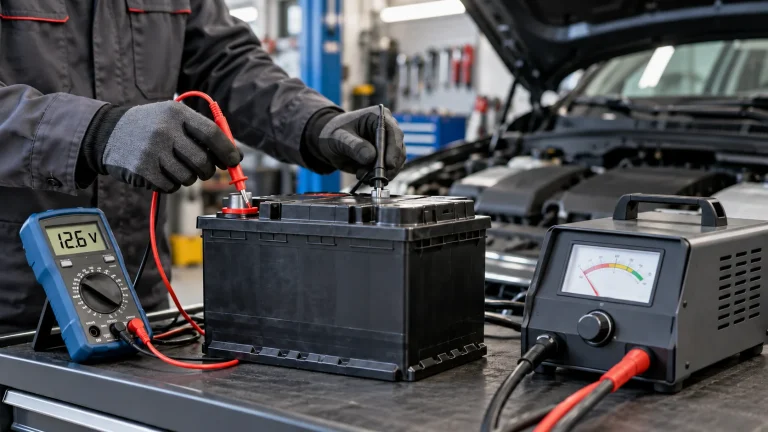
A car battery that dies while parked may have an unwanted electrical load, called a parasitic draw. Check battery health and charging first. After the vehicle sleeps, under 50 milliamps is a useful general guide; over 100 milliamps deserves investigation. Always check the limit for your vehicle. Fluke explains these starting points.
Normal vs Abnormal Parasitic Battery Drain: Know Your Numbers
There is no single normal draw for every car. As a general guide, a sleeping vehicle below 50 milliamps is usually normal, while a steady draw above 100 milliamps needs investigation. Some vehicles have different factory limits and sleep cycles. Confirm the value in the service information for your model.
Checking the vehicle-specific limit prevents needless battery purchases. Every car pulls a tiny baseline current when parked. Automotive engineers call this baseline dark current. Remote entry receivers, clock memory, and engine modules require this small flow. Trouble starts when a stuck part draws heavy power past factory limits.
Dark Current Benchmarks: Pre-2010 vs Modern Connected Vehicles
Vehicle wiring changed rapidly over the past twenty years. Older cars with simple wiring draw almost zero current when parked. Many older cars have fewer standby electronics. Their resting current may be lower, but model year alone cannot establish a safe limit. Look up the specification for the exact vehicle.
Modern vehicles run dozens of networked computers. Cellular antennas, alarm sensors, remote key receivers, and tire monitors stay active on standby. A modern pickup or luxury sedan can have several standby loads. Its acceptable current depends on equipment, battery condition, and the manufacturer’s specification.
These are general screening values from Fluke’s parked-current guidance. A vehicle service manual takes priority.
| Current after sleep. | How to interpret it. |
|---|---|
| Under 50 mA. | Usually normal as a general guide; check the vehicle specification. |
| 50 to 100 mA. | Compare with the vehicle’s service limit and battery condition. |
| Over 100 mA. | Suspect an unwanted load if the reading stays high after the sleep period. |
A steady draw above 100 milliamps is a useful warning sign. Repeated deep discharge can shorten battery life, especially if the battery is already weak.
Battery Reserve Capacity Drain Math: 50mA vs 500mA Failure Timeline
Car batteries store electrical energy measured in amp-hours and reserve capacity. Battery capacity varies by model and condition. Use a 60 amp-hour battery as an example, then estimate how much a parked load consumes. The calculation cannot predict the exact day an engine will fail to start.
A 50 milliamp draw uses 1.2 amp-hours each day. In this example, it uses 30 amp-hours in 25 days, or half the battery’s nominal 60 amp-hour capacity. Starting ability can fade earlier in cold weather.
A 500 milliamp load uses 12 amp-hours each day. It uses 30 amp-hours in 60 hours on the example 60 amp-hour battery. Actual resting voltage and starting ability depend on battery health, temperature, and initial charge.
See how long a battery lasts powering accessories. That guide shows how standby loads deplete lead plates. Voltage drops quickly cause symptoms of a weak car battery during starts.
This is example arithmetic for a 60 Ah battery starting full. Using 30 Ah equals half its nominal capacity. It does not predict a guaranteed no-start date.
| Constant draw. | Amp-hours used per day. | Time to use 30 Ah. |
|---|---|---|
| 50 mA. | 1.2 Ah. | 25 days. |
| 100 mA. | 2.4 Ah. | 12.5 days. |
| 500 mA. | 12 Ah. | 2.5 days. |
7 Possible Causes of Battery Drain While Parked
These seven causes are useful places to check when a car battery dies while parked. Common culprits include misaligned interior switches and stuck cooling fan relays. Blown alternator diodes and aftermarket dashcams also cause drain. Sleepless computer networks and dirty battery cases pull constant power. Nearby smart key fobs also keep vehicle systems awake.
1. Misaligned Glovebox, Trunk, and Vanity Mirror Switches
Mechanical contact switches fail often inside passenger cabins. Glove boxes, center consoles, and rear hatches use small push buttons. Over time, plastic door bumpers crack or fall off.
The door looks shut from outside. Inside the compartment, the switch pin stays open. A 5-watt bulb draws about 420 milliamps at 12 volts. Left on for 36 hours, it uses about 15 amp-hours. A weak battery may then struggle to start the car.
Test these switches with a smartphone camera. Start video recording on your phone. Place the phone inside the glove box. Close the door completely. Open the door and check the video to see if the bulb turned off.
2. Welded A/C Compressor Clutch and Cooling Fan Relays
Mechanical relays control heavy electrical parts under the car hood. Relays switch electric cooling fans and air conditioning compressor clutch coils. Each time a relay opens, inductive sparks create electrical arcs across internal contacts.
Electrical arcs melt copper contact pads over time. The relay contacts weld shut. The air conditioning clutch or cooling fan stays powered with the key out.
A stuck relay can leave a fan or clutch powered after shutdown. Current varies by vehicle and component. Listen for a running fan after parking and check the circuit with a meter. Do not touch moving or hot engine parts.
3. Blown Alternator Rectifier Diodes Leaking Reverse Current
Alternator rectifier bridges change alternating current into direct current. Six silicon diodes act as one-way electrical valves. Healthy diodes allow current to flow only toward the battery.
Voltage spikes or extreme heat can short out an alternator diode. A shorted diode lets electrical current flow backward through the windings to ground. The size of the reverse leak varies with the failure.
A bad diode may drain the battery while parked, with or without a charging warning light. A charging-system test helps confirm the fault. A bad alternator can cause situations where your battery dies while driving under heavy load. Understanding whether a car can run without a battery explains how alternator diodes regulate voltage. Test diode ripple voltage with a multimeter set to AC millivolts while the engine idles.
4. Hardwired Dashcams and Low-Voltage Cutoff Failures
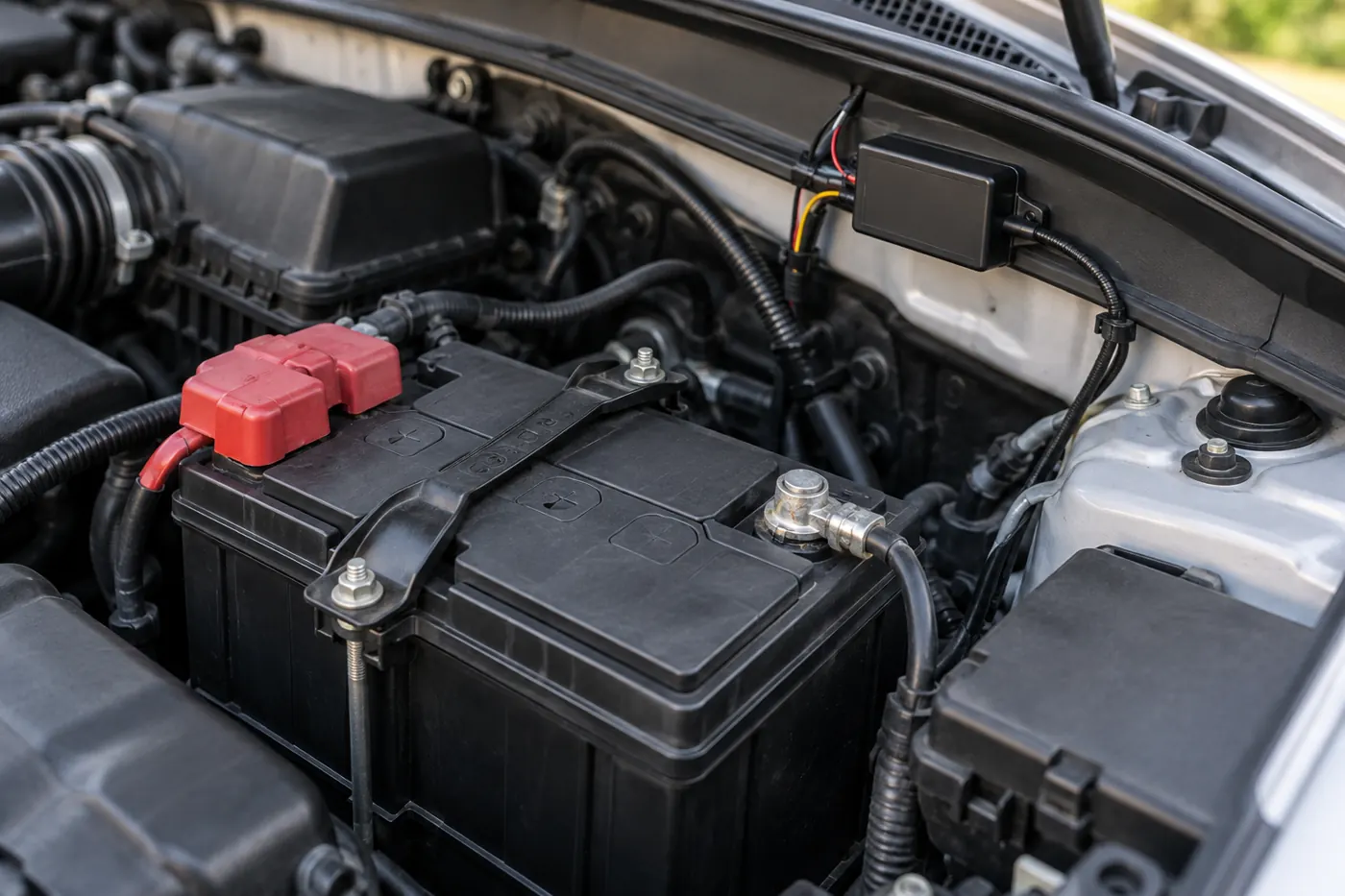
Aftermarket cameras protect parked cars through parking surveillance modes. Installers wire these devices into unswitched fuse slots. Dashcams rely on low-voltage cutoff boxes to protect the battery.
A low cutoff setting can leave too little charge for the next start. Check the dashcam and battery maker’s guidance before choosing a threshold. As one example, ODYSSEY recommends recharging its battery before 12.2 volts, about half charge under its stated conditions.
A 250 milliamp camera uses 6 amp-hours in a day. Cold weather or a weak battery may make that enough to cause a no-start. Set the cutoff using the battery and dashcam manuals.
5. Sleepless CAN Bus Networks and Body Control Modules
Modern vehicles link dozens of computers using the CAN bus communication network. Once you remove the key, onboard computers run shut-down routines. Modules can take 10 to 45 minutes or longer to sleep, depending on the vehicle.
A single bad sensor keeps the whole network awake. Broken door switches, aftermarket alarm trackers, or wet seat modules send digital pulses across the bus.
An awake module can draw far more than its sleep current. A technician can use a scan tool and wiring diagram to find which module remains active. A reset alone does not repair a failed switch or wiring fault.
6. Conductive Case Dirt and Battery Acid Surface Tracking
Car batteries collect road grime, oil mist, and battery acid across the plastic top cover. That dirty film creates a conductive bridge across the terminals.
Current leaks from the positive post across the dirty case to the negative post or metal hold-down clamp. The grime layer conducts current outside the internal cells.
Keep the battery top clean and dry. Interstate Batteries advises cleaning heavy dirt and oil from the case because surface contamination can speed discharge. Wear eye and hand protection, avoid bridging the terminals with a tool, and follow the battery maker’s cleaning steps.
7. Key Fob Proximity Pinging and Sleeping Transceivers
Modern smart key systems use radio transceivers inside the cabin and door handles. Key detection range varies by vehicle. Some systems wake modules when a paired key is close enough to communicate.
Storing key fobs near garage walls or front doors creates continuous communication loops. The vehicle repeatedly queries the smart key. This keeps internal computers awake.
If the problem appears only when a key stays near the car, move it farther away and repeat the sleep-current test. Check the vehicle manual for its key detection behavior. Do not assume a fixed distance works for every model.
Step-by-Step DIY Parasitic Draw Test: The Voltage Drop Method
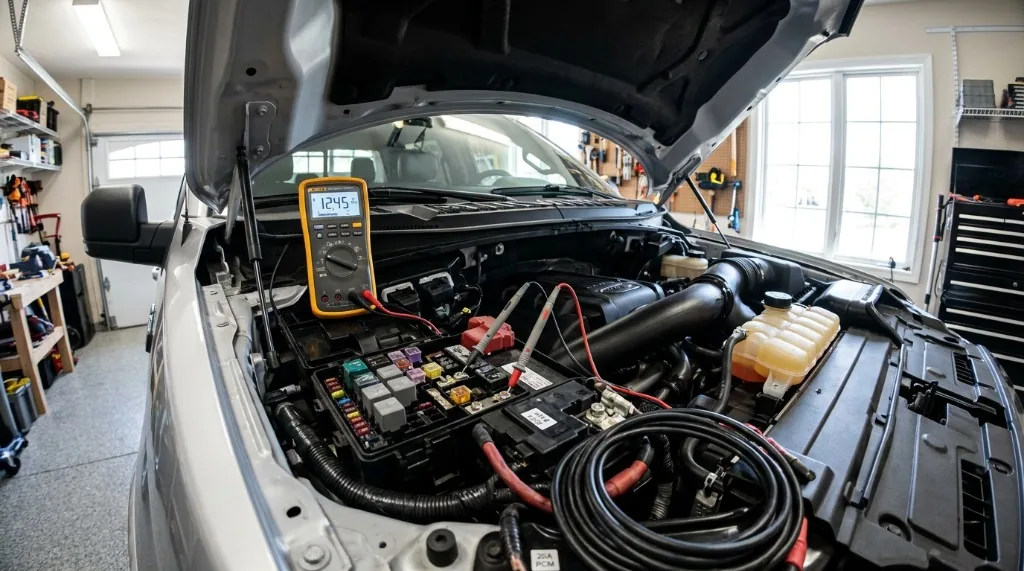
Use DC millivolts across the two exposed test pins of one installed fuse to find current in that circuit. This method avoids removing fuses while modules sleep. A nonzero reading only shows current flow; it does not prove a fault. Convert it with the correct fuse chart, then compare with the vehicle’s normal sleep current.
Why Pulling Fuses Corrupts CAN Bus Sleep on Modern Vehicles
Older repair books told drivers to pull fuses one by one. That old method ruins electrical testing on modern cars.
Removing a fuse can wake a sleeping module when power returns. Some vehicles then need another sleep cycle before readings settle. The wait can be up to 45 minutes, but follow the model’s service procedure.
Professional technicians measure voltage drop across fuse test pins. Every blade fuse has fixed internal electrical resistance. Any current flowing through the fuse creates a measurable millivolt drop. Use a digital multimeter instead of a test light. A digital meter isolates faults without waking car modules.
Step 1: Latch Access and Vehicle Sleep Preparation
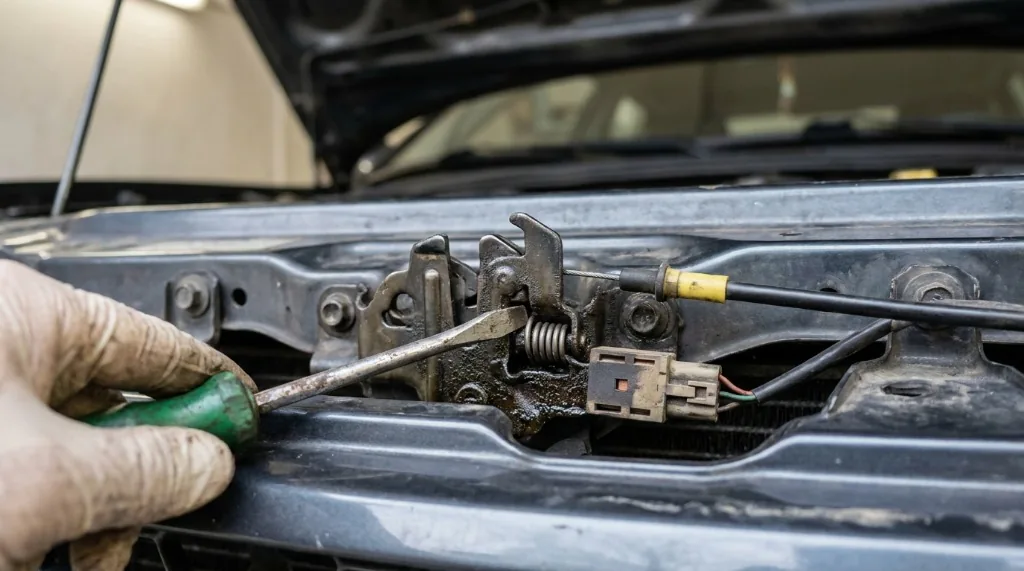
Many vehicles monitor door and hood latches. If access to a fuse panel holds a switch open, follow the service manual’s latch procedure. Keep the key off and the vehicle parked. Never close a hood or door onto a manually latched catch.
- Park your vehicle on flat ground and turn off the engine.
- Open the vehicle hood to access the main engine fuse box.
- Find the metal hood latch mounted on the front radiator core support.
- If the service manual calls for a hood-latch bypass, use its exact procedure. Keep fingers clear of the catch and mark the hood as open so nobody tries to close it.
- Open the driver door if needed for the cabin fuse panel. Bypass its latch only if the vehicle manual directs you to do so.
- Move the smart key fob well outside the vehicle’s detection range.
- Lock the vehicle doors using the power lock switch.
- Wait for the sleep period specified for your vehicle without touching handles or controls. Some vehicles need up to 45 minutes.
Step 2: Multimeter Setup and Millivolt Fuse Pin Testing
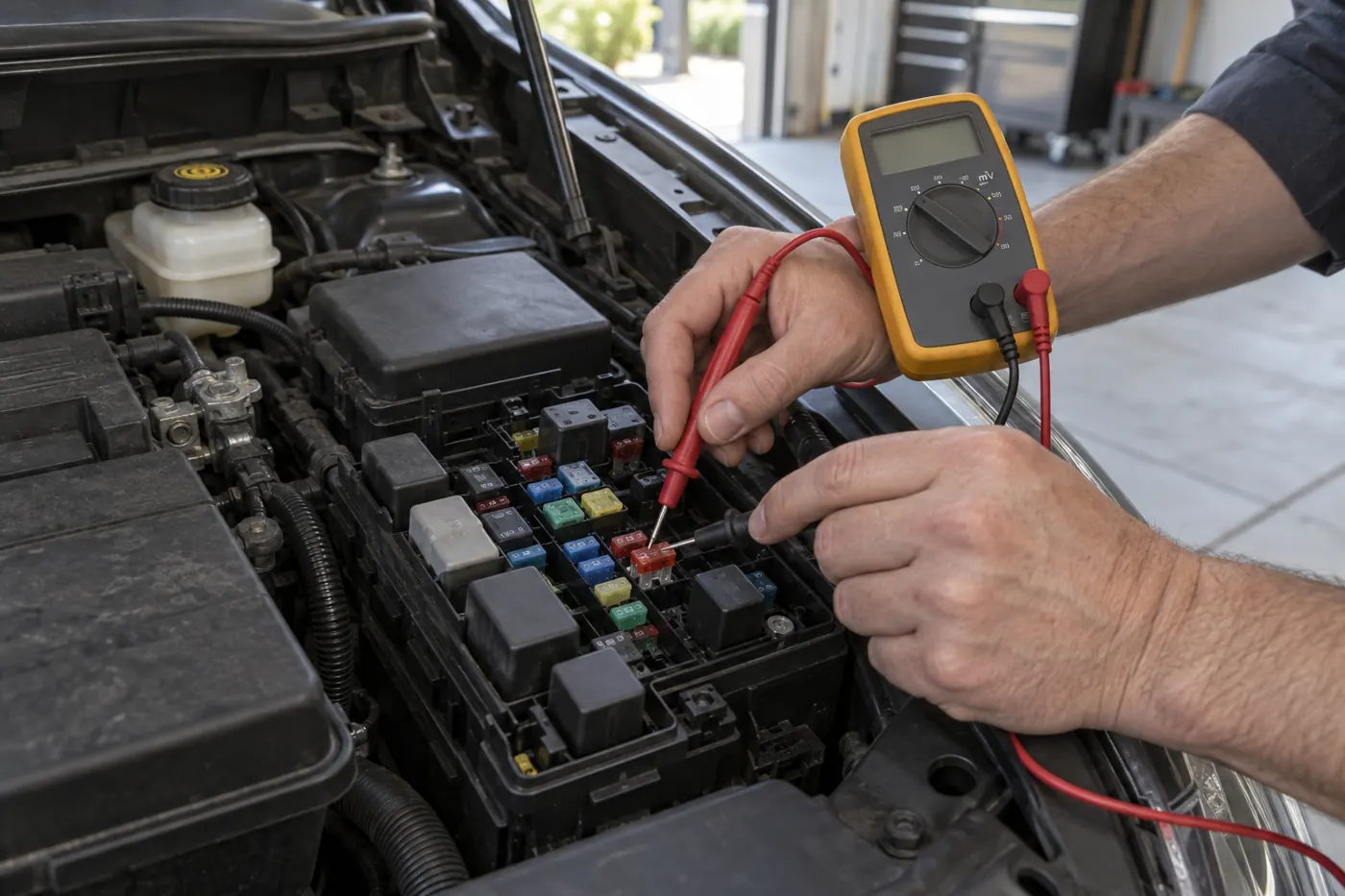
Standard car blade fuses have two metal test pins on top of the plastic housing.
- Turn your digital multimeter dial to DC millivolts.
- Plug standard pointed test probes into the meter jacks.
- Check that the meter shows 0.0 millivolts before testing.
- Press the black probe against one test pin on top of the fuse.
- Press the red probe against the second test pin on the same fuse.
- Read the meter screen. A 0.0 millivolt display means no current was detected at the meter’s resolution; it does not prove that the circuit draws nothing.
- Test each fuse across the underhood and cabin fuse panels in order.
- Record the fuse number, type, rating, and any stable voltage drop your meter can resolve.
Step 3: Millivolt-to-Milliamp Conversion and Circuit Isolation
A millivolt reading shows current through that fuse. Convert it with a chart matching the fuse type and rating. The figures below are approximate examples from the Power Probe fuse voltage drop chart. A fused circuit can carry a normal standby load; confirm total draw before diagnosing a fault.
| Fuse Amperage Rating. | Standard Fuse Plastic Color. | Mini Blade Fuse (mA per 1.0 mV). | Standard ATO Blade Fuse (mA per 1.0 mV). | Maxi Blade Fuse (mA per 1.0 mV). |
|---|---|---|---|---|
| 5 Amp Fuse. | Light Tan Housing. | 65 mA. | 70 mA. | Not Applicable. |
| 7.5 Amp Fuse. | Brown Housing. | 95 mA. | 100 mA. | Not Applicable. |
| 10 Amp Fuse. | Bright Red Housing. | 135 mA. | 140 mA. | Not Applicable. |
| 15 Amp Fuse. | Vibrant Blue Housing. | 215 mA. | 225 mA. | Not Applicable. |
| 20 Amp Fuse. | Bright Yellow Housing. | 305 mA. | 315 mA. | 135 mA. |
| 25 Amp Fuse. | Clear White Housing. | 390 mA. | 410 mA. | Not Applicable. |
| 30 Amp Fuse. | Light Green Housing. | 490 mA. | 510 mA. | 225 mA. |
For example, a standard 10-amp red fuse with 2.0 millivolts across it indicates about 280 milliamps on this chart. That is circuit current, not proof of a parasitic fault. Check your owner manual fuse diagram to see which parts share that circuit. Use the automotive diagnostic process to confirm the circuit before replacing a part.
Before closing a hood or door, release any latch you moved by hand. Check that it operates normally. If you cannot restore the latch safely, stop and consult a technician.
When to Call an Automotive Electrical Specialist
Hire an automotive diagnostic technician when multiple modules stay awake. Call a shop if draw traces into a main wiring bundle. Complex network faults and body module errors require factory scan tools. Some wiring faults need factory diagrams and specialist test equipment. A technician can choose the right test before removing interior panels.
Seek professional workshop help under these specific conditions:
- Current draw traces to a 60-amp to 120-amp main fuse feeding multiple distribution blocks.
- Oscilloscope tests display continuous digital packet noise on CAN data lines while parked.
- Battery drain appears unpredictably every few days without clear electrical patterns.
- Sunroof drain leaks or windshield seals have soaked body control modules with standing water.
Diagnostic rates vary by shop and location. Bringing recorded fuse readings and the vehicle’s service history can help a technician isolate the fault faster.
Frequently Asked Questions About Overnight Battery Drain
What is a normal parasitic draw on a car battery?
After the car enters sleep mode, under 50 milliamps is a useful general guide. A steady draw above 100 milliamps deserves investigation. The exact acceptable value depends on the vehicle, its equipment, and the maker’s service specification.
How do you find what is draining a car battery?
Find battery drain by measuring millivolt drop across fuse pins. Use a digital multimeter on DC millivolts. Wait 45 minutes for computerized modules to enter sleep mode. Probe the two metal test pins on each fuse. A nonzero reading indicates current through that circuit. Use the correct fuse chart and the vehicle’s total draw specification to decide whether it is abnormal.
Can an alternator drain a car battery when the car is off?
Yes, a faulty alternator can drain a car battery when parked. A shorted rectifier diode leaks current backward through the alternator. Power drains to ground with the engine off. The amount of current and any warning-light behavior vary by failure. A charging-system and parked-current test can confirm the cause.
Will a blown fuse cause a parasitic battery drain?
No, a blown fuse cannot cause a parasitic battery drain. A blown fuse opens the circuit and stops electrical current from flowing completely. Parasitic draws occur when stuck relays or sleepless computers keep circuits powered. Short circuits also cause drain. These faults pull power when circuits should shut off.
How long does it take for a 100mA draw to drain a battery?
A steady 100 milliamp draw uses 2.4 amp-hours a day. It uses 30 amp-hours, half of an example 60 amp-hour battery, in about 12.5 days. The car may fail to start sooner or later depending on battery health, temperature, and starting requirements.
Can a bad car battery drain itself without an electrical draw?
Yes, automotive batteries experience natural internal self-discharge. Old electrolyte fluid or lead plate shedding creates internal short circuits within battery cells. Self-discharge varies with battery design, age, and temperature. A damaged battery can lose charge much faster. If parked-current testing is normal, charge and test the battery itself.