Can a Weak Battery Cause Rough Running? (The 5-Minute Test)


Yes, a weak battery causes rough running, poor idle, and engine misfires in modern cars. Alternators only make 30 to 40 percent of their full power at low idle speeds. Turning on lights, fans, or A/C draws extra power. That load tops what the alternator can make. Your car must draw extra power from the battery.
I have fixed cars for fifteen years as an ASE Master Technician. Drivers often ask me why their car shakes at red lights. The car runs fine on the highway. The answer comes down to car electronics. Modern engine computers need steady voltage to fire spark plugs and meter fuel. When a battery loses power, system voltage drops. This voltage drop starves fuel injectors and ignition coils. This leads to engine misfires.
The Alternator Myth: Why Weak Batteries Starve Engines at Red Lights
A common myth claims car batteries only start the car and do nothing once the motor runs. In reality, the alternator only generates 35 to 45 amps at low idle speeds. When headlights, cooling fans, and A/C run together, total demand exceeds alternator output, forcing the vehicle to draw reserve power from the battery.
Alternator power links directly to engine speed. On the highway at 2,000 RPM, a 130-amp alternator spins fast and makes full power. When you stop at a red light, engine speed drops to 650 RPM. At this low speed, that same unit only makes 35 to 45 amps.
| Vehicle Class & Alternator | Idle Power (650 RPM) | Cruise Power (2,000 RPM) | Accessory Load (A/C, Fans) | Idle Battery Load |
|---|---|---|---|---|
| Small Sedan (100A) | 32 Amps | 98 Amps | 46 Amps | -14 Amps (From Battery) |
| Midsize SUV (130A) | 42 Amps | 128 Amps | 58 Amps | -16 Amps (From Battery) |
| Full-Size Truck (160A) | 55 Amps | 158 Amps | 72 Amps | -17 Amps (From Battery) |
| Heavy Duty Diesel (220A) | 85 Amps | 215 Amps | 95 Amps | -10 Amps (From Battery) |
Modern cars place big power demands on the battery. Headlights draw ten amps. Cabin blower fans pull fifteen amps. Radiator cooling fans pull twenty-five amps. Heated seats add thirty more amps. If your battery is worn out, voltage quickly drops from 14.2 volts down to 11.8 volts. Does your battery go flat while parked? Test key-off power draw with our car battery drain calculator.
How Voltage Drops Trigger Fuel Starvation and Cylinder Misfires
Voltage drops cause engine misfires because low voltage slows down fuel injector opening speeds and weakens ignition coil spark power. When system voltage drops below twelve volts, fuel injectors take 0.40 milliseconds longer to pop open. This delay cuts delivered fuel mass by fifteen to twenty-five percent, causing lean cylinder misfires.
Fuel injectors use small electric coils to open internal valves. At 14.0 volts, this action takes 0.85 milliseconds. When voltage falls to 11.5 volts, that same motion takes 1.25 milliseconds. Mechanics call that 0.40 millisecond lag injector dead time.
At low idle speed, fuel spray time lasts only two to three milliseconds. Losing nearly half a millisecond cuts fuel flow by fifteen to twenty-five percent. This cuts fuel flow and leans out the fuel mix. The cylinder starves for gas. The plug fails to light the lean mix. The engine shakes with a misfire code (P0300).
Ignition coils suffer from this same power loss. Modern coils need three milliseconds to build strong spark power. Dropping supply voltage weakens the spark. Instead of a hot blue spark, the coil makes a weak yellow spark. That weak spark cannot light compressed gas at idle. Learn how long parts pull power before voltage drops in our guide on how long a car battery lasts with the radio on.
Dirty Voltage Ripple: How Bad Battery Cells Corrupt Engine Sensors
A healthy car battery acts like a massive electrical shock absorber that filters out raw AC voltage ripple from the alternator. When internal battery plates wear out or dry up, the battery loses this filtering power. Unfiltered AC electrical noise bleeds across sensitive five-volt sensor lines, corrupting throttle and airflow signals.
Alternators make alternating current (AC) through spinning wire coils. A diode pack turns this AC power into direct current (DC). However, this change never makes pure DC power. It leaves a small wave of ripple voltage.
A good car battery works like a sponge. It soaks up voltage spikes and keeps power clean. When lead plates dry out, internal resistance climbs. The battery stops soaking up electric ripple. This raw AC noise spills into vehicle wiring.
The engine computer runs sensors using a steady five-volt wire feed. Sensors like the Throttle Position Sensor (TPS) and Mass Airflow (MAF) need clean voltage to read airflow and pedal angle. When voltage ripple bleeds into sensor ground wires, readings jump around. The computer misreads these noisy inputs. It shifts fuel mix and spark timing back and forth. This sensor confusion makes the engine hunt for idle and shake. Never pull a battery cable off a running engine to test this; see why can a car run without a battery causes costly alternator diode damage.
The 5-Minute Multimeter Test: Bad Battery, Alternator, or Vacuum Leak?
You can diagnose an electrical rough idle in five minutes using a basic voltmeter set to DC and AC volts. By testing resting battery voltage, cranking voltage sag, alternator idle charging output, and AC ripple voltage, you can instantly separate a dying battery from a blown alternator diode or vacuum leak.
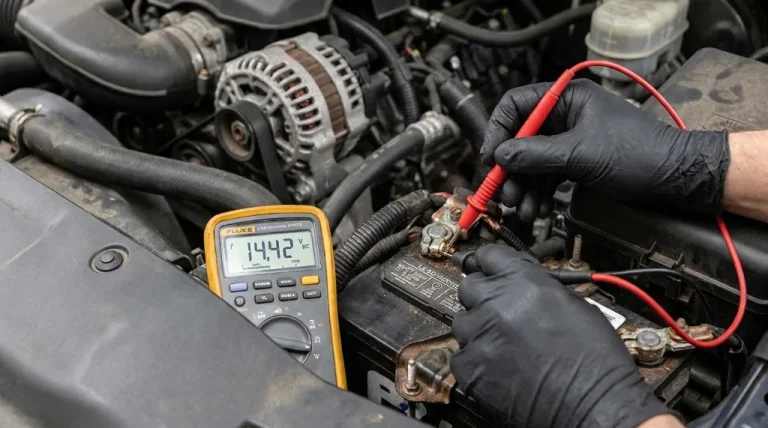
Set your voltmeter (DMM) to DC volts and run these four test steps on your battery posts:
- Test resting voltage across the posts with the engine off. A full battery shows 12.60 to 12.65 volts. A reading under 12.20 volts points to a discharged battery with low reserve life.
- Watch the meter screen while a friend turns the key. Cranking voltage must stay above 9.60 volts. If voltage falls below nine volts while cranking, worn lead plates have ruined starting power.
- Start the engine, turn on lights and A/C, and test voltage at idle. A good system holds between 13.80 and 14.50 volts. If idle voltage falls below 12.80 volts with loads on, your alternator cannot keep up.
- Turn your meter dial to AC millivolts with the engine running under load. A good alternator diode pack reads under 0.050 volts AC (fifty millivolts). A reading above 0.100 volts AC shows a bad diode leaking AC noise into sensor wires, which confuses the computer and creates rough idle shaking.
| Drive Problem | Idle Charging Voltage | Cranking Voltage Drop | AC Ripple Voltage | Fuel Trim Response |
|---|---|---|---|---|
| Bad Battery | Normal (13.8V to 14.4V) | Big Drop (< 9.5V) | Normal (< 0.05V AC) | Normal (+/- 5%) |
| Bad Alternator Diode | Low at Idle (< 12.8V) | Normal (> 10.0V) | High (> 0.10V AC) | Jumps (+/- 15%) |
| Vacuum Leak | Normal (14.2V) | Normal (> 10.5V) | Normal (< 0.03V AC) | High Lean (+18% to +25%) |
| Dirty Throttle Body | Normal (14.1V) | Normal (> 10.5V) | Normal (< 0.03V AC) | Normal or Rich |
| Bad Ground Strap | Normal at Battery, Low at Block | Slow Crank | Small Voltage Spike | Random Sensor Codes |
Battery size and lead plate weight shape how well a battery holds up to heavy loads. Read how much a car battery weighs to see how lead mass impacts battery life. When checking ground straps or wheel sensors under the car, verify bolt torque with our lug nut torque chart. If voltage drops while driving on the road, review our steps for battery dies while driving symptoms.
Throttle Relearn: How to Fix Rough Idle After Installing a New Battery
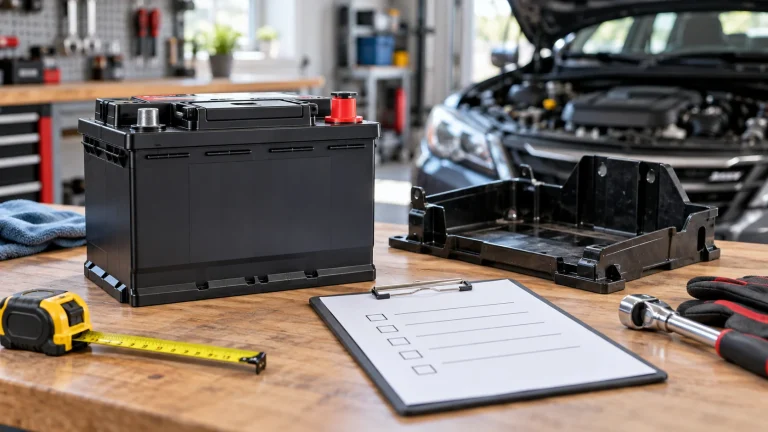
Unhooking an old battery erases the engine computer volatile memory, wiping out learned throttle body airflow values. Over years of driving, the computer slowly opens the throttle plate to bypass carbon buildup. Installing a new battery resets these learned settings to factory zero, causing severe engine shaking until you complete a throttle relearn.
Modern electronic throttle bodies do not use throttle cables. A small electric motor moves the throttle plate based on gas pedal signals. When you unplug battery power, the engine computer forgets how much carbon blocks the throttle bore.
When you start the car with a new battery, the computer sets the throttle plate to factory stock angles. With carbon blocking bypass air, the engine starves for air. Idle speed drops to 450 RPM and the car shakes. You can run an electronic throttle relearn in your driveway without shop tools:
- Turn the key to the ON position without starting the engine, and leave it on for sixty seconds. Listen for faint clicking under the hood as the throttle plate checks travel limits.
- Turn the key off and remove it for thirty seconds so the computer saves baseline stops to memory.
- Start the engine without touching the gas pedal. Keep all A/C, fans, and radio units off.
- Let the engine idle in park for ten minutes until the engine reaches full operating heat (190 degrees Fahrenheit).
- Turn on the A/C for five minutes so the computer learns idle steps under load.
During routine tune-ups and electric checks, verify engine oil specs with our engine oil capacity guide. Before heading out on long trips after replacing parts, plan your fuel stops with our road trip cost calculator. To reset car electronics safely without unplugging cables, follow our guide to reset a car computer without disconnecting battery cables.
Frequently Asked Questions: Weak Batteries and Engine Driveability
Can a weak battery cause engine misfires while driving on the highway?
No, a weak battery rarely causes misfires at highway speeds. At high engine RPM, the alternator spins fast and makes full power to hold fourteen volts. Misfires from weak batteries happen at low idle. At idle, alternator output drops below car power demand.
Why does my engine shake only when the air conditioner turns on?
The A/C system puts two big electric loads on your car: the compressor clutch and the electric radiator fans. Together, they pull thirty to forty amps. At idle, this load pulls voltage down if an old battery is weak. That starves your ignition coils.
Will replacing my weak battery fix a rough idle immediately?
Yes, if low voltage was starving your fuel injectors or coils. However, if your car has carbon buildup in the throttle body, unhooking the battery resets learned idle settings. You must run a five-minute electronic throttle relearn so the computer adapts to carbon buildup.
Can corroded battery terminals cause the engine to run rough?
Yes, corroded battery terminals add electric resistance to the charging path. Even if the battery holds a charge inside, dirty contact points drop voltage between the battery posts and cable clamps. This voltage drop mimics a bad battery, starving engine sensors and fuel injectors of steady current.