How to Maintain Your Pool’s Water Level: The Definitive Step-by-Step Guide

The first thing I check every morning isn’t the pH or the chlorine. It’s the water level. After owning a pool for over ten years in the American Southwest, I’ve found that one glance at the skimmer tells me more about what’s going on than any test strip. This guide walks through the whole process so you can manage your water level with the same confidence.
Key Takeaways
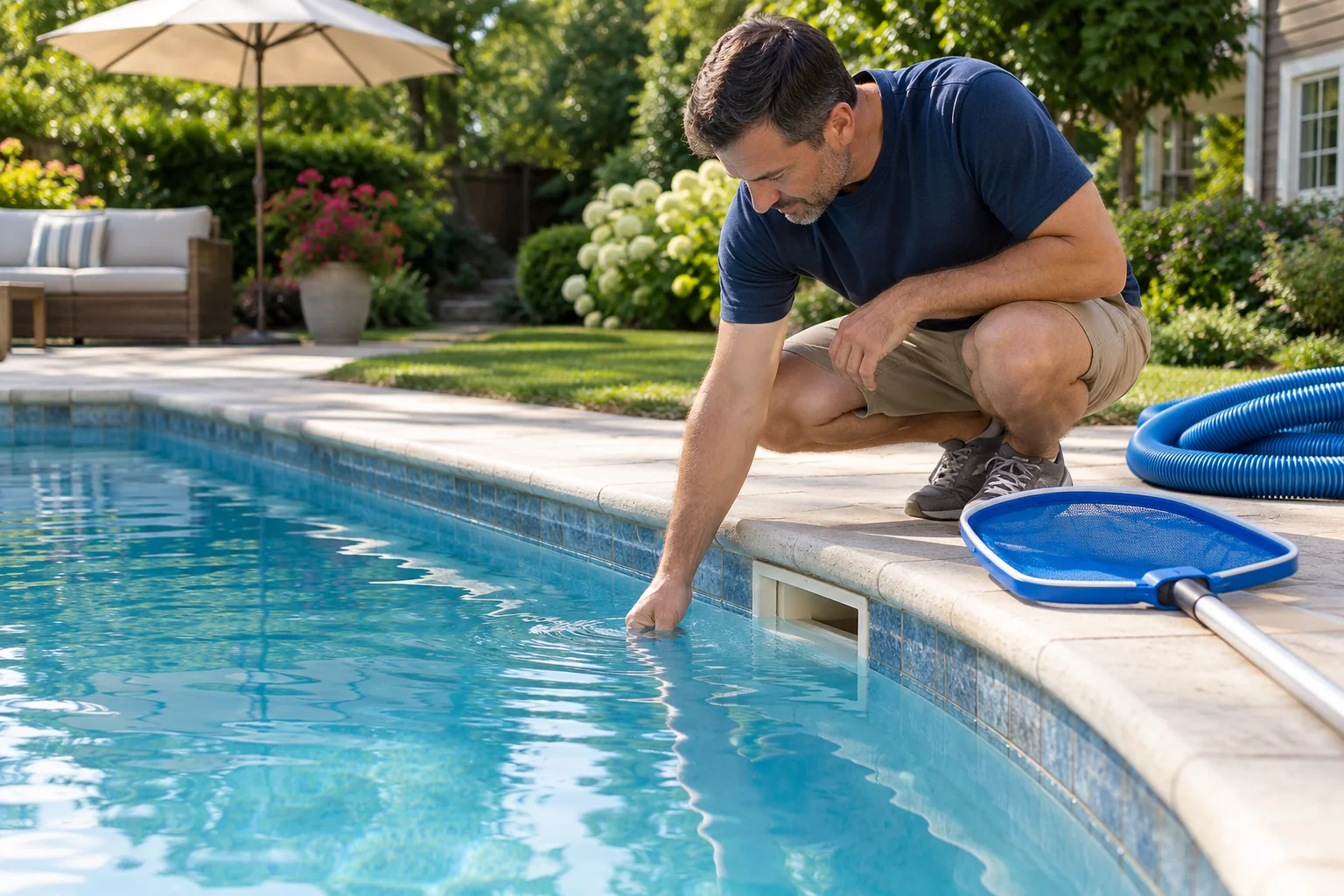
- Ideal Level: Water should sit at the midpoint of the skimmer opening, covering one-third to one-half of the skimmer throat.
- Low Water Risk: A level that drops too low lets the pump suck air, causing it to lose prime and overheat within minutes.
- High Water Risk: A level that runs too high kills skimmer suction, leaving debris floating freely in your pool.
- Key Test: The bucket test is the only reliable way to tell whether you have a leak or normal evaporation.
- Best Prevention: A pool cover cuts evaporation by up to 95%, keeping your level stable with very little effort.
Why Does Pool Water Level Actually Matter?
Your pool’s water level directly controls whether the pump stays protected, the skimmer cleans effectively, and your chemicals hold their balance. Get the level wrong in either direction and you’re dealing with equipment damage, cloudy water, or a chemistry problem that takes days to sort out. Here’s what each failure looks like.
It Keeps Your Pool Equipment from Getting Damaged
The pool circulation system works as one connected loop: the skimmer draws surface water in, the pump pushes it through the filter, and the return jets send it back. The pump is the heart of that loop, and it depends on a steady water supply from the skimmer. When the level drops too low, the skimmer starts pulling air along with water. Once air gets into the pump, it loses prime and runs dry.
Running dry is genuinely bad. The pump impeller and seals need water moving through them to stay cool and lubricated. Without it, heat builds up fast. I learned this the hard way after a slow leak went unnoticed for a few days at my place in Arizona. The pump ran dry for a few hours, the rubber seals melted, and I was out several hundred dollars on a replacement. A thirty-second level check every morning would have caught it.
The skimmer also has an equalizer line, a secondary suction port near the pool floor that kicks in when the main surface level drops. It’s a backup, not a solution. Don’t rely on it.
It Keeps the Skimmer Actually Doing Its Job
The skimmer traps surface debris before it sinks. It creates a small waterfall-like current over the weir door, pulling leaves, bugs, and pollen into the skimmer basket. That current only works at the right water level.
Too high and the weir door floats wide open, killing the current. Debris just drifts past. Too low and the pump sucks air. Either way, you end up with junk settling to the pool floor. The midpoint of the skimmer opening is the only position that works consistently.
It Protects Your Water Chemistry
Pool chemistry is calibrated for a specific volume of water. Your chlorine, pH, alkalinity, cyanuric acid, and calcium hardness targets are all based on that volume. Change the volume significantly and the balance shifts.
Heavy rain adds fresh water fast, diluting chlorine and dropping the pH. The cyanuric acid (CYA) that stabilizes your chlorine gets diluted too, which means your chlorine burns off faster in sunlight once levels drop. On the flip side, water loss from evaporation or a leak concentrates everything, pushing calcium hardness up and raising total dissolved solids (TDS). When TDS climbs too high, your water chemistry becomes hard to control. Stable water level is what keeps the chemistry manageable, and it’s often the difference between clear water and a sudden algae bloom.
What Is the Ideal Pool Water Level?
The ideal pool water level is at the midpoint of the skimmer opening, covering one-third to one-half of the skimmer throat. This is the level where the pump gets a reliable, uninterrupted water supply and the skimmer produces enough surface current to pull in floating debris. It’s a small target range, but it matters.
The weir door, the small hinged flap inside the skimmer throat, is your built-in indicator. When the level is right, that door floats slightly open and water flows over it continuously. Drop below the midpoint and the door swings shut. Rise above it and the door floats flat, open and useless. If you’re ever unsure whether the level is right, look at the weir door first.
Above-ground pools work the same way. The skimmer box mounts on the pool wall, and the correct level is at the center of that box’s opening. Same rule, different design.
What Causes Pool Water Level to Drop or Rise?
Pool water level changes for four main reasons: evaporation, swimmer activity, backwashing, and leaks. Knowing which one you’re dealing with determines exactly what to do about it.
Evaporation
Evaporation is steady and constant. In hot, dry, or windy conditions typical of states like Arizona, Texas, Nevada, or New Mexico during summer, a pool can lose a quarter-inch to a half-inch of water every single day from evaporation alone. That’s multiple inches per week without any swimmers or mechanical issues.
Pool surface area, humidity level, air temperature, and wind speed all affect how fast water evaporates. Low humidity and strong wind speed up the process considerably. A pool in Phoenix loses water much faster than one in Tampa, even at similar temperatures, simply because Florida’s humidity slows evaporation.
Splash-Out from Swimmers
Every jump and exit pulls water out of the pool. For a typical swim session this is pretty minor. For a full pool party on a hot Saturday, you might lose an inch or two just from activity. It’s not worth worrying about on its own, but it adds up over a busy week.
Backwashing the Sand or D.E. Filter
Backwashing flushes debris out of your sand or diatomaceous earth (D.E.) filter by running water backward through the filter media and out the waste line. A typical backwash cycle removes 200 to 300 gallons of pool water. You’ll see a clear drop after every backwash. Always top off the pool afterward, and re-test the chemistry since you’ve added fresh water that dilutes the existing balance.
Leaks
A leak is the most serious cause and the trickiest to confirm without testing. Heavy evaporation can look exactly like a slow leak if conditions are right. The bucket test solves that problem cleanly.
How to Check and Adjust Your Pool’s Water Level Step by Step
Checking your pool water level takes about two seconds. Adjusting it, if something is off, takes anywhere from 30 minutes to a few hours depending on how far it’s drifted and your pool’s size. Here is the full process from start to finish.
Step 1: Check the Skimmer Every Morning
Walk up to the skimmer and look. Water at the midpoint? You’re done. Takes no time at all. This one habit catches low-level problems before they become pump damage or chemistry disasters. I’ve caught two slow leaks this way, both times before they got expensive.
Step 2: Raising a Low Pool Water Level
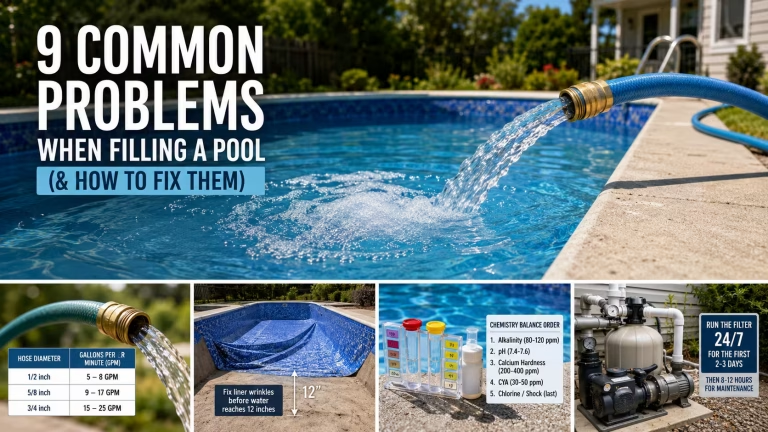
A standard garden hose is the right tool for this. Put the end in the pool away from the skimmer and turn on the water. Set a phone timer. Do not leave a running hose overnight (here’s how to fill faster without overdoing it). Forget about it for eight hours and you’re adding roughly 5,000 gallons to a pool that might only need 300. That’s a chemistry wipe-out and a water bill you won’t like.
A garden hose at standard household pressure runs at about 8 to 12 gallons per minute. Getting from low back to normal on most residential pools takes 30 minutes to a few hours. After filling, always retest chlorine, pH, alkalinity, and CYA. Fresh water dilutes all of them.
Worth knowing if you’re on municipal water with high calcium hardness: adding a large volume of hard tap water can push calcium hardness above 400 ppm. That triggers scale buildup on the pool shell and inside the equipment. It’s a bigger issue in the Midwest and Southwest where tap water tends to run hard. If you’re concerned, fill slowly and test calcium hardness afterward.
Step 3: Lowering a High Pool Water Level
Too much water usually follows a heavy rain. You have two solid options.
Option 1: Multiport Valve to Waste. Turn the pump off. Rotate the multiport valve handle to “Waste” or “Drain.” Turn the pump back on. Water now bypasses the filter and pumps directly to the waste line. Watch the skimmer and stop when the level hits the midpoint. Stay nearby during this. Don’t walk away.
Option 2: Submersible Sump Pump. Drop a small submersible pump on a pool step, run the discharge hose somewhere that can handle the water, and let it run. Most submersible pumps move 1,500 to 3,000 gallons per hour, so removing a few inches of excess water doesn’t take long.
Important Safety Note
Never drain an inground pool completely without talking to a pool professional first. The groundwater in the soil around your pool pushes up against the outside of the shell constantly. This is hydrostatic pressure. When the pool is full, the water weight holds the shell in place against that pressure. Empty the pool completely, and the upward force can physically push the pool shell out of the ground. People call this “floating” or “popping” and the structural damage runs into tens of thousands of dollars. Only drain small amounts when correcting the level.
How to Tell If Your Pool Is Leaking: The Bucket Test
The bucket test separates a real leak from normal evaporation. Both show up as a dropping water level. The difference is that evaporation happens from all open water surfaces equally, including a bucket sitting on a pool step, while a pool leak only affects the pool. If the pool drops more than the bucket, something is leaking.
I spent two summers convinced I had a leak, adding water twice a week through July and August. When I finally ran the bucket test properly, the pool and bucket dropped by identical amounts over 48 hours. Just evaporation. I had been using a lot of water and stressing over nothing. That test saved me the cost of a professional leak detection service.
Here’s how to run it:
- Place a 5-gallon bucket on a pool step so it sits half-submerged in the water.
- Fill it with pool water until the level inside the bucket matches the pool water level outside.
- Mark both water levels, inside and outside the bucket, with waterproof tape or a marker.
- Turn off the pump and any auto-fill devices.
- Wait 48 hours for the most accurate result.
- Check the marks. Same drop inside and outside? Evaporation. Bigger drop outside the bucket than inside? Leak.
If you confirm a leak, start by walking the equipment pad and looking for wet spots, drips around the pump or filter, or water pooling where it shouldn’t be. Next, inspect the skimmer throat where it meets the pool wall. That joint is a common failure point. A dye test using pool dye tablets can pinpoint small cracks or gap leaks that aren’t visible. If both checks come up empty, call a professional leak detection company. Underground pool plumbing leaks and structural shell cracks need specialist equipment to find.
Skimmer Not Pulling Water: What to Do Right Now
Hear a sucking or gurgling sound from the skimmer? The pool level has probably dropped below the skimmer opening and the pump is pulling air through the main drain or equalizer line. Turn the pump off right away. Running a pump dry even briefly damages the impeller and seals. Add water to the midpoint, then prime the pump before restarting it. Don’t restart it until the level is correct.
How to Keep Your Pool Level Stable Without Constant Work
A pool cover, an auto-fill leveler, and a liquid cover handle most water-level upkeep without you thinking about it, especially in hot summer months when evaporation is worst. Here’s what each one does and when it’s worth adding.
Use a Pool Cover
A pool cover is the best tool you have for water level stability. It physically blocks the water surface from dry air and wind, cutting evaporation by up to 95% compared to an uncovered pool, according to the EPA’s WaterSense program (EPA, 2023). A solar cover does this while also collecting heat from sunlight, which saves money on heating costs. A cover pump removes rain that collects on the cover surface so it stays off the pool entirely.
For pools closed over winter, dropping the water level slightly below the skimmer opening is standard practice in freeze-prone areas like the Mountain West and upper Midwest. This protects the skimmer throat, skimmer basket, and connected plumbing from ice expansion damage.
Install an Automatic Water Leveler
An auto-fill device works on the same principle as the float valve inside a toilet tank. A float in a small chamber connected to your household water supply line drops when the pool level drops. That opens a valve, adds water until the level is correct, then closes. No action needed from you.
These devices are genuinely useful in hot, dry climates where daily evaporation loss is significant, and they pair well with proper refill prep if you’re starting from a very low level. They keep the skimmer operating at the correct level around the clock without requiring you to think about it.
Try a Liquid Pool Cover
A liquid pool cover is a non-toxic, biodegradable product you add directly to the water. The active ingredient, typically cetyl alcohol, spreads across the surface and forms a thin invisible layer that reduces evaporation. Independent field testing by the National Plasterers Council found real-world liquid covers cut evaporation by roughly 14% to 16%, well below lab-only estimates, since wind and swimmer activity break up the film (NPC, 2016). You swim right through it without noticing it, and it won’t affect water clarity or chemistry readings.
It won’t replace a physical cover for evaporation control, but it’s useful when the pool is in daily use and putting on a physical cover each evening isn’t practical.
What Should You Do After Rain Raises Your Pool Water Level?
Rain overfilling the pool is one of the most common water level problems, especially during storm season across the Gulf Coast, Southeast, and Midwest. The fix has two steps: remove the excess water, then fix the chemistry.
- Drain the excess. Use the multiport valve “Waste” setting or a submersible pump to bring the water level back to the skimmer midpoint.
- Rebalance the chemistry. Rainwater is mildly acidic, has no chlorine or CYA, and dilutes everything. Test pH, total alkalinity, free chlorine, and CYA. Adjust each reading back into range. Shock the pool if the chlorine is significantly low. If you got a lot of rain and the pool overflowed, also check calcium hardness since it may have dropped with the dilution.
If you deal with heavy rain regularly, a pool cover prevents most of this from happening in the first place. A cover pump handles whatever does land on top of the cover.
Frequently Asked Questions
What is the ideal water level for a swimming pool?
The correct level sits at the midpoint of the skimmer opening, covering one-third to one-half of the skimmer throat. At this height, the pump gets a steady supply without pulling air, and the skimmer creates enough surface current to trap floating debris. Check the weir door: it should float slightly open, never pushed shut or lying flat.
Why is my pool water level dropping so fast?
Losing more than half an inch a day usually means a leak or unusually high evaporation. A recent backwash also removes 200 to 300 gallons per cycle, which can look like a sudden drop. Run the bucket test to be sure: equal drops in the pool and bucket mean evaporation, while a bigger pool drop means a real leak.
How often should I add water to my pool?
Add water whenever the skimmer level drops below the midpoint; how often that happens depends on climate and pool size. Hot, dry areas like Arizona or Texas often need a top-off every few days in summer. Humid Gulf Coast or East Coast regions may only need it weekly. Checking the skimmer daily keeps you ahead of it.
What should I do after heavy rain overfills my pool?
Drain the excess with the multiport valve’s “Waste” setting or a submersible pump until the level hits the skimmer midpoint. Then test pH, total alkalinity, free chlorine, and CYA, since rainwater is slightly acidic and dilutes all of them. Rebalance every reading before anyone swims, and shock the pool first if chlorine dropped significantly.
Can you leave a hose running in the pool overnight?
Not a good idea. A standard garden hose running at about 10 gallons a minute adds roughly 600 gallons an hour, so an overnight fill can dump close to 5,000 gallons into a pool that may only need a few hundred. That wipes out your chemical balance and runs up a real water bill. Set a timer and check back.
How much does it cost to fix a pool leak?
Professional leak detection alone costs $100 to $1,000, averaging around $300, according to Angi’s 2026 cost guide. That’s before any repair work. Simple skimmer or plumbing fixes often add a few hundred dollars, while major shell repairs can run into the thousands. Try the bucket test first since it’s free and often rules out a leak entirely.
The Bottom Line
Pool water level management is not complicated. One quick look at the skimmer every morning catches problems early. Keep the level at the midpoint, use the bucket test before calling anyone about a leak, and put a cover on the pool to cut evaporation. Those habits handle the large majority of what comes up.
The worst pool damage, burned-out pumps, popped pool shells, chronic chemistry problems, almost always traces back to a water level that sat wrong for too long. The daily check takes two seconds. It’s worth it.