How to Fill a Pool Faster: 9 Proven Tips That Cut Fill Time in Half

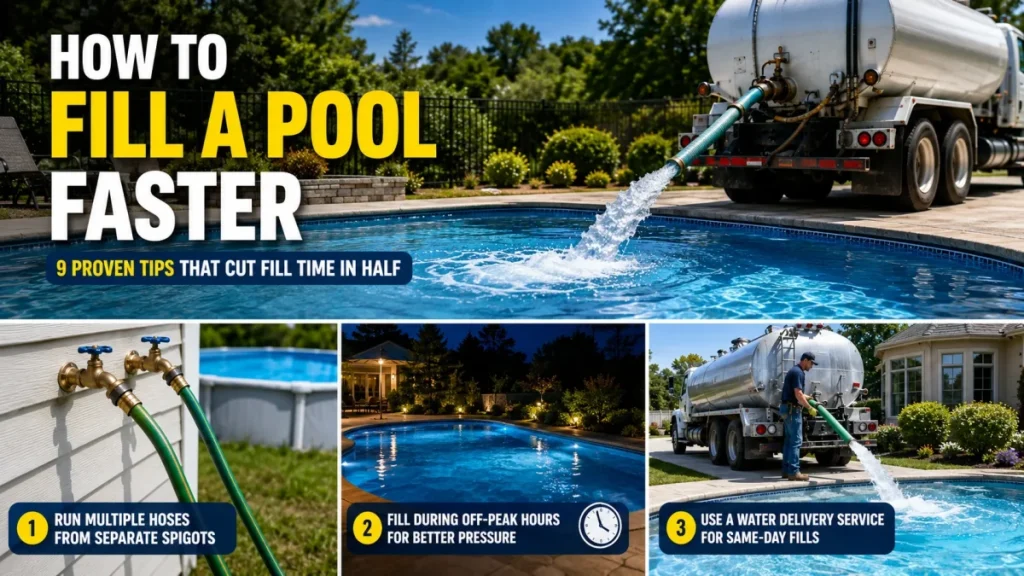
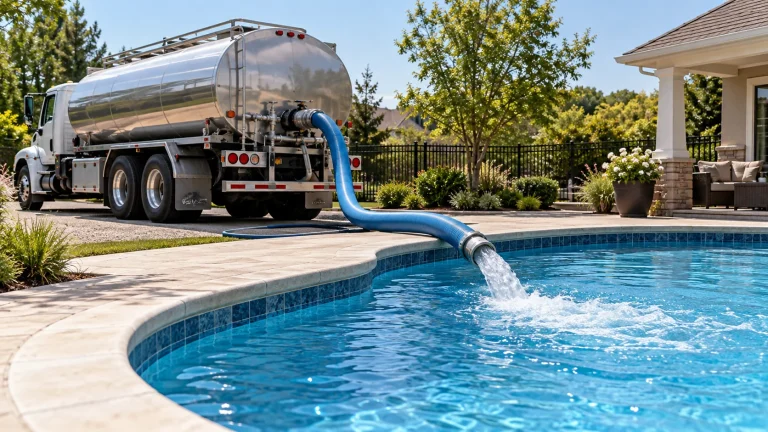
The fastest way to fill a pool is to order a water delivery truck. A tanker carrying 6,000 to 9,000 gallons at a time can fill most residential pools in two to four hours. If you are sticking with city water or a garden hose, running two hoses simultaneously is the single easiest speed upgrade, cutting fill time from roughly 37 hours down to 18 or less on a 20,000-gallon pool.
That said, speed is not the only thing that matters. Fill too fast with unregulated pressure and you can wrinkle a vinyl liner permanently. Fill with untreated well water and iron staining can ruin pool walls before you add the first drop of chlorine. These nine tips cover both speed and the pitfalls that trip up first-time pool owners.
Key Takeaways
- A standard 5/8-inch garden hose delivers about 9 GPM at 40 PSI. A 20,000-gallon pool takes roughly 37 hours on one hose.
- Running two hoses cuts that to around 18 hours. Running three cuts it to 12.
- A water delivery truck fills most pools in 2 to 4 hours at a cost of $200 to $600.
- Call your water utility before you fill. Many US municipalities offer a sewer credit that can cut your bill by 30 to 50 percent.
- If using well water, add metal sequestrant before any chlorine to prevent iron and copper staining.
- Never run your pool pump without water flowing through it. Cavitation destroys the motor in minutes.
What Should You Check Before Adding a Drop of Water to the Pool?
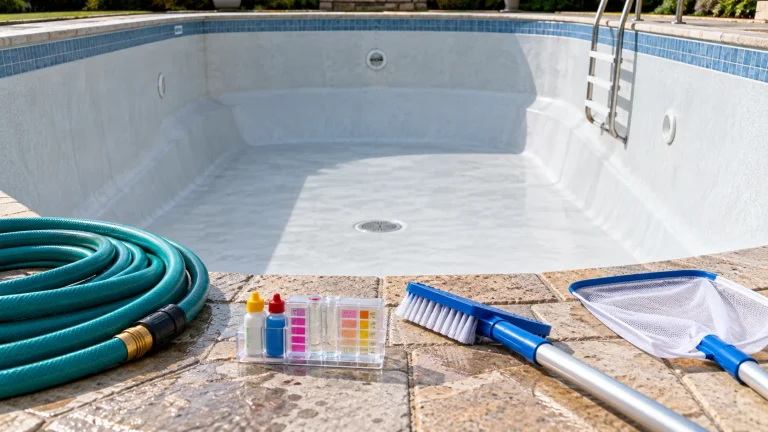
Running a short prep check before filling saves hours of frustration later. The three things that cause the most problems when skipped are liner condition, hose equipment, and water source planning.
Inspect the Pool Interior
Walk the inside of the pool and look for wrinkles in the liner if you have a vinyl pool, in-ground or above-ground. Once water weight settles over a wrinkle, it becomes permanent. Clear any leaves, twigs, or debris that blew in overnight.
For concrete or plaster pools, check for cracks or uncured spots. For fiberglass, look for surface voids. These are far easier to address before the water goes in.
Prepare Your Hoses and Equipment
Uncoil all hoses fully and check for kinks or worn spots. A kinked hose drops flow rate significantly. If you plan to run multiple hoses, test each spigot separately to confirm pressure is consistent. Have a clean cloth or old sock ready to put over the hose end so water diffuses instead of blasting the liner or plaster surface directly.
Decide on Your Water Source First
This is the one step most people skip. Switching from city water to well water mid-fill because “it’s taking too long” often leads to well pump burnout. Decide upfront. Read through the method breakdowns below, pick your approach, and have everything staged before you open the first valve.
If you are refilling rather than filling new, check our guide on how to prepare your pool for a refill first since there are a few extra steps around chemical neutralization.
How Many Garden Hoses Does It Actually Take to Fill a Pool Quickly?
Two hoses are almost always better than one, and the math is straightforward. A standard 5/8-inch garden hose delivers roughly 9 GPM at typical residential water pressure of 40 to 60 PSI. Two hoses running simultaneously delivers 18 GPM, cutting your fill time roughly in half.
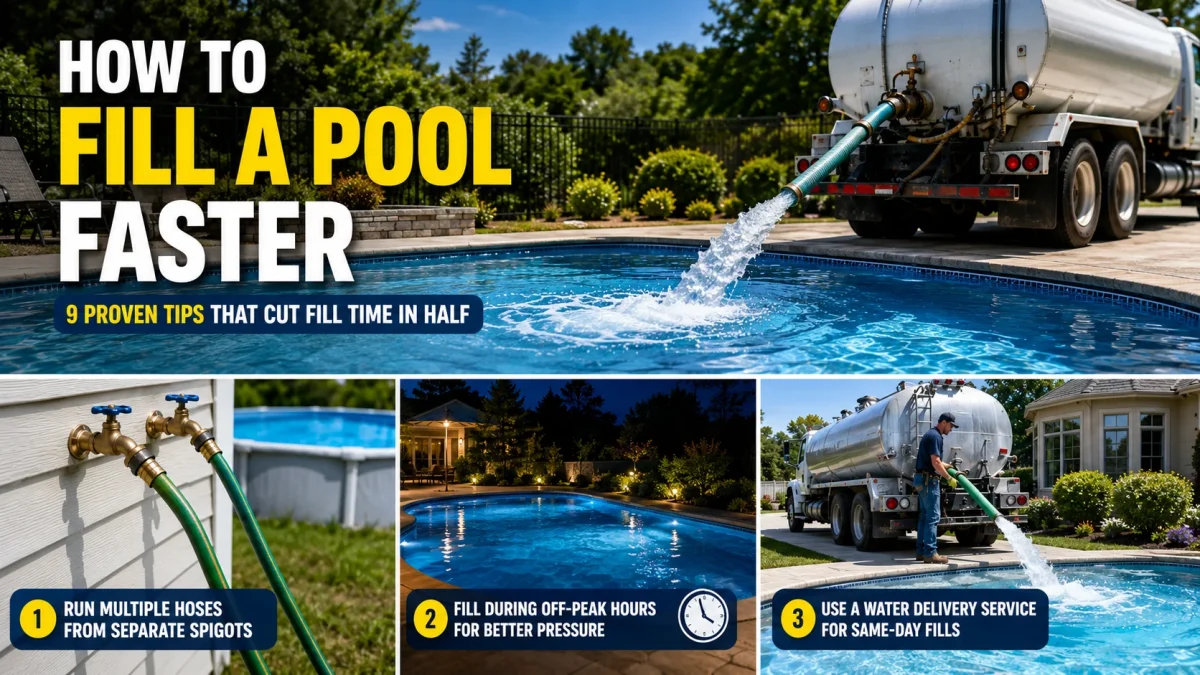
Tip 1: Run Multiple Hoses From Separate Spigots
The key is using separate outdoor spigots, not a splitter on a single spigot. A Y-splitter on one spigot shares pressure between both hoses and you often end up with less combined flow than a single full-pressure hose. Two hoses from two different spigots double your flow rate cleanly.
Hose diameter matters more than most people realize. A 3/4-inch hose delivers around 13 GPM compared to 9 GPM for a 5/8-inch hose. Upgrade to the wider diameter if you are doing a lot of pool fills. For the right hose for this task, see our review of the best hoses for filling a pool.
| Setup | Approx. GPM | 20,000-Gallon Fill Time |
|---|---|---|
| 1 x 5/8-inch hose | 9 GPM | ~37 hours |
| 2 x 5/8-inch hoses | 18 GPM | ~18.5 hours |
| 1 x 3/4-inch hose | 13 GPM | ~26 hours |
| 2 x 3/4-inch hoses | 26 GPM | ~13 hours |
| Water delivery truck | 200+ GPM | 2 to 4 hours |
Tip 2: Fill During Off-Peak Hours for Better Pressure
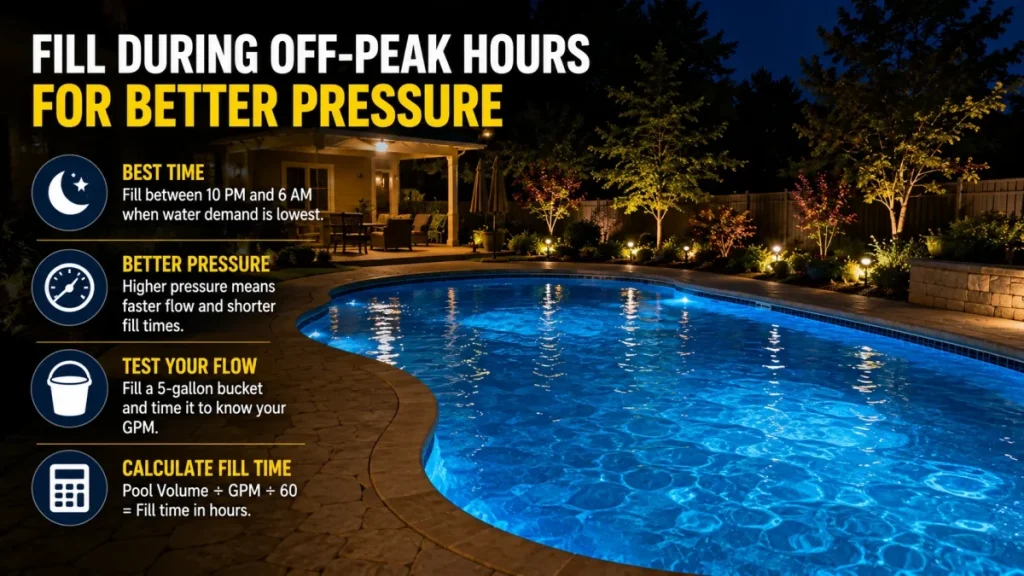
Municipal water pressure is highest late at night and in the early morning, typically between 10 PM and 6 AM, when neighborhood demand drops. Starting a fill at 10 PM and letting it run overnight can noticeably improve flow compared to filling midday when nearby sprinkler systems and household use are competing for the same pressure.
If you are not sure how much water your setup actually moves, do a simple bucket test. Fill a 5-gallon bucket from your outdoor spigot and time it. If it takes 30 seconds, your GPM is 10 (5 gallons divided by 0.5 minutes). Once you know your actual GPM, you can calculate fill time exactly by dividing pool volume by GPM and then dividing by 60 for hours.
Is a Water Delivery Service Actually Worth It for Filling a Pool?
Water delivery is the fastest method available for filling a residential pool, and in most cases the cost is reasonable given the time saved. A typical water delivery truck carries 6,000 to 9,000 gallons per load and runs a high-volume pump that operates at 200 GPM or more. A 20,000-gallon pool requires two to three truck loads and fills in two to four hours total.
Tip 3: Call a Water Delivery Service for Same-Day Fills
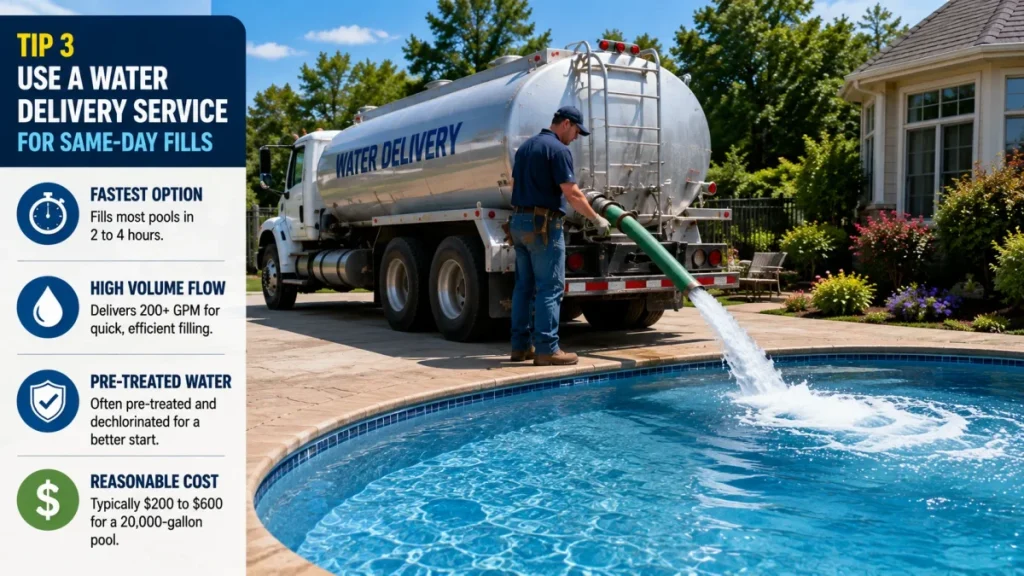
Water delivery costs roughly $200 to $600 for a 20,000-gallon pool depending on your region, delivery distance, and the company. The water is often pre-treated and dechlorinated, which gives your chemical startup a head start. You avoid a multi-day wait and you avoid the risk of a $1,000 or more well pump repair.
For a full cost breakdown and comparison, see our guide on the average cost to fill a pool with a garden hose versus other methods.
If delivery feels too expensive for your situation, check whether your city offers alternative options. Our article on alternatives to filling a pool with a garden hose covers a few less obvious sources including neighbor connections, community wells, and reclaimed water programs.
Can You Use Well Water to Fill a Pool, and What Can Go Wrong?
You can use well water to fill a pool, but it comes with two real risks: burning out the pump if you run it continuously, and staining your pool surfaces with iron or copper if you skip water treatment. Both problems are avoidable with the right approach.
Tip 4: Give Your Well Pump Rest Cycles
A residential well pump recovers at 3 to 5 GPM and is designed for short-burst use, not continuous operation. Running it straight for 24 hours to fill a 15,000-gallon pool overheats the motor and can destroy it. The repair cost is typically $800 to $2,500.
Use a one-hour-on, one-hour-off cycle. Check your well’s recovery rate (often listed on your pump installation paperwork or on the pressure tank label) before deciding to use it at all. If your well recovers slower than your pump draws, you risk pulling air, which causes cavitation damage even with rest periods.
Tip 5: Treat Well Water Before Adding Any Chlorine
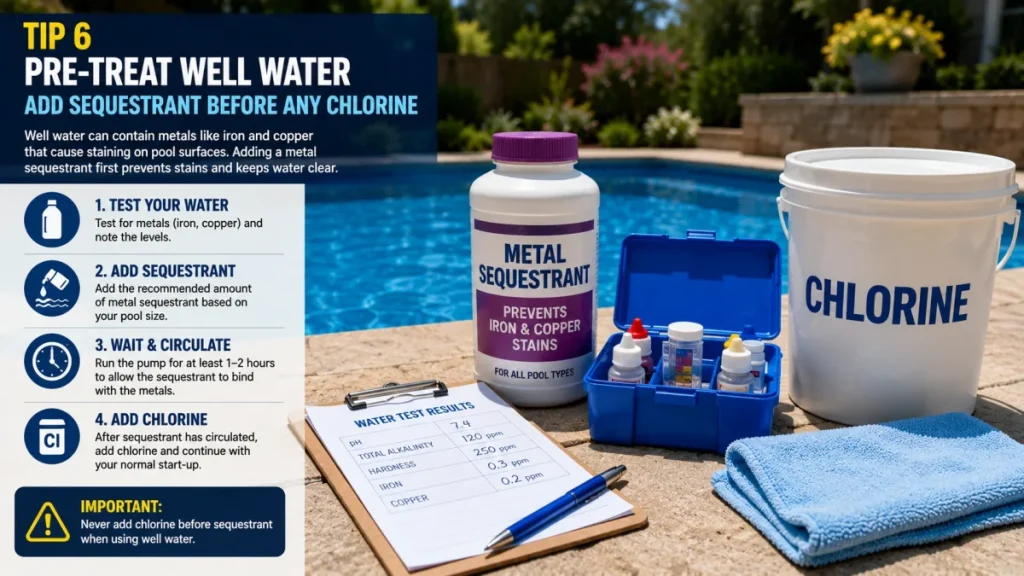
Well water frequently contains elevated iron, manganese, and copper. When chlorine hits untreated iron or copper, it oxidizes those metals instantly and deposits them on pool walls, vinyl liners, or plaster as brown or blue-green stains. These stains are difficult to remove and can be permanent on plaster surfaces.
Add a metal sequestrant to the water during the fill, before you add any chlorine or shock. After the fill, test for iron and copper levels using a full water test kit or take a water sample to a local pool store. Balance pH to 7.2 to 7.6 and total alkalinity to 80 to 120 ppm before adding any oxidizer.
Does Your Water Utility Offer a Pool Fill Sewer Credit, and How Do You Claim It?
Many US municipalities offer a one-time pool fill sewer credit because pool water does not enter the sewer system. Depending on your city, this can reduce your water bill by 30 to 50 percent on a large pool fill. This is one of the most overlooked cost savings in pool ownership and takes only a phone call to claim.
Tip 6: Call Your Water Utility Before the Fill
Call your city’s water department or check their website before you start filling. Ask specifically about a pool fill sewer credit or pool fill adjustment. Some municipalities handle this automatically if you submit a form within 30 days of filling. Others require advance notice.
While you are on the call, ask about tiered billing thresholds. Many city water systems charge a significantly higher rate once you exceed a monthly usage cap. If filling a 20,000-gallon pool pushes you into the next tier, you may save money by splitting the fill across two billing periods or filling in the first few days of a new billing cycle.
How Do You Prevent Liner Damage and Plaster Erosion During a Pool Fill?
Directing a high-pressure water stream at the same spot on a vinyl liner or new plaster surface for 36 to 48 hours causes real damage. Liners can develop permanent wrinkles under point pressure. New plaster and pebble finishes can pit or erode where concentrated water hits repeatedly. The fix takes about 10 seconds.
Tip 7: Diffuse the Water Flow at the Hose End
Tie a clean old sock or a small piece of cloth over the end of the hose. This spreads the water flow over a wider area and drops the impact pressure dramatically. Alternatively, position the hose end in the deep end so water runs down the slope rather than blasting a flat surface.
For above-ground pools and Intex-style pools especially, this matters from the very first minute of filling. The liner is fully unsupported until the water weight settles it into shape, and any wrinkle that forms early tends to stay.
When Should You Turn On the Pool Pump During the Fill Process?
Turn on the pool pump when the water level reaches halfway up the skimmer opening. At that point the skimmer has enough water to pull from without drawing air. Starting the pump too early, before adequate water covers the skimmer, runs the risk of air lock and dry running.
Tip 8: Never Run the Pool Pump Without Water
Running a pool pump dry, even for a few minutes, destroys the impeller, seal plate, and motor. It is called pump cavitation: the impeller spins without water resistance, generates intense heat, and the motor fails. This is a $300 to $800 repair in most cases.
As you fill, check that your filter, pump basket, and return lines are correctly primed and ready. Once the water level is correct, turn the pump on and let it run continuously for 24 hours after the initial fill to circulate and distribute the startup chemicals evenly.
After your fill is done, maintaining the right water level consistently is what protects your pump long-term. See our guide on how to maintain your pool’s water level through evaporation and splash loss.
What Chemicals Do You Need Ready the Moment the Pool Is Full?
Have your startup chemical kit staged and ready before you start filling. The window between pool full and pool swimmable is where most people lose days unnecessarily. Getting the chemistry right on day one sets you up for the whole season.
Tip 9: Balance Chemistry in This Exact Order
Always balance in this sequence: total alkalinity first (target 80 to 120 ppm), then pH (target 7.2 to 7.6), then calcium hardness (target 200 to 400 ppm for plaster, 175 to 225 ppm for vinyl), then add stabilizer or cyanuric acid if using an outdoor chlorine pool (target 30 to 50 ppm), then shock the pool with chlorine.
Skipping the sequence causes problems. Adding shock before alkalinity is balanced can lock pH into an unstable range that burns through chlorine fast. If you used well water, add metal sequestrant before any of these steps and wait at least 24 hours before adding shock.
Once chemicals are balanced and the pump has run for 24 hours, cover the pool. A pool cover prevents the evaporation that drains both water and chlorine, reducing your chemical use through the season. For anything that went wrong during your fill, our guide to common problems when filling a pool covers the most frequent issues with specific solutions.
Frequently Asked Questions About Filling a Pool Faster
Is it cheaper to fill a pool with a garden hose or a water delivery truck?
A garden hose costs $60 to $120 for a 20,000-gallon pool using city water at average US rates. A water delivery truck costs $200 to $600 for the same volume. The hose wins on price but loses on time. If your time is valuable or you are filling a new vinyl liner pool where wrinkle risk increases with slow fills, delivery is worth the extra cost. You can find the full breakdown in our pool fill cost guide.
Can filling a pool with well water really burn out the pump?
Yes, it can. A residential well pump recovers at roughly 3 to 5 GPM and is built for short bursts, not continuous 24-hour operation. Running it straight through a pool fill overheats the motor. The fix is a one-hour-on, one-hour-off cycle. Check your well’s recovery rate before starting so you do not drain the aquifer below the pump intake.
How long does it take to fill a pool with a garden hose?
A standard 5/8-inch garden hose delivers around 9 GPM at 40 PSI. At that rate, a 10,000-gallon pool takes roughly 18.5 hours and a 20,000-gallon pool takes around 37 hours. A 3/4-inch hose delivers about 13 GPM and cuts those times by about 30 percent. Running two hoses cuts fill time roughly in half. Use our pool volume formula: Pool Volume in Gallons divided by GPM, then divided by 60, equals total fill hours.
Should I call my water utility before filling the pool?
Yes. Many US municipalities offer a one-time pool fill sewer credit because the water does not enter the sewer system. This credit can reduce your bill by 30 to 50 percent on large fills. Some utilities also have tiered billing that jumps to a higher rate once you exceed a monthly threshold. Knowing the schedule helps you plan fills to avoid the higher tier.
Do I need to add metal sequestrant when filling with well water?
Yes. Well water commonly contains elevated iron and copper. Without a metal sequestrant added at the start of the fill, those metals oxidize when chlorine hits them and stain your pool walls, liner, or plaster permanently. Add sequestrant before any chlorine or shock. Test for iron and copper levels using a water test kit before balancing pH or alkalinity.
Ready to Fill Your Pool? Start Here
Filling a pool faster comes down to three decisions: your water source, your flow rate, and your prep work. Water delivery is fastest. Two or three hoses is the best DIY speed upgrade. And calling your water utility for a sewer credit is the easiest money you will save.
Before you start, know how many gallons your pool holds. Use this guide on how to calculate pool volume in gallons if you are not sure. Once you know your volume, calculate your fill time using the GPM formula above, stage your startup chemicals, and do not forget the sock on the hose end.
The fill itself is just the beginning. The next step is getting the water chemistry right so the pool is actually safe to swim in. Check our complete pool startup chemical guide for the exact sequence.