Chain Link Fence Cost (2026 Price per Foot: Galvanized vs Black Vinyl, Gates & DIY)

A chain link fence costs $15 to $30 per foot for galvanized steel. Black vinyl chain link costs $18 to $35 per foot. A typical 150-foot residential yard runs $2,250 to $5,250 total. Final costs depend on fence height, pipe thickness, soil conditions, and gates.
Chain link fencing remains the most economical metal boundary for homes. It provides reliable pet containment at half the cost of wood privacy boards.
Chain Link Fence Cost per Foot: Average 2026 Prices by Yard Size
Chain link fence installation costs $15 to $35 per foot for common yards. Standard 4-foot galvanized mesh costs $15 to $22 per foot installed. A 6-foot black vinyl system costs $24 to $35 per foot installed. Materials cost $7 to $12 per foot, but labor adds $8 to $18 per foot.
Total project costs scale with property line length. Larger properties reduce the unit cost per foot through crew efficiency.
| Fence Length | Typical Size | Galvanized Installed | Black Vinyl Installed | DIY Materials. |
|---|---|---|---|---|
| 50 Linear Feet | Small patio run or dog run | $950 – $1,750 | $1,100 – $2,000 | $350 – $600. |
| 100 Linear Feet | Small suburban backyard | $1,500 – $3,000 | $1,800 – $3,500 | $700 – $1,200. |
| 150 Linear Feet | Typical quarter-acre backyard | $2,250 – $4,500 | $2,700 – $5,250 | $1,050 – $1,800. |
| 200 Linear Feet | Half-acre suburban property | $3,000 – $6,000 | $3,600 – $7,000 | $1,400 – $2,400. |
| 300 Linear Feet | Full-acre perimeter boundary | $4,500 – $9,000 | $5,400 – $10,500 | $2,100 – $3,600. |
| 400 Linear Feet | Commercial yard or large perimeter | $6,000 – $11,200 | $7,200 – $13,200 | $2,800 – $4,800. |
Unit installation prices decline as perimeter footage grows, so on a 50-foot run, fixed travel fees dominate the bid. On a 400-foot run, crews spread fixed costs over hundreds of feet. This drops the installed rate toward the bottom of the price range.
Why Contractor Quotes Swing from $15 to $45 per Foot (The 1/3 Rule & Trip Fees)
Fence contractors price bids using a three-part formula. Total job cost splits into one-third materials, one-third labor, and one-third overhead with profit. Runs under 100 feet trigger crew trip fees between $500 and $800. These fixed minimum fees push small job rates up to $45 per foot.
Contractor pricing reflects real field logistics. Moving a crew, an auger truck, and a tool trailer costs money before workers dig one hole.
Four job site conditions explain wide quote variations:
- Project size economies of scale. On a 50-foot run, fixed travel fees dominate the bill. Crews set layout lines, mix cement, and let footings cure over two trips. On a 400-foot run, crews spread setup costs across hundreds of feet. This volume drops the rate down to $18 per foot.
- Ground slope and terrain. Flat ground allows smooth wire mesh stretches. Sloped yards need crews to bias-cut the mesh or step the fence down hills. This work adds 20 percent to total labor hours.
- Digging obstacles and soil. Soft dirt allows auger drilling in two minutes per hole. Hard clay, rock, or limestone ledges need jackhammers or carbide drill bits. These ground conditions add $8 to $15 per hole in labor. Review our construction guide on mitigating tree impact when digging near roots.
- Old fence removal. Taking down an old chain link or wood fence costs $3 to $7 per foot. This fee covers concrete footing removal, metal scrap hauling, and dump fees.
Height vs Cost: 4-Foot Pet Containment to 8-Foot Security Boundaries
Home chain link fences range from 4-foot pet runs to 8-foot security barriers. A standard 4-foot galvanized fence costs $15 to $22 per foot installed. Upgrading to 6 feet costs $20 to $32 per foot. Commercial 8-foot fences run $26 to $45 per foot.
Fence height balances security against local zoning rules. Cities often cap front yard fences at 4 feet and backyard fences at 6 feet.
| Fence Height | Best Use | Galvanized Installed | Black Vinyl Installed | Concrete Post Depth. |
|---|---|---|---|---|
| 4 Feet | Front yards, pet containment, property boundaries | $15 – $22 per foot | $18 – $26 per foot | 24 Inches (2 Feet). |
| 5 Feet | Medium dogs, suburban perimeter boundaries | $18 – $25 per foot | $21 – $29 per foot | 30 Inches (2-1/2 Feet). |
| 6 Feet | Large dog containment, privacy slat retrofits | $20 – $32 per foot | $24 – $35 per foot | 36 Inches (3 Feet). |
| 8 Feet | Commercial storage yards, athletic courts | $26 – $45 per foot | $30 – $52 per foot | 42 Inches (3-1/2 Feet). |
Raising fence height from 4 feet to 6 feet adds 50 percent more metal weight. This upgrade needs thicker pipe walls and deeper post holes. In cold zones with deep frost lines, an 8-foot post leaves only 5 feet above grade. Installers order 9-foot or 10-foot pipe from commercial fence suppliers.
Swimming pool codes impose strict barrier rules under IRC Section AG105, but codes set a 48-inch minimum fence height. They limit mesh openings to 1.25 inches or 1.75 inches to block climbing footholds. Gates must swing out from the pool. They need self-closing hinges and a magnetic latch set 54 inches above grade.
Galvanized vs Black Vinyl: The 9-Gauge Steel Core vs Cheap 12-Gauge Trap
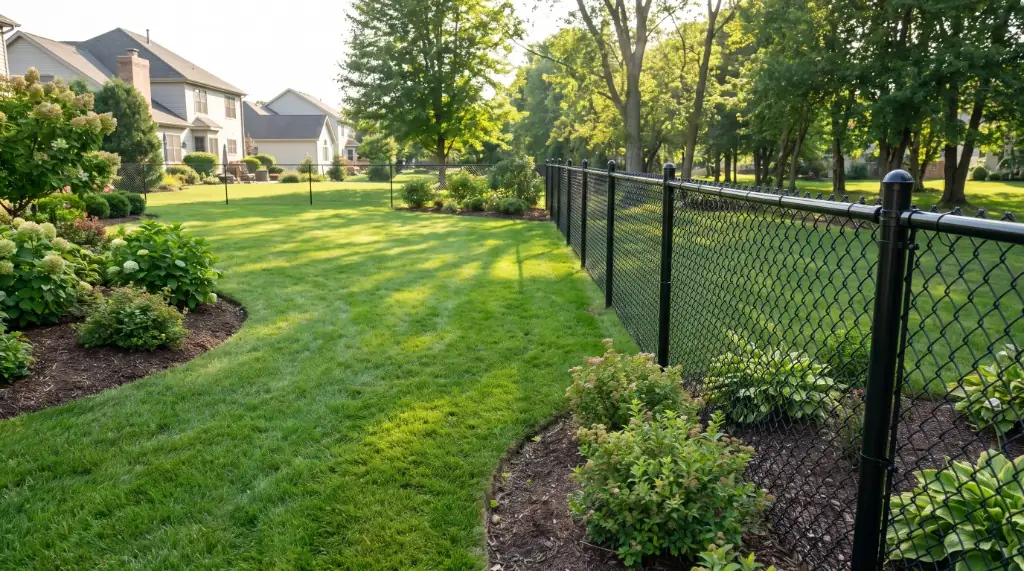
Black vinyl chain link costs $3 to $8 more per foot than silver galvanized mesh. The dark coating blends with trees, shrubs, and yard shadows, and this finish stops the reflective glare of raw zinc. Homeowners must verify core wire gauge before buying. Quality vinyl chain link uses a 9-gauge finished wire over a sturdy 10-gauge steel core.
Traditional galvanized fencing uses steel wire woven into diamonds and dipped in hot zinc. This hot-dip coating shields raw steel from moisture. Over fifteen years, natural surface aging forms a protective gray finish.
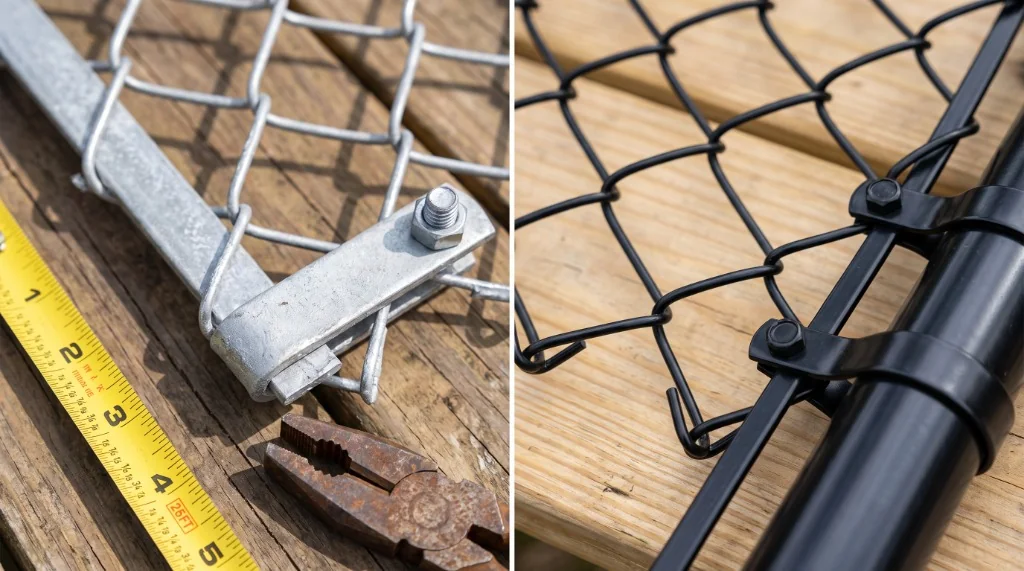
Color-coated fence uses a bonded vinyl plastic jacket over galvanized core wire. This bonded PVC barrier shields the steel core from salt, dog urine, and fertilizer overspray.
Homeowners face a common wire gauge trap in retail quotes:
- Core wire gauge deception. In wire gauges, lower numbers mean thicker steel, so standard galvanized fencing uses 9-gauge or 11-gauge steel. Budget stores sell vinyl wire labeled as 9-gauge finish. That product conceals an ultra-thin 12-gauge steel core inside plastic that bends under dog impact.
- Coating application standards. ASTM F668 defines two vinyl standards. Class 1 extruded vinyl forms a loose plastic sleeve where trapped water rusts steel unseen. Class 2b thermally bonded vinyl fuses PVC to the steel core with adhesive primers. This finish resists peeling and cracks for twenty-five years.
- Vine damage. Vines like ivy or honeysuckle add 300 to 500 pounds of weight across the top rail. Foliage traps moisture against the wire, so this dampness causes rust and bends posts within five years.
| Comparison Metric | Traditional Galvanized | Black Vinyl-Coated Mesh. |
|---|---|---|
| Average Material Cost (4ft) | $7.00 to $9.50 per linear foot | $9.50 to $13.50 per linear foot. |
| Typical Service Lifespan | 20 to 30 years | 25 to 35 years. |
| Visual Yard Impact | High contrast industrial silver | Recedes 80% into yard shadows and tree foliage. |
| Recommended Core Wire | 9-gauge or 11-gauge solid steel | 10-gauge steel core (9-gauge finish). |
| Resistance to Dog Scratching | High (raw metal surface) | Moderate (sharp claws can gouge vinyl). |
| HOA Neighborhood Approval | Strict zoning review | Widely approved across modern HOAs. |
The Terminal Post Trap: Why 0.065-Inch Tubing Bends and Schedule 40 Survives
Terminal posts anchor corners, gates, and fence ends. These corner posts hold hundreds of pounds of stretch tension from the wire mesh. Strong jobs need Schedule 40 steel pipe with a 0.145-inch wall thickness. Cheap contractors cut bids by using thin 0.065-inch pipe on corners. This light pipe bends and collapses under heavy wire tension.
Structural framing divides posts into two operational classes:
- Intermediate line posts. Line posts support vertical wire weight every eight to ten feet along straight runs. They safely use 16-gauge tubing with a 0.065-inch wall thickness and a 1-7/8-inch outer diameter.
- Terminal, corner, and gate posts. Terminal posts anchor horizontal tension bars and brace bands. Under winch tension, thin 0.065-inch pipe bows inward and leaves the middle fabric loose. Terminal posts need 2-3/8-inch outer diameter Schedule 40 pipe. Gate posts need 2-7/8-inch Schedule 40 pipe to stop latch sag.
| Pipe Location | Outer Diameter | Wall Thickness | Weight per Foot. |
|---|---|---|---|
| Residential Top Rail | 1-3/8 Inches | 0.055″ to 0.065″ (16-gauge) | 0.95 Pounds. |
| Intermediate Line Post | 1-7/8 Inches | 0.065″ to 0.085″ (16-gauge to 14-gauge) | 1.30 to 1.65 Pounds. |
| Terminal / Corner Post | 2-3/8 Inches | Schedule 40 (0.145″ wall thickness) | 3.65 Pounds. |
| Walk Gate Post | 2-3/8 Inches | Schedule 40 (0.145″ wall thickness) | 3.65 Pounds. |
| Double-Drive Gate Post | 2-7/8 Inches | Schedule 40 (0.203″ wall thickness) | 5.79 Pounds. |
Footing depth and hole shape control post stability:
- Frost heave prevention. Dig post holes with straight vertical walls. If concrete forms a mushroom shape near the top, frozen soil grips that collar in winter. Frost heave then lifts the post out of the ground. Pour 3 inches of crushed gravel into the hole before setting pipe and concrete. This gravel base lets rainwater drain away from the hollow steel tube.
- Post spacing and tensioning. Installers space line posts ten feet apart on level ground. In windy areas or heavy snow regions, installers tighten post spacing to eight feet. These shorter spans stiffen the top rail and stop wire mesh wobble. Crews let concrete footings cure for two to three days before pulling the wire mesh tight.
Walk Gates vs Driveway Gates: Single Swing to Double-Drive Hardware Costs
Chain link gate installations cost $150 for a 4-foot walk gate up to $2,500 or more for an automated double-drive driveway gate. Walk gates include frame hinges, post collars, and a gravity fork latch. Vehicle gates need heavy commercial hinge posts, diagonal truss rods, and center drop rods.
Gate costs scale with opening width and hardware grade:
- Pedestrian walk gates. A 4-foot walk gate costs $150 to $350 installed. Assemblies include frame hinges, post collars, bolts, and a gravity fork latch. Pool gates need self-closing hinges and a magnetic latch mounted 54 inches high.
- Single-drive vehicle gates. An 8-foot to 12-foot gate costs $300 to $700 installed for mower or driveway access. Gates over 10 feet wide need diagonal steel truss rods and turnbuckles to stop latch sag.
- Double-drive vehicle gates. Double-drive gates spanning 12 to 16 feet cost $600 to $1,400 installed with 3-inch hinge posts and drop rods. Automated slide operators cost $2,000 to $4,500 installed with solar backup and safety sensors.
Adding Privacy Slats or Bamboo: Material Costs and the High-Wind Sail Hazard
Adding vertical plastic privacy slats to chain link costs $3 to $8 per foot for materials and $2 to $4 per foot for labor. Slats provide 75 to 90 percent visual blockage, and solid inserts catch wind like a sail. Homeowners must reinforce structural posts and embed footings below the local frost line.
Slats turn open mesh into an opaque barrier without the cost of wood fencing:
- Bottom-locking HDPE slats. Rigid plastic strips slide down the diamond weave and lock into a bottom track. They cost $4 to $7 per foot and provide 85 percent visual privacy.
- Winged privacy slats. Flexible fins expand inside the diamond weave to deliver 90 to 95 percent visual privacy. They cost $6 to $10 per linear foot.
- Privacy screening fabrics. Knitted windscreen fabrics attach to rails and posts with grommets. They cost $1.50 to $3.50 per foot and block 85 percent of through-fence vision.
Structural wind warning: Open chain link wire lets 90 percent of wind pass through diamond openings. Adding solid privacy slats or fabric screens catches wind like an open boat sail. In 50-mile-per-hour storm gusts, lateral wind load rises by over 300 percent. This pressure bends the entire fence flat if line posts sit in shallow holes without deep concrete.
If your primary goal is full privacy without wind hazards on metal posts, compare costs in our wood fence cost guide and overall fence installation cost guide.
DIY vs Hiring a Contractor: Tool Rentals, Stretcher Bars, and Sweat Equity
Installing a chain link fence yourself cuts project costs by 45 to 55 percent. Total expenses fall to $7 to $15 per foot for materials and tool rentals. DIY installation needs post hole augers, cable come-alongs, stretcher bars, and three to four days of hard physical labor. Hiring a licensed contractor costs $15 to $35 per foot but ensures plumb posts.
Chain link installation needs mechanical wire tensioning. This differs from building residential wood fencing, so unstretched woven mesh sags and deforms over time.
Essential equipment for successful DIY installation includes:
1, and gas-powered two-man post hole auger ($80 to $120 daily rental fee). 2, while heavy-duty cable come-along winch ($35 to $60 buy). 3, but steel stretcher bar with tension hooks ($30 to $50 buy). 4, where heavy lineman pliers and manual post level ($25 buy). 5, so steel wheelbarrow and concrete mixing hoe ($60 buy).
Digging post holes by hand needs days of heavy labor, and setting posts plumb needs an accurate magnetic post level. Tightening tension bands needs socket ratchets and lineman pliers. Professional crews use a steel stretcher bar and a cable winch to pull mesh taut. Without mechanical tensioning tools, DIY fences develop loose spots that sag within six months.
Pet containment needs special care along the ground line, but dogs push under loose bottom knuckles. Installing a high-tensile 7-gauge bottom tension wire along the base prevents escapes. Secure the wire to bottom knuckles with galvanized hog rings every 12 to 18 inches. This upgrade costs $30 to $50 in materials. For invisible perimeter options, review our electric invisible fence guide and fishing line deer fence designs. For large rural properties, compare figures in our pole barn cost breakdown.
4 Red Flags in a Fencing Quote: Spotting Missing Tension Bars and Shallow Posts
Evaluating contractor estimates needs auditing structural pipe specs, post schedules, and hardware allowances. A reliable fencing quote lists pipe diameters, wall thickness, hole depth, and gate hardware. Bids without these details often hide cheap materials that fail within three seasons.
Audit competitive estimates against these four trade red flags:
- Uniform 0.065-inch pipe quotes. If an estimate lists 0.065-inch tubing on all posts without Schedule 40 for corners and gates, reject the bid. The contractor cuts material costs on structural uprights.
- Shallow footing specifications. Quality contractors dig holes to one-third of post height, or six inches below frost depth. In cold regions, shallow 18-inch holes heave within two winters.
- Omission of tension bars. Cheap quotes omit vertical tension bars and brace bands, so careless workers wrap thin tie wire directly around corner posts. Proper setups secure mesh through a steel tension bar bolted into tension collars.
- Missing bottom tension wire. Bids without a bottom rail or 7-gauge bottom tension wire leave fabric loose at ground level. Lawn mowers catch jagged knuckles, and pets tunnel beneath the fence.
Frequently Asked Questions: allows, Frost Lines, and Dog Containment
How much does 100 feet of chain link fence cost installed?
Installing 100 linear feet of 4-foot residential galvanized chain link fence costs between $1,500 and $2,200 total. This project scope covers raw materials, crew labor, and one standard walk gate. Installing 100 feet of 5-foot or 6-foot black vinyl-coated chain link runs between $1,800 and $3,500 total. Final costs depend on terrain slope, old fence removal, and local labor rates.
Is chain link fencing cheaper than wood or vinyl?
Yes. Chain link fencing costs 40 to 60 percent less than solid wood privacy fencing and 60 to 70 percent less than vinyl fencing. Standard galvanized chain link averages $15 to $30 per foot installed. Pressure-treated wood runs $22 to $38 per foot, and composite or vinyl averages $35 to $65 per foot.
How do I stop my dog from pushing under a chain link fence?
Install a 7-gauge coiled steel bottom tension wire along the base of the fence fabric. Weave the high-tensile wire through the bottom diamond knuckles and clamp it every 12 to 18 inches using steel hog rings. For aggressive digging dogs, embed the wire mesh four inches below grade or install a galvanized bottom steel rail.
Do I need a zoning approval and survey for a chain link fence?
Most municipalities need a zoning approval for fences over 6 feet in height. Front yard fences over 4 feet often face strict local zoning restrictions. Always contact your regional utility locator service (Call 811) before digging post holes. A professional property survey ensures you place fence posts inside your boundary lines.
How long does a galvanized chain link fence last?
A standard hot-dip galvanized chain link fence lasts 20 to 30 years in residential environments before exhibiting surface rust. Black vinyl-coated chain link fences last 25 to 35 years. The bonded PVC outer coating shields the galvanized steel core from humidity, rain, and road salt corrosion.