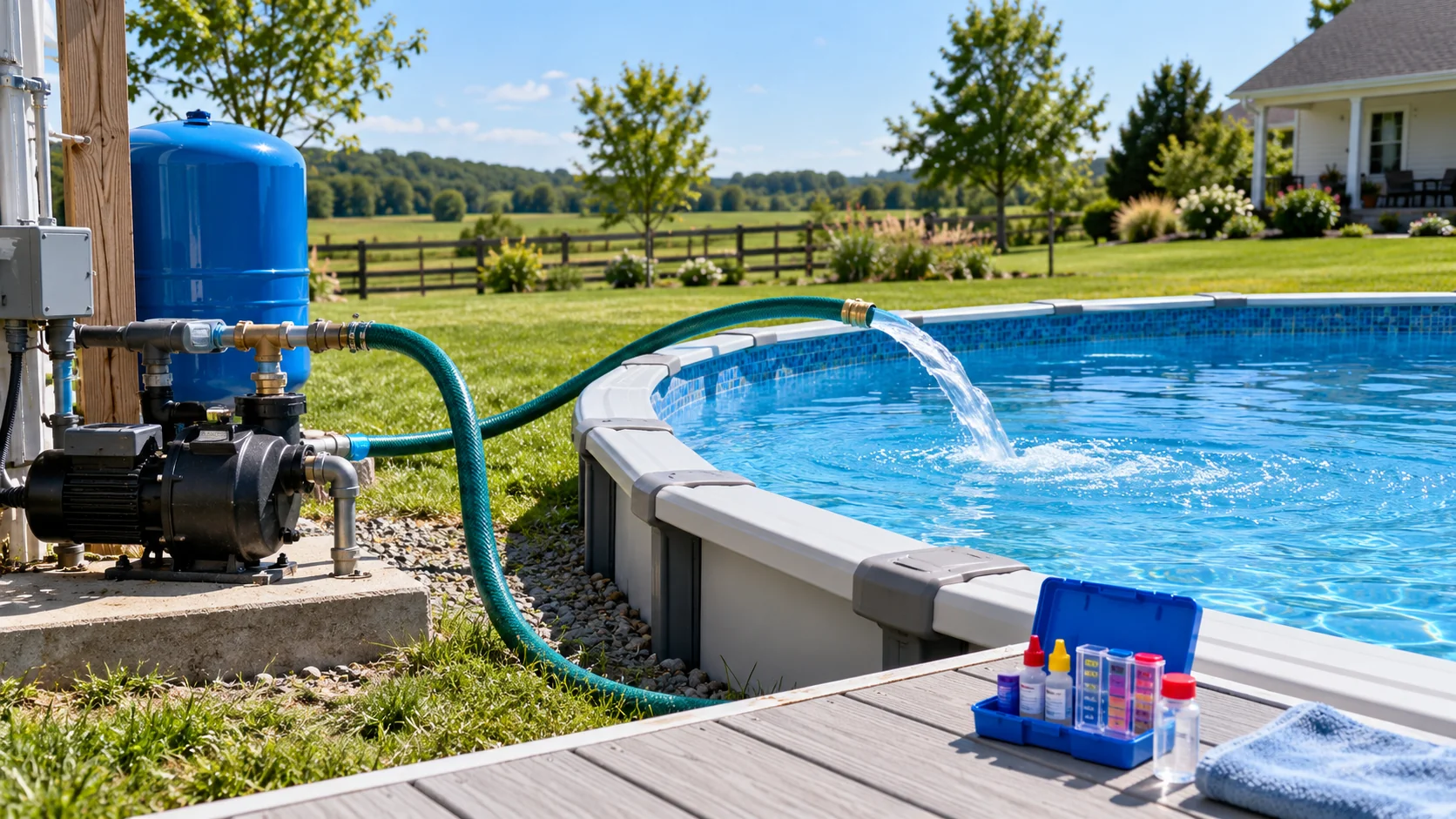
How to Fill a Pool with Well Water (Without Burning Out Your Pump)

Can you fill a pool with well water? Yes, you can. Take a breath, because this project sounds riskier than it is. Thousands of well owners fill their pools every summer without a hitch. There’s one thing you must check before you turn anything on, though: your well’s flow rate, measured in GPM (gallons per minute). Skip that five-minute check, and you’re gambling with a four-figure pump repair.
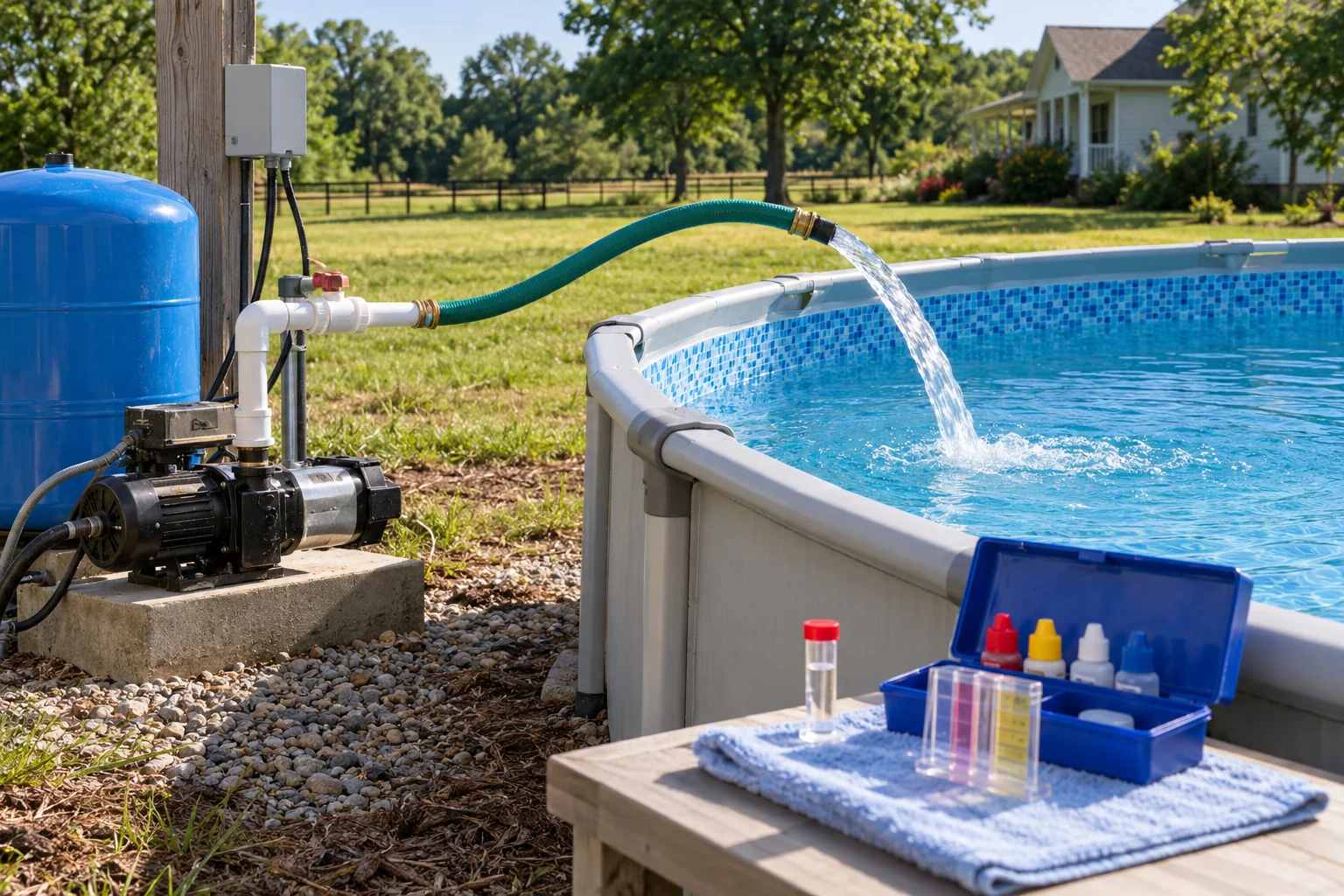
Most homeowners on well water have never seen their GPM number. Many assume the well can run all day without a break. That assumption is exactly what burns out pumps. This guide covers three things: checking your well’s capacity, filling in safe sessions, and treating the iron and copper hiding in well water before any chlorine goes in.
Quick Summary
- Yes, you can fill a pool with well water. Check your GPM first.
- Under 8 GPM means pump burnout risk. Angi puts replacement at 2,824.
- Fill in 4-6 hour sessions with 4-6 hour recovery breaks.
- Test for iron and copper before any chlorine goes in.
Is Your Well Safe to Fill From? Check the Table
| Well Yield | GPM | Safe to Fill? | Method |
|---|---|---|---|
| Low | Under 8 GPM | ⚠️ High risk | Water delivery recommended |
| Medium | 8-15 GPM | ✅ With breaks | Fill in 4-6 hour sessions |
| High | 15+ GPM | ✅ Continuous | Fill like city water |
Every step below comes back to this table. Find your row, and the rest of the plan writes itself. These tiers match the 2026 pool filling guidance from SC Well Service, a well pump repair company: continuous filling for 15+ GPM wells, session filling for 8-15 GPM, and water delivery for wells under 8 GPM.
Step 1: Check Your Well’s GPM Before You Fill a Pool with Well Water
Your well’s GPM tells you how hard you can push it. GPM is the number of gallons your well delivers per minute. Under 8 GPM, continuous pool filling can pull the water level below the pump intake and burn out the motor. Over 15 GPM, you can fill like you’re on city water.
Don’t know where that number lives? You have three options. First, check your well report or well permit, which was filed when the well was drilled. Second, call your well driller, since drillers keep well yield records for years. Third, run a bucket test yourself.
To run a bucket test, put your outdoor hose into a 5-gallon bucket and time the fill with your phone. Divide 5 by the fill time in minutes. A bucket that fills in 30 seconds means roughly 10 GPM. Repeat it three times and use the lowest number.
The bucket test measures flow at the hose, which runs a little lower than true well yield. That makes it a safe, conservative estimate. Can’t find a number at all? Treat your well as medium-yield and fill in sessions. That’s the cautious path, and cautious is cheap.
Here’s why this matters so much. Well pump burnout starts when the pump keeps running while the water level drops. Eventually it pulls air instead of water, overheats, and fails.
⚠️ Warning: Skipping the GPM check is the #1 mistake well owners make when filling a pool. In 2026, Angi’s cost data put well pump replacement at 2,824, with an average around $1,900. A 5-minute bucket test prevents that bill.
✅ Check: You’ll know Step 1 is done when you have a GPM number written down, or you’ve decided to treat your well as medium-yield and fill in sessions.
Step 2: Fill in Sessions, Not Continuously
For medium-yield wells (8-15 GPM), run the hose for 4-6 hours, then shut it off for 4-6 hours. The break lets the aquifer recharge. The aquifer is the underground water layer your well draws from. Repeat the cycle until the pool is full. A 15,000-gallon pool at 8 GPM takes about 2-3 days this way.
Why the recovery break? Water seeps back into the well slowly, and that refill speed is called well recovery time. The break isn’t wasted time. It keeps your household taps running and keeps the pump underwater where it belongs. Curious about the math for other pool sizes?
Here’s the schedule that worked for us: hose on at 7 a.m., off at noon, back on after dinner, off at bedtime. Three days later the pool hit the fill line, and our household water pressure never dipped once.
Watch for signs the well is struggling, and stop right away if you notice any of these:
- Reduced flow at the hose
- Air sputtering from the line
- Sediment or cloudy discharge
If any of those show up, shut the hose off and give the well 24 hours to recover before restarting. SC Well Service gives the same advice in its pool filling guide: stop at the first sign of air or sediment.
✅ Check: Step 2 is done when the water reaches the fill line and your house pressure never dropped along the way.

Video: a real well water pool fill from start to finish.
Step 3: Test Your Well Water Before Adding Any Chemicals
Well water often carries dissolved iron and copper you can’t see. The moment chlorine hits them, they oxidize (react with the chlorine and change color). Iron turns the water rust-brown. Copper turns it green. So the rule for pool chemistry on a well is test first, treat second, shock last.
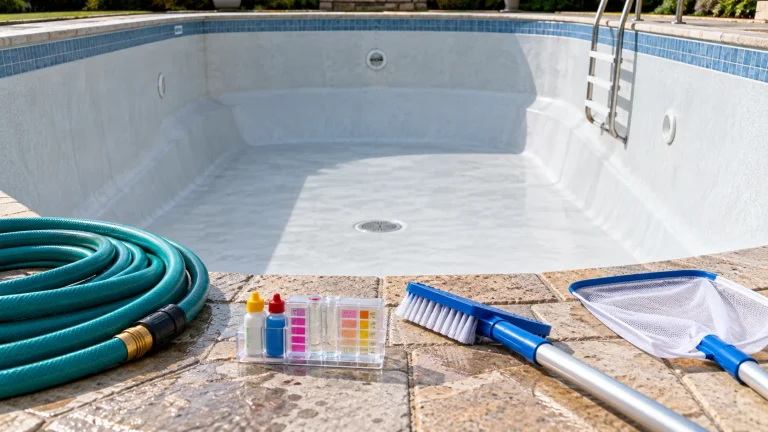
You only need three things for this step: a pool water test kit, a bottle of metal sequestrant, and patience. Test the fresh fill for iron, copper, pH, and total hardness. High water hardness (lots of dissolved calcium) can cloud the water, so write that reading down too. Many pool supply stores will run a water test on a sample for free if you’d rather not read strips.
A metal sequestrant is a chemical that grabs dissolved metals and holds them so chlorine can’t react with them. You’ll also see it sold as a sequestering agent or chelating agent. Same product, different label.
Why does the order matter so much? Because every step protects the next one. Here’s the sequence:
- Add the metal sequestrant first
- Run the filter for 24 hours
- Adjust the pH
- Shock (chlorinate) the pool
Most guides tell you to add sequestrant before shocking. Add it earlier than that: before the filter’s first run. Running the filter too early can strip the sequestrant out of the water before it finishes binding metals. Sequestrant, then 24 hours of filtration, then pH, then chlorine. That order is the whole trick.
Expect roughly 50 in chemicals for a first fill, depending on what your water test shows.
⚠️ Warning: Never add chlorine to well water before testing for metals. Add a metal sequestrant first, run the filter for 24 hours, THEN shock. Reversing this order turns the pool green or rust-brown.
Metal sequestrant pool treatment order for a well water fill.
✅Check: Step 3 is done when your test shows metals treated and the sequestrant has circulated a full 24 hours before any shock goes in.

Video: A DIY pre-filter setup that catches iron during a well water fill.
Common Well Water Pool Problems and Fixes
Already staring at a green or brown pool? Don’t drain it. Most well water pool problems trace back to metals, hardness, or an overworked well. Each one has a fix that doesn’t involve starting over. Match your symptom in the table below.
| Problem | Cause | Fix |
|---|---|---|
| Green water | Copper oxidized by chlorine | Metal sequestrant + run filter 48 hours |
| Brown or rust water | Iron oxidized by chlorine | Sequestrant + pool clarifier + vacuum |
| Cloudy water | High hardness or pH imbalance | pH adjustment + clarifier |
| Pump stops mid-fill | Well ran dry | Stop immediately, wait 24 hours before restarting |
| Sediment in pool | Well disturbed by heavy draw | Let it settle, then vacuum to waste |
Green pool water is the one that panics people most, and it’s also the most fixable. Iron staining on steps or the liner usually lifts after a sequestrant dose and a slow pass with the pool vacuum. A cloudy pool after the metals are handled usually means hardness or pH, and a clarifier speeds up the cleanup.
One more spot to check: if your well system has a sediment filter, rinse or swap the cartridge after the fill. A heavy draw stirs up grit, and a clogged cartridge chokes your household pressure. Sound familiar? That post-fill pressure drop is often the filter, not the pump.
When to Use Water Delivery Instead of Your Well
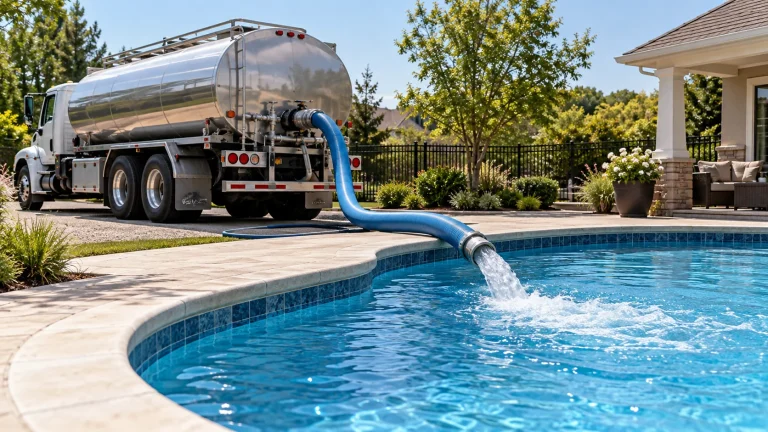
If your well runs under 8 GPM, has a history of pump trouble, or slowed down during past dry spells, water delivery is the safer call. A pool water truck fills the pool without your well lifting a finger, and it usually costs far less than a pump repair.
What if you’re somewhere in the middle? There’s a smart hybrid option. Use delivery for the first 5,000 to 8,000 gallons, then top off from the well. The truck handles the heavy lifting, your pump handles the light finish, and the pool fills faster.
Tip: Unsure about your well’s capacity? Water delivery for the first half of the fill, combined with well water for the rest, is a smart middle ground.
Delivery also makes sense when the pool’s volume dwarfs your pump capacity, like a 25,000-gallon in-ground pool on a modest well. And if your well has had pump problems before, don’t risk it. Call a well service company before filling if your pump is older, has needed repairs, or your pressure has ever dropped during heavy use. Choosing delivery isn’t a failure. It’s the same call a well driller would make after looking at your numbers.
FAQ: Filling a Pool with Well Water
Will well water turn my pool green?
It can. Green water after a well fill almost always means copper. Dissolved copper is invisible until chlorine oxidizes it, and then the whole pool shifts green within hours. Test for metals before shocking and add a metal sequestrant first. Treated early, the copper never gets the chance to show.
How long does it take to fill a pool with well water?
Plan on 2-3 days for a 15,000-gallon pool at 8 GPM using 4-6 hour fill sessions. A high-yield well at 15+ GPM can run continuously and finish in 1-2 days. Divide your pool’s gallons by your GPM for total minutes, then add recovery breaks.
How do I test my well’s GPM?
Three ways: pull your well report (filed with the county when the well was drilled), call the well driller listed on it, or run a bucket test. For the bucket test, time how long your hose takes to fill a 5-gallon bucket, then divide 5 by that time in minutes.
What chemicals do I need to add to well water in a pool?
In this order: metal sequestrant first, then run the filter for 24 hours, then adjust pH, then shock with chlorine. Reversing the order is how pools turn green or brown. Expect roughly 50 in chemicals for a first fill, depending on your test results.
Will filling a pool drain my well?
It can if you push a low-yield well too hard. Wells under 8 GPM risk running dry during a continuous fill. Stick to 4-6 hour sessions with matching recovery breaks, and stop right away if you notice sputtering air, falling pressure, or sediment in the water.
Ready to Fill? Your 3-Step Recap
Here’s the whole plan: check your GPM, fill in sessions, and test the water before any chemicals go in. That’s it. None of this is complicated, and it’s honestly easier than it looks. Five minutes with a bucket, a patient hose schedule, and one bottle of sequestrant stand between you and a full, clear pool. Once the water’s in, your next job is getting the chemistry dialed.