How to Fix Green Pool Water: A Step-by-Step Recovery Guide

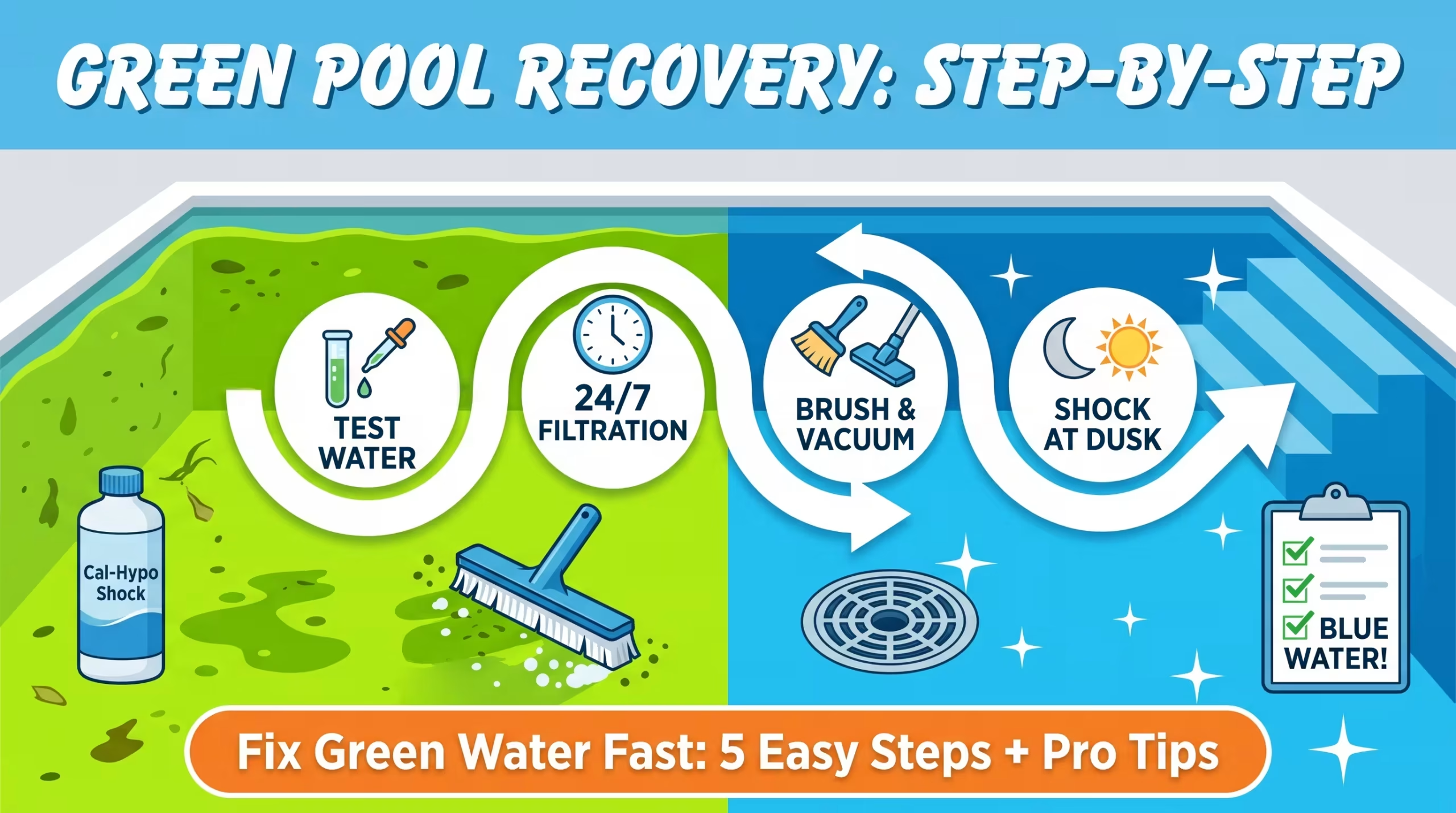
Walked outside and found your pool looking like a swamp? Take a breath, because this is fixable. Here’s how to fix green pool water: test the chemistry, correct the pH, add a heavy dose of chlorine shock, then run the filter nonstop until the water clears. Most pools start turning blue again within 24 to 48 hours.
The work itself takes an afternoon. The waiting takes longer, anywhere from a day for a light haze to a full week for water so dark you can’t see the steps. Green swimming pool water almost always means algae, and algae dies fast once chlorine and filtration gang up on it. You’ve got this.
Key Takeaways
- Shock with 1 lb of cal-hypo per 10,000 gallons for light blooms, 2 lb or more for dark water.
- Keep pH at 7.2 to 7.6 so the chlorine actually works.
- Run the filter 24/7 until the water clears.
- DIY chemicals run 90; HomeGuide puts professional green pool cleanup at 500.
What Causes Green Pool Water?
Algae causes green pool water in nearly every case. When free chlorine drops too low to kill spores, they multiply within hours, and warm sunny weather speeds them up. The less common culprit is dissolved metal. Copper or iron can oxidize and tint the water green with no algae involved.
Free chlorine is the portion of chlorine still available to sanitize. Total chlorine includes the spent portion, so a pool can show plenty of total chlorine while the free chlorine level sits near zero. That gap is where algae gets its opening.
So what tips the balance? A skipped week of testing. A heat wave. Sunlight burning off chlorine in a pool with no cyanuric acid, which is the stabilizer that acts like sunscreen for chlorine. Phosphates from lawn runoff feed the bloom, and a pump that runs too few hours lets it settle in.
What Different Shades of Green Mean
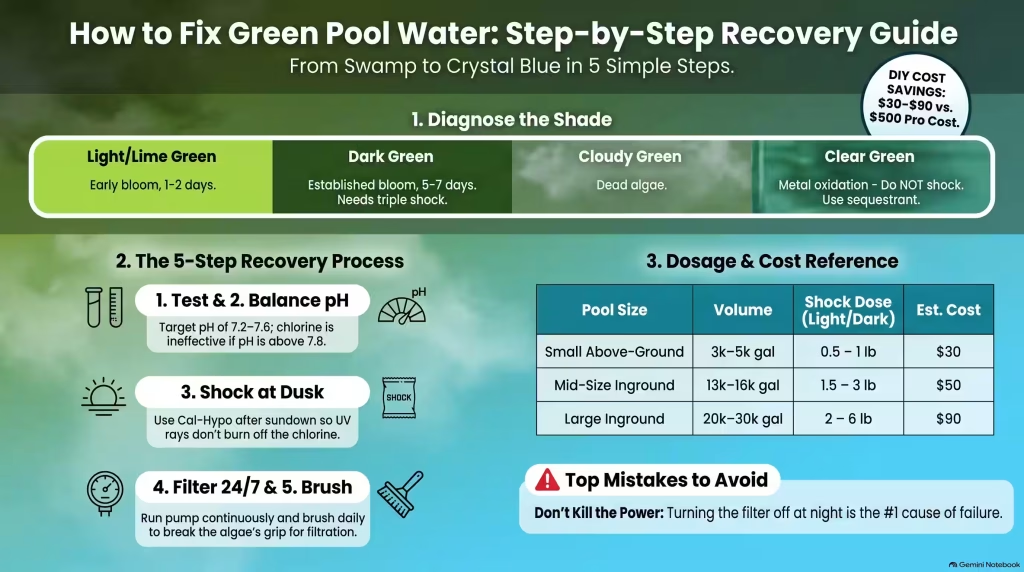
The shade tells you what you’re fighting. Light or lime green means a young algae bloom your chlorine can still overpower. Dark green means an established bloom. Cloudy green means dead or dying algae clogging the water. And green water you can see through usually means metals, not algae at all.
Which row matches your water?
| Shade of green | Likely cause | What to do |
|---|---|---|
| Light or lime green, floor visible | Early green algae bloom | Balance pH, single shock dose, filter 24/7 |
| Dark green, floor barely visible | Established algae bloom | Balance pH, double or triple shock dose, brush daily |
| Cloudy or murky green | Dead algae suspended in water | Keep filtering, add clarifier or flocculant, vacuum |
| Green but clear, no cloudiness | Oxidized copper or iron | Add a metal sequestrant. More chlorine makes it worse |
That last row trips people up. A clear green pool after a shock treatment often means the chlorine oxidized dissolved copper, and no amount of extra shock will fix a metal problem. A sequestrant, which binds metals so they can’t stain or tint, is the correct tool there.
What You’ll Need
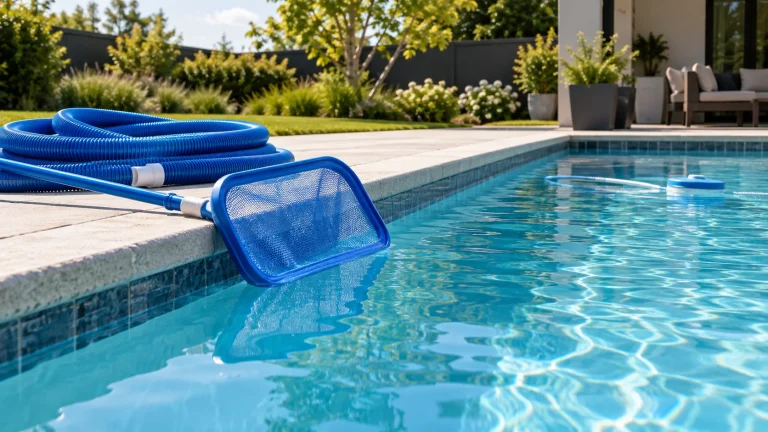
You need five things to clear a green pool: a pool test kit, calcium hypochlorite shock (cal-hypo, the strongest common pool shock), a stiff pool brush, a manual vacuum, and patience with the filter. An algaecide and a bottle of clarifier help, but most blooms die without them.
🔧 Tools You’ll Need
- Liquid drop test kit or test strips: 70
- Cal-hypo pool shock: about 6 per pound
- Pool brush (nylon bristles for vinyl liners, stainless for plaster): 25
- Manual vacuum head, pole, and hose: 60
- pH decreaser, pH increaser, and alkalinity increaser: 25
- Optional: polyquat 60 algaecide (a copper-free type that won’t stain): 30
- Optional: clarifier or flocculant: 20
Time: 1 to 2 hours of active work, then 1 to 7 days of filtering | Difficulty: Beginner | Chemical cost: 90
Step 1: Test Your Water
Start with a full water test before touching any chemicals. You need four numbers: free chlorine, pH, total alkalinity, and cyanuric acid. Free chlorine is the chlorine still able to kill algae. Total chlorine includes the used-up portion, so don’t confuse the two readings on your kit.
A liquid drop kit gives more accurate results than strips, and accuracy matters most for cyanuric acid. Cyanuric acid should sit between 30 and 50 ppm. Below that range, sunlight destroys your chlorine within hours. Above roughly 100 ppm, you’re heading toward chlorine lock, which we cover in the mistakes section below.
Write all four numbers down. You’ll retest daily during the cleanup, and the trend matters as much as any single reading.
✅ Check: You have written values for free chlorine, pH, total alkalinity, and cyanuric acid before opening a single chemical bucket.
Step 2: Balance the pH and Alkalinity
Correct the pH and alkalinity before you shock, because chlorine kills algae best at a pH of 7.2 to 7.6. Past 7.8, most of your chlorine shifts into a weak, inactive form. Total alkalinity should sit between 80 and 120 ppm so the pH doesn’t bounce around.
Aim for the low end, around 7.2, before shocking. Use dry acid or muriatic acid to bring a high pH down, and baking soda or an alkalinity increaser to raise low alkalinity. Add one chemical at a time, run the pump for a couple of hours, then retest before adding anything else.
Skipping this step is the top reason a shock fails. People pour in pounds of chlorine at a pH of 8.0, watch nothing happen, and assume the algae is invincible. It isn’t. The chlorine was working at a fraction of its strength.
✅ Check: pH reads between 7.2 and 7.6 and total alkalinity reads between 80 and 120 ppm on a fresh test.
Step 3: Shock the Pool
Shock the pool at dusk using 1 lb of cal-hypo per 10,000 gallons for a light bloom. Dark or severe green water needs 2 lb or more per 10,000 gallons. Free chlorine has to climb past 3.75 to 4 ppm before it starts killing an active algae bloom.
Why dusk? The sun eats chlorine. Shocking after sundown gives the chemical a full night to work at full strength instead of fighting UV rays all afternoon.
Adding Cal-Hypo Safely
Pre-dissolve the shock in a bucket of pool water first, always adding shock to water and never water to shock. Pour the mix slowly around the pool’s perimeter with the pump running. Keep undissolved granules off vinyl liners, since they can bleach the material, and never combine different chlorine products in one bucket.
Hold off on algaecide for now. Shock-level chlorine destroys most algaecides on contact, so the bottle does nothing until levels come back down. Polyquat 60 earns its keep a day or two later as a follow-up, not as an opening move.
✅ Check: Within a few hours the water shifts from green toward a grey-blue or milky white. That color change is dead algae, and it means the shock is winning.
Step 4: Run the Filter Around the Clock
Run the pump and filter 24 hours a day until the water is fully clear. Not 8 hours. Not overnight only. Filtration is what physically removes dead algae, and every hour of downtime adds delay. Empty the skimmer basket and check the filter pressure gauge twice a day.
Why so aggressive? Chlorine kills algae, but killing it turns the water cloudy rather than clear. Millions of dead cells stay suspended until the filter traps them, and a filter can only trap what flows through it.
Dead algae clogs filters quickly. Backwash a sand or DE filter whenever the pressure gauge climbs 8 to 10 psi above its clean baseline. For a cartridge filter, pull the cartridge and hose it down whenever flow visibly weakens.
✅ Check: Water visibly clearer each morning, skimmer basket emptied, and filter pressure back near baseline after each backwash or rinse.
Step 5: Brush, Vacuum, and Clear the Water
Brush every wall, step, and corner once a day while the water clears, because brushing breaks the algae’s grip and exposes it to chlorine. Vacuum settled debris to waste if your filter has that setting. If the water stalls at cloudy, a clarifier or flocculant finishes the job.
The two products work in opposite directions. A clarifier clumps fine particles into bigger ones your filter can catch, so you keep the pump running. A flocculant drags everything to the floor overnight, and you vacuum the sediment to waste the next morning with the pump off.
Vacuuming to waste sends debris out the backwash line instead of through the filter. You’ll lose a few inches of water, but the filter never touches that sludge. Top the pool back up afterward.
✅ Check: You can see the main drain at the deepest point of the pool. That’s the finish line for clarity.
Shock Dosage and Cost by Pool Size
Match the shock dose to your pool’s volume, not to a scoop-and-hope guess. The table below covers the two most common dose levels and what the chemicals cost. Don’t know your gallons? Multiply length by width by average depth in feet, then multiply by 7.5.
| Pool size | Volume | Shock dose (light green) | Shock dose (dark green) | Est. chemical cost | Typical time to clear |
|---|---|---|---|---|---|
| Small above-ground (12-15 ft round) | 3,000-5,000 gal | 0.5 lb cal-hypo | 1 lb | 30 | 1-3 days |
| Mid-size inground (14×28 ft) | 13,000-16,000 gal | 1.5 lb cal-hypo | 3 lb | 50 | 2-5 days |
| Large inground (16×32 ft and up) | 20,000-30,000 gal | 2-3 lb cal-hypo | 4-6 lb | 90 | 3-7 days |
Costs assume cal-hypo at roughly 4 to 6 per pound plus a follow-up algaecide dose. Severity moves the timeline more than size does: a light green bloom clears in 24 to 48 hours, while a dark green bloom takes 5 to 7 days of shocking, brushing, and nonstop filtering.
💡Budgeting past this rescue? Our pool maintenance cost guide breaks down what weekly care and chemicals run per month.
How to Fix Green Pool Water Fast
The fastest safe fix is a double shock at dusk, flocculant overnight, and a vacuum to waste in the morning. A light bloom can be swimmable in about 24 hours this way. Nothing safe clears a dark green pool overnight, so treat any product promising that with suspicion.
What makes floc the shortcut? It skips the slowest part of the process. Instead of waiting days for the filter to strain out dead algae, the flocculant drops it all to the floor in one night, and one careful vacuuming removes it.
The speed sequence looks like this. Balance pH to 7.2 in the afternoon. Shock at double strength at dusk. Add flocculant late that evening and shut the pump off. In the morning, vacuum the sediment layer to waste, restart the filter, and retest before anyone swims.
How to Fix a Green Salt Water Pool
Fix a green salt water pool the same way as a chlorine pool: balance, shock, filter. Don’t rely on the salt water chlorine generator, because it makes chlorine far too slowly to overwhelm a bloom. Shock manually with cal-hypo or liquid chlorine, and inspect the salt cell for scale.
Why bypass a system you paid thousands for? A generator is built to maintain 1 to 3 ppm of chlorine, drip by drip. An algae bloom demands shock levels several times higher, right now. The boost or superchlorinate mode helps hold the line afterward, but it can’t win the initial fight.
While the pool clears, pull the salt cell and look at the plates. White crusty scale on the plates chokes chlorine production, and a scaled cell is often the reason the pool went green in the first place.
Fixing Green Water in Above-Ground and Intex Pools
Above-ground and Intex pools clear faster than inground pools but punish overdosing, so measure carefully. A 12 ft Intex pool holds roughly 1,700 to 3,000 gallons, which calls for a few ounces of shock rather than a full pound. The small cartridge filter is the real bottleneck.
Tempted to eyeball the dose? Don’t. In 2,000 gallons, an extra half pound of cal-hypo sends chlorine to eye-burning levels and can bleach the liner. Weigh or measure the shock, pre-dissolve it, and pour slowly.
Those little cartridge filters clog fast once algae starts dying. Rinse the cartridge twice a day during cleanup, or keep a $10 spare and rotate them. For pools under about 3,000 gallons, compare the chemical bill against a drain and refill, which sometimes costs less. Check local rules first, since some cities restrict where pool water can be discharged, and our pool filling guide covers refill costs and timing.
Why Pools Turn Green After Rain or Opening
Rain strips your pool’s defenses three ways at once. It dilutes free chlorine, washes in phosphates and organic debris that feed algae, and knocks the pH out of range. Spring opening is riskier still, because the water has sat for months with weak circulation and fading chlorine.
Test within 24 hours of any heavy storm, and follow a big rain with a small preventive shock treatment. Storm runoff from decks and lawns carries more algae food than the rain itself, so skim debris out quickly and brush afterward.
Opening a green pool in spring? Open earlier next year. Algae wakes up when water passes about 60°F, and a pool opened before that point starts the season with chlorine already in charge. A pool opened in late May often starts the season already green under the cover.
Common Mistakes That Keep Pools Green
Five mistakes cause nearly every stubborn green pool: shocking before fixing the pH, underdosing, turning the filter off at night, adding algaecide at the same time as shock, and ignoring chlorine lock. Chlorine lock happens when cyanuric acid climbs so high that chlorine can barely work.
Sound familiar? Underdosing is the most common of the five. A dark green bloom hit with a light green dose recovers overnight, and you’ve spent money teaching the algae nothing. When in doubt, round the dose up, not down.
Chlorine lock deserves its own explanation. Every puck of stabilized trichlor chlorine adds cyanuric acid that never leaves the water. Once cyanuric acid passes roughly 100 ppm, it binds up your chlorine, tests turn confusing, and shock after shock seems to vanish. The fix is a partial drain and refill, and our guide on how to break chlorine lock walks through it.
When to Call a Pool Pro
Call a pool professional when the water has been green for over a month, when black algae shows up, or when cyanuric acid tests above 100 ppm and a partial drain is on the table. HomeGuide puts professional green pool cleanup at 500 for the initial visit.
Compare that against 90 in DIY chemicals and it’s clear why most people try the shock route first. Still, a pro earns the fee in specific situations, and there’s no shame in handing one of these over.
🚨 When to Call a Pro:
- Water has stayed green for 4+ weeks despite repeated shocking
- Black algae spots on plaster (they root into the surface and resist normal treatment)
- Cyanuric acid above 100 ppm, requiring a partial or full drain
- Metal staining spreading on the liner or plaster
- A pump or filter that won’t hold pressure, since no chemical fixes broken circulation
How to Keep Your Pool from Turning Green Again
Prevention takes five minutes a week: test the water, keep the free chlorine level between 1 and 3 ppm, and hold cyanuric acid in the 30 to 50 ppm range. Run the pump 8 to 12 hours a day during swim season. Covered, circulated, chlorinated water almost never turns green.
Build the habit around a fixed day. Test every Sunday evening, brush the walls while you’re there, and empty the skimmer basket. Retest after storms, parties, and heat waves, since those three events cause most mid-season blooms. A printed weekly pool maintenance checklist on the shed wall makes the routine automatic.
Pool chemistry drifts slowly, then all at once. Catching free chlorine at 1 ppm on a Sunday costs you a scoop of shock. Catching it at zero on a Friday costs you the weekend.
Frequently Asked Questions
How long does it take to fix green pool water?
Light green water clears in 24 to 48 hours with shock and constant filtration. Dark green water takes 5 to 7 days, sometimes longer if the filter clogs with dead algae and needs repeated backwashing. The biggest factor isn’t the chemical dose. It’s how many hours the filter runs.
Is it safe to swim in a green pool?
No. Green water can carry bacteria that cause skin rashes, ear infections, and irritated eyes, and murky water also hides swimmers from view. Wait until the water is clear, free chlorine has dropped back below 5 ppm, and at least 24 hours have passed since the last shock.
Why is my pool still green after shocking it?
Three causes explain nearly every failed shock: the dose was too small for the bloom, the pH sat above 7.8 so the chlorine went inactive, or metals like copper are tinting the water and chlorine can’t help. Retest, correct the pH, then shock again at double strength.
Will a green pool clear itself without chemicals?
Not reliably. Filtration alone can slowly thin an algae bloom, but it can’t kill algae that’s actively multiplying, and it does nothing for metal discoloration. Shock treatment paired with round-the-clock filtering remains the standard fix. Skipping chemicals usually trades days of green water for weeks of it.
What turns pool water green in the first place?
Algae, in the vast majority of cases. Low chlorine, high pH, or weak circulation lets spores bloom, often right after rain, a heat wave, or a stretch of missed testing. Less often, dissolved copper or iron oxidizes and tints the water green even though it stays clear.
How do you fix green hair from pool water?
Green hair comes from copper in the water, not chlorine. The copper oxidizes and bonds to hair, especially blonde or bleached hair. Wash with a clarifying or chelating shampoo, or work a paste of crushed vitamin C tablets and water through damp hair for five minutes, then rinse.
One Last Thing Before You Grab the Shock
A green pool says nothing about you as a homeowner. Pools turn on the people who love them most, usually the week of a party. Now you know how to fix green pool water without paying for a service call, so start tonight: test, balance, shock at dusk, and let the filter grind while you sleep.
Tomorrow morning the water should already look different. Once it’s blue again, put five weekly minutes of testing on the calendar, because that small habit is the difference between owning a pool and fighting one. And if you’re weighing whether ongoing service is worth it, our pool maintenance cost guide lays out the real monthly numbers.