How Much Space Between a Refrigerator and an Island?
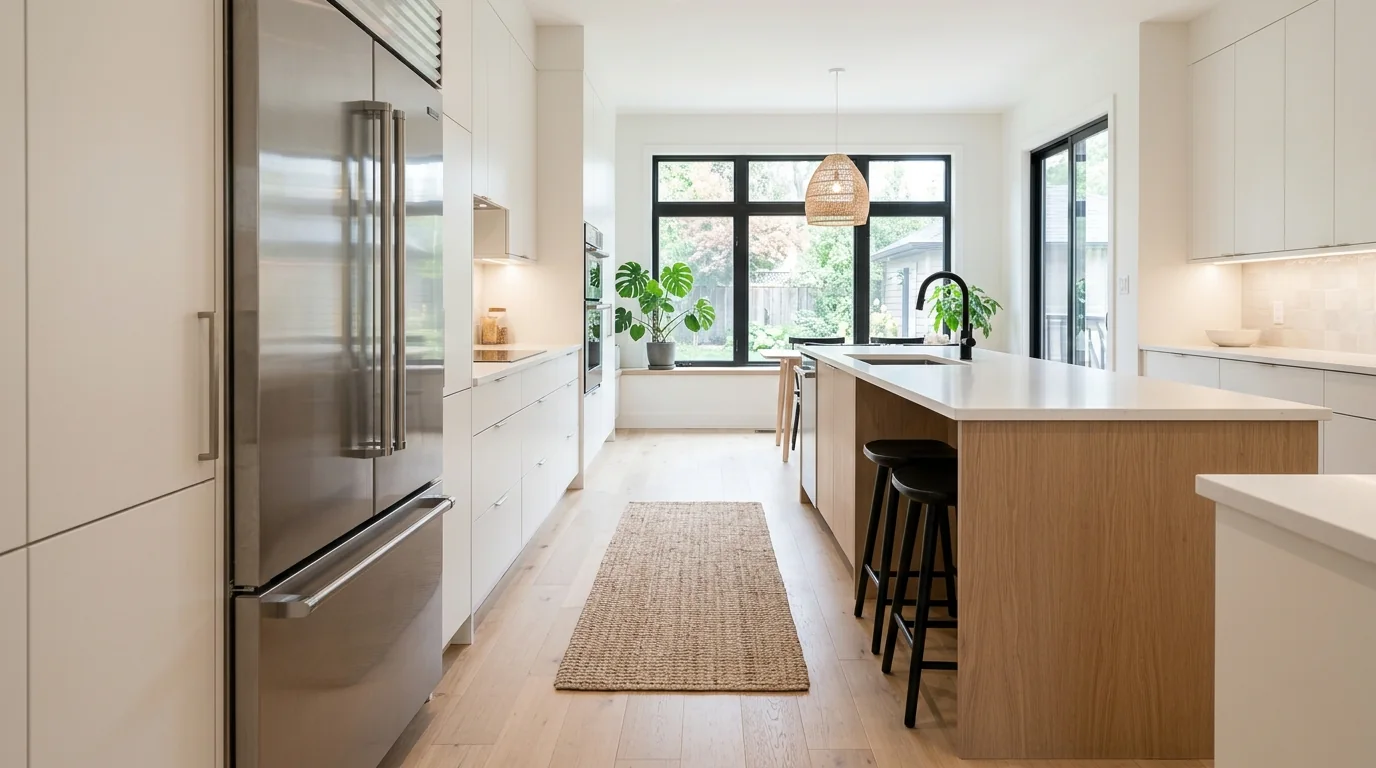
Start by measuring from the closed refrigerator handle to the nearest kitchen island edge. In a 42-inch (107 cm) aisle, the two GE French-door models below leave 31.0 to 34.1 inches (79 to 87 cm) in front at 90 degrees. Pull the freezer drawer out separately, then test pass-through room.
A tape measure, your refrigerator model number, and a few flattened cardboard boxes are all you need to test a layout before ordering cabinets. Showroom floors hide how fast a swinging door or deep freezer bin eats up an aisle. Checking three exact points, closed handle gap, 90-degree door reach, and full freezer extension, prevents daily kitchen bottlenecks.
Is 36, 42, or 48 Inches Enough Between a Refrigerator and an Island?
A 42-inch (107 cm) handle-to-island gap works well for one cook in most residential kitchens, while 48 inches (122 cm) lets a second person walk past an open fridge door comfortably. Thirty-six inches (91 cm) only suits a secondary side route where nobody needs to pass behind you.
A 36-inch gap feels workable if the refrigerator sits near the end of an island with an open walkway around the other side. Place that same 36-inch gap on the single path to your sink, and every milk grab blocks the room. One Houzz household reported that even a 39.5-inch (100 cm) gap felt tight whenever two people cooked together.
All values below are in inches, starting with the stated clear distance from the closed handle to the island edge. Extra reach at 90 degrees equals open depth minus closed depth with handle. Subtract that reach from the closed aisle and round to one decimal.
| GE Model | Closed With Handle | Open at 90° | Extra Reach | Left at 36 in | Left at 42 in | Left at 48 in |
|---|---|---|---|---|---|---|
| GNE27JYMFS, French-Door | 35.875 in | 43.75 in | 7.875 in | 28.1 in | 34.1 in | 40.1 in |
| GWE19JYLFS, Counter-Depth | 31.0 in | 42.0 in | 11.0 in | 25.0 in | 31.0 in | 37.0 in |
Each row above holds the handle-to-island distance constant. When comparing GE GNE27JYMFS specifications against GE GWE19JYLFS specifications inside the same kitchen, hold the island and the rear wall plane fixed instead. At the same installed rear plane, the counter-depth GWE19JYLFS ends 1.75 inches (4.4 cm) closer to the wall when open to 90 degrees. Account for each model’s rear air clearance, and remember that door arc, freezer extension, and standing body room each require their own separate check.
Where Do You Measure the Distance Between a Fridge and an Island?
Measure the distance between a refrigerator and an island from the appliance’s furthest closed projection, usually its front door handle, straight across to the closest finished island edge or cabinet pull. Measuring from base cabinet box to base cabinet box overstates your true walking aisle by several inches.
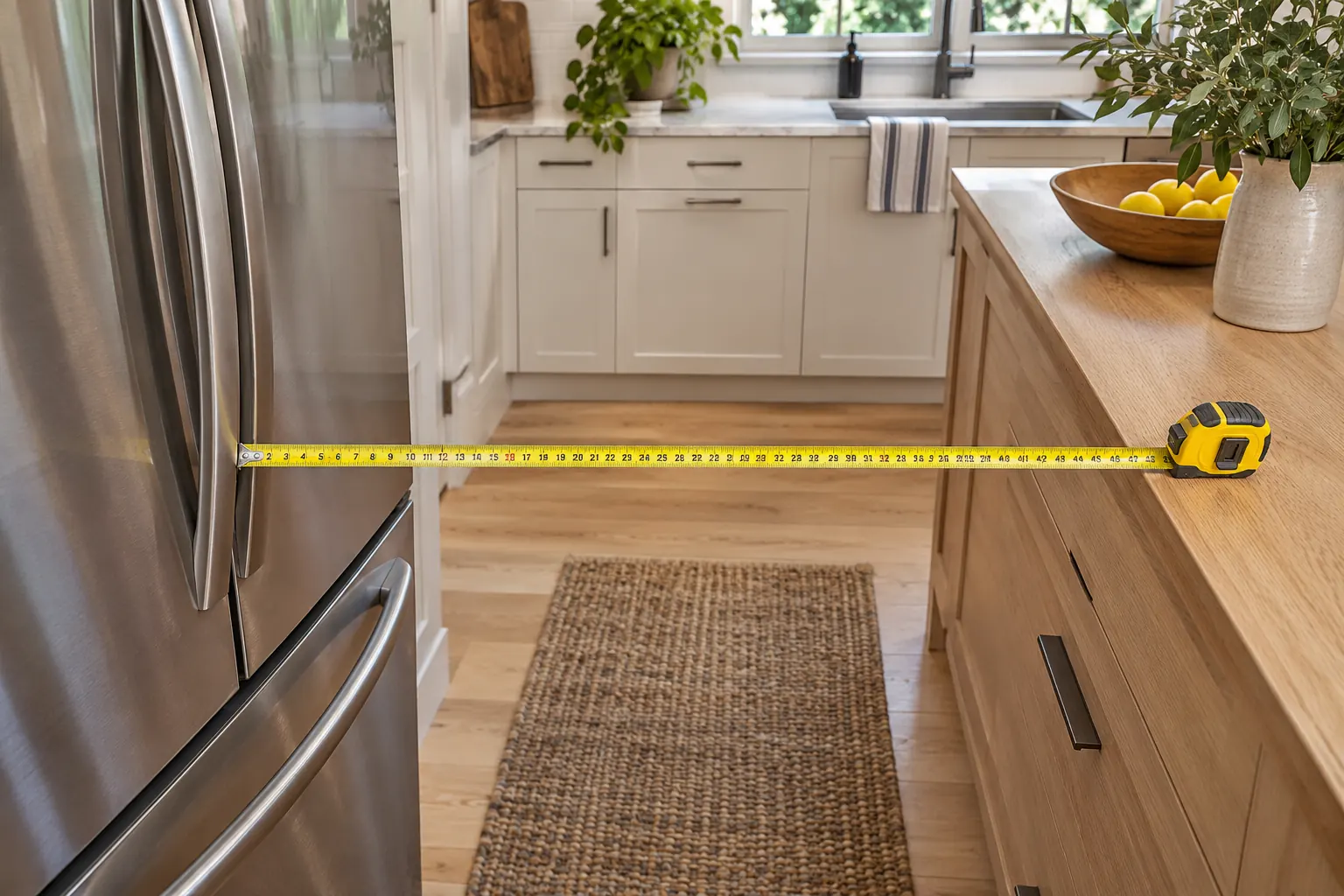
Cabinet layouts often show a clean 45-inch (114 cm) gap between two 24-inch base boxes. That number disappears fast once real hardware arrives. A standard-depth French-door fridge with handles reaches 35.875 inches (91 cm) from the wall, which sticks out nearly 12 inches past adjacent 24-inch base cabinets.
On the opposite side, a 1.5-inch (4 cm) countertop overhang plus a 1.25-inch (3 cm) island drawer pull pushes the island outward by almost 3 inches. On a blueprint, always mark the installed fridge front after adding the model’s rear air-circulation gap (often 1 to 2 inches behind the box for water lines and cords). Only the space left between those two outermost edges belongs to your feet.
How Do You Measure Refrigerator Door Swing Clearance?
Find your exact model’s closed depth with handles and its depth open at 90 degrees on the manufacturer spec sheet. Subtract closed handle depth from 90-degree open depth to see how far the door reaches, then trace the full swing arc on the floor with painter’s tape.
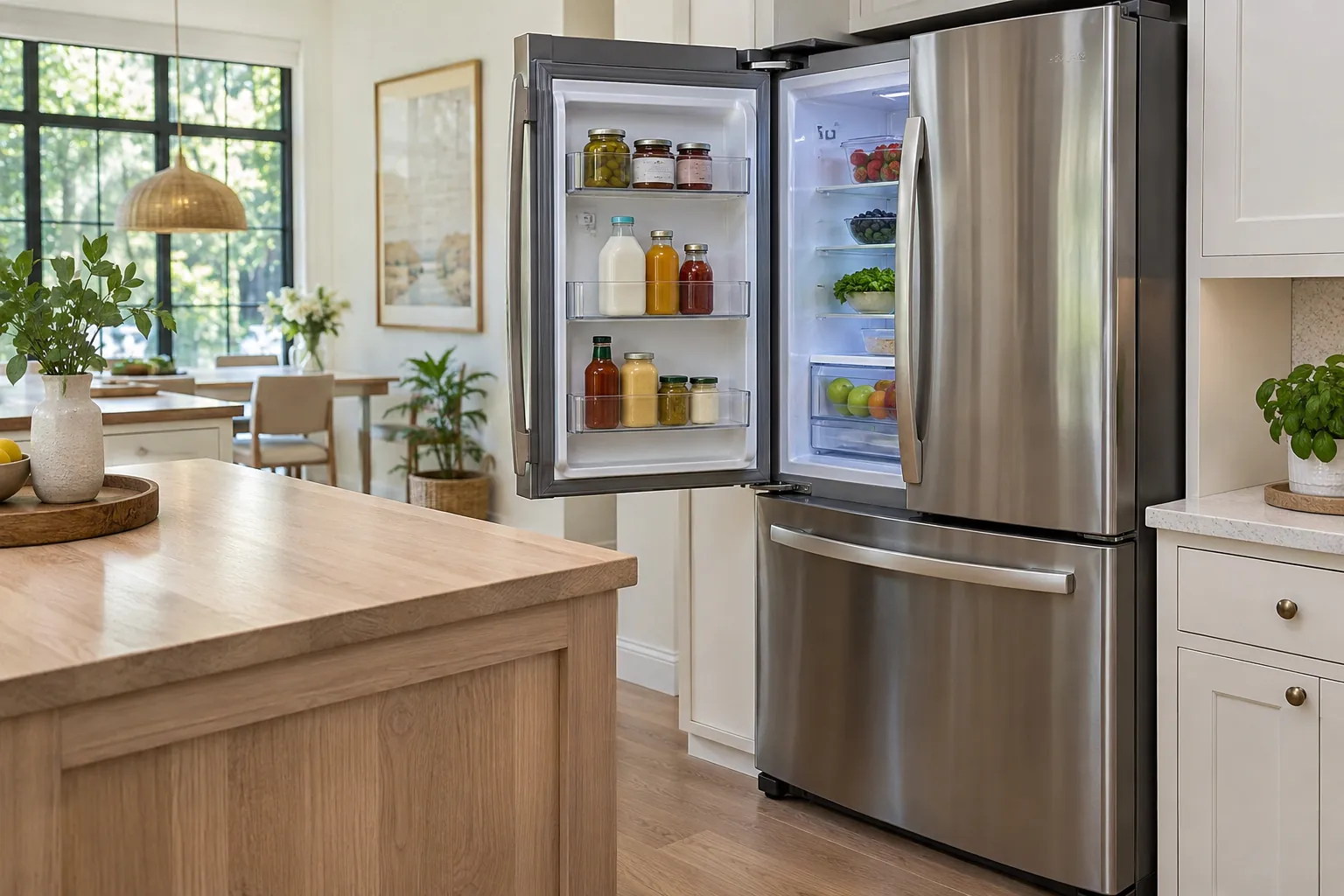
Walk through one quick subtraction using the GE GWE19JYLFS counter-depth French-door model. Its 90-degree open depth is 42.0 inches (107 cm), and its closed depth with handles is 31.0 inches (79 cm). Subtracting 31.0 from 42.0 gives 11.0 inches (28 cm) of extra reach past the closed handle.
French-door refrigerators have narrow split doors, so they swing less far forward than single-door models. A 36-inch single-door fridge swings a much wider arc straight toward your island. Trace that full curved arc on your floor with tape, especially if only one corner of the island overlaps the fridge opening.
Check hinge-side walls and door bins before assuming 90 degrees is enough. If a refrigerator sits tucked right against a side wall or tall pantry cabinet, a 90-degree stop often keeps interior crisper drawers from sliding out. Opening the door to 110 or 120 degrees needs extra side clearance so thick handles do not dent adjacent drywall.
Can You Fully Open the Freezer Drawer and Remove the Crisper?
Test your bottom freezer drawer at full rail extension separately from the upper doors, because a pull-out freezer basket often reaches farther into the aisle than a French door at 90 degrees. Then verify you can still swing upper doors wide enough to lift crisper bins out for cleaning.
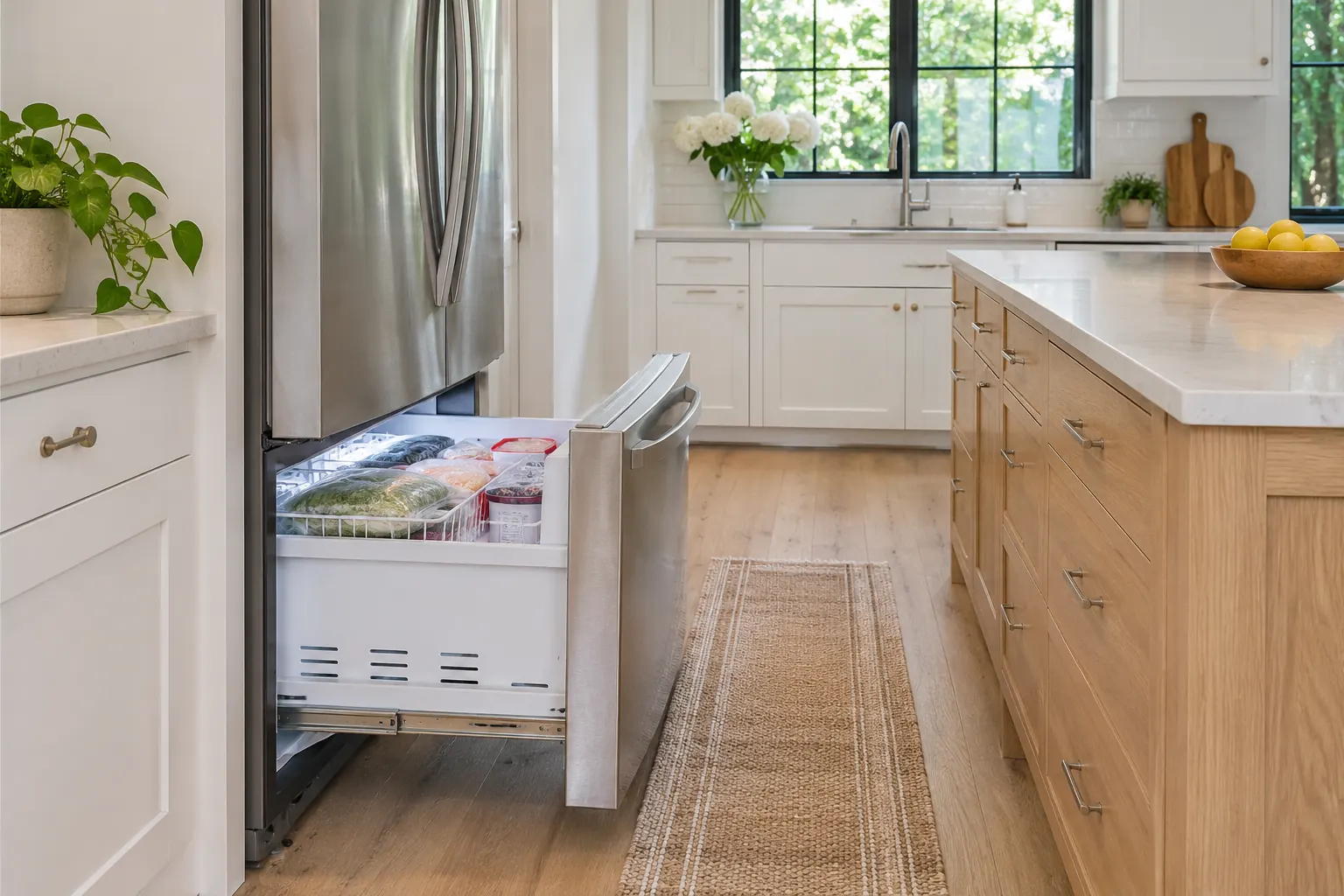
Accessing daily produce and lifting an entire glass-and-plastic crisper bin out for scrubbing are two completely different tasks. Many upper doors require a 110-degree or wider swing for a crisper drawer to clear the door-mounted gallon bins. Check the installation manual or pull a showroom drawer open with your own tape measure.
Bottom-freezer drawers present an even bigger floor pinch point because the solid drawer box slides straight out into your shins. Take a hypothetical drawer example: if a freezer drawer extends 22 inches (56 cm) beyond the closed handle inside a 42-inch (107 cm) aisle, only 20 inches (51 cm) remains between the drawer front and the island edge. Standing in front of that 22-inch drawer to lift a frozen turkey means your hips touch the island counter behind you.
Can Someone Walk Past While You Unload Groceries?
Stack cardboard boxes along your planned island edge to run a live grocery test before finalizing cabinet widths. Set a full shopping bag on the island landing spot, open the refrigerator door, lift a heavy milk jug inside, and ask another adult to walk their usual route to the sink.
Real-world kitchen friction shows up during grocery unloading, not empty walkthroughs. One Reddit layout thread highlighted how quickly an open refrigerator door blocks a narrow island landing spot when two adults try to put food away together. If your island has no clear landing counter within one pivot step of the fridge, you end up carrying heavy bags across the room while the door swings shut on your back. Check whether the second person has to squeeze sideways, wait, or detour around the far end of the island.
If that mock-up fails, test three quick fixes before buying anything. First, trim 6 inches (15 cm) off the length of the island end closest to the fridge so the doorway opens into open room space. Second, move your landing zone to a perimeter counter right beside the refrigerator hinge. Third, switch to a shallower counter-depth model or test opposing appliance doors, checking dishwasher door clearance if a dishwasher sits on the island side opposite your fridge. Whenever you slide an island back to widen the fridge aisle, recheck occupied seats on the opposite side.
Common Questions About Fridge-to-Island Spacing
Homeowners comparing refrigerator models and island sizes usually run into three final edge cases: whether counter-depth units automatically solve tight aisles, how corner overlaps change door swings, and what happens when bar stools sit across from the fridge.
Does a counter-depth fridge always give me more room?
A counter-depth refrigerator gives you extra floor space when closed, yet the gain shrinks once you open the door. In our GE comparison at a fixed rear wall plane, the counter-depth GWE19JYLFS ends just 1.75 inches (4.4 cm) closer to the wall at 90 degrees because its door swings 11 inches past the handle.
What if only one corner of the island overlaps the door?
If only one corner of the island sits across from the refrigerator opening, trace the full curved swing arc of the door with painter’s tape instead of measuring a straight line. Many French-door arcs clear the corner easily even in a 38-to-40-inch (97 to 102 cm) corner pinch point.
What changes if stools face the refrigerator?
Never place island bar stools in the same aisle facing an active refrigerator door. A seated diner occupies 18 to 22 inches (46 to 56 cm) behind the counter edge, which blocks freezer drawers completely; review clearance behind occupied island stools to keep seating on a separate side.