How to Fix Dark Corner in a Room: 5 Lighting Hacks
Reader Disclosure: This post contains affiliate links. If you buy through them, we may earn a commission at no extra cost to you. We only recommend items tested for clean craftsmanship and authentic durability.
Fix a dark corner with warm light that bounces off both walls. Use a floor uplight, an arc lamp, a battery sconce, a cordless table lamp, or a diagonal mirror. These options remove gloomy shadows without rewiring or a costly electrical job.
Standard home lighting design often relies on a single central ceiling fixture. A lone flush-mount dome or central chandelier casts light downward in a cone. This brightens the middle of the room but leaves corners in deep shadow. That uneven light can make a room feel cramped and gloomy. Your eye focuses on the bright center and skips the dark edges. Light the corners to show the full outline of the room. This makes the space feel larger and more balanced.
Before selecting fixtures, calculate your exact ambient light requirements with our interactive Room Lumens and Lighting Calculator to match corner fixture lumens directly to your room dimensions.

The Optical Science of Corner Shadow Removal
A dark corner looks brighter when light reaches both walls. Aim light at the seam where two walls meet. The light bounces across both walls and makes the room edges feel farther away.
Strong light contrast can tire your eyes. A bright screen and dark corners make your eyes work harder when you watch TV or read. That constant adjustment can cause eye strain and restlessness. Add 300 to 500 lumens of soft accent light in a dark corner. It evens out the room light and creates a calmer place to relax.
Bulb color also decides whether a corner feels cozy or cold. Do not use cool 4,000K bulbs in a dark nook. Cool light can make a shadowy nook feel harsh and unwelcoming. Use warm white bulbs rated at 2,700K. For detailed guidance on warm light coordination, read our comparison of 2700K vs 3000K living room lighting.
Top 5 Corner Lighting Solutions: Comparison Matrix
Match your corner lighting method to the available floor space, nearby power access, and your ceiling height. Consult our comparison matrix before choosing your installation hardware:
| Lighting Method | Power Source | Best Corner Application | Target Lumens & Kelvin | Electrician Required |
|---|---|---|---|---|
| Floor Can Uplight + Plant | Standard wall outlet | Behind large potted foliage | 400 – 800 Lm / 2700K | No (Plug-and-play cord) |
| Cantilevered Arc Floor Lamp | Standard wall outlet | Arched over reading chair or sofa | 600 – 1000 Lm / 2700K | No (Weighted base) |
| Rechargeable “Magic” Sconce | USB-C Lithium Battery | Drywall with no nearby outlet | 300 – 600 Lm / 2700K | No (Zero wires) |
| Cordless Pedestal Lamp | Rechargeable Battery | Corner console or plant pedestal | 200 – 450 Lm / 2700K | No (easy-to-move touch dimming) |
| 45° Diagonal Floor Mirror | Passive window daylight | Corner opposite exterior window | Natural daylight bounce | No (Passive reflection) |
Recessed ceiling lights often miss corners because the cans sit too far from the walls. Review our technical rules on recessed lighting layouts and pot light counts to coordinate your ceiling layout with dedicated corner accent fixtures.
Hack 1: Low-Profile Floor Can Uplights and Plant Silhouettes
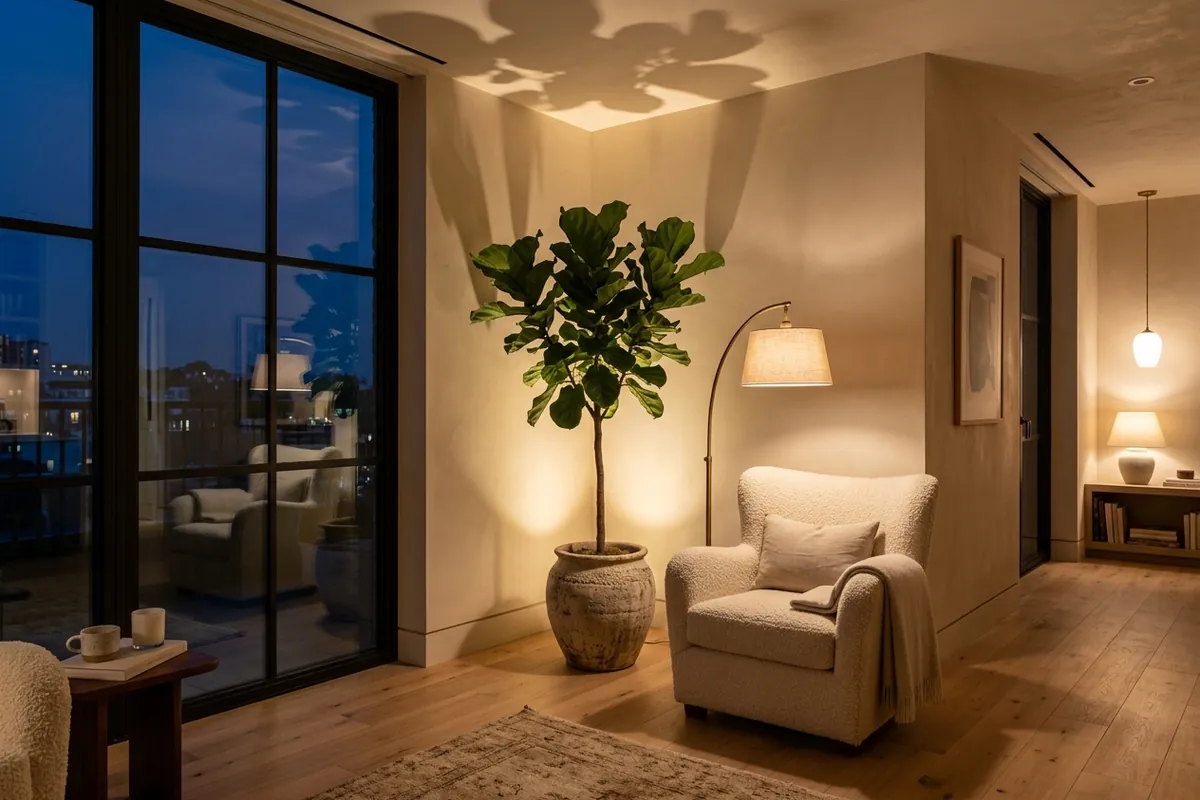
Place a small floor uplight 6 to 12 inches behind a large houseplant. Aim it through the leaves to cast soft plant shadows on the walls and ceiling.
This plant-light setup solves two decor problems at once. First, it fills an empty corner with height. Second, broad leaves soften the light like a lampshade. The leaves soften bulb glare and the hard 90-degree wall seam. Select hardy, shade-tolerant indoor plants with broad, sculptural foliage:
- Cast Iron Plant (Aspidistra elatior): Unmatched tolerance for low light. Thick lance-shaped foliage catches upward beam angles cleanly.
- ZZ Plant (Zamioculcas zamiifolia): Glossy waxy leaflets reflect upward light rays. This reflection introduces soft highlight accents across corner walls.
- Snake Plant (Dracaena trifasciata): Rigid sword-like vertical spears project bold room shadows that visually heighten low ceilings.
If your room lacks natural daylight entirely, fit your floor can with a full-spectrum LED grow bulb rated at three thousand kelvins. Modern warm grow bulbs emit balanced photosynthetic radiation without purple or pink hues. Keep the bulb at least eight to twelve inches away from the lowest foliage to prevent thermal leaf scorching. Pair the fixture with compact indoor floor spotlight can uplights equipped with a built-in foot pedal switch. Connect the cord to a smart plug timer. Your corner will illuminate automatically at sunset. This creates a cozy room atmosphere without manual switching.
Hack 2: Cantilevered Arc Floor Lamps Over Dark Corner Seating
Tuck the weighted base of a cantilevered arc floor lamp behind a corner armchair. The curved metal neck sweeps upward and suspends an overhead shade directly above your seating zone.
Many homeowners avoid placing comfortable reading chairs in room corners because standard table lamps require side tables that crowd the floor plan. An arc lamp resolves this spatial challenge. The heavy stone base occupies minimal floor space behind the chair. The sweeping arm delivers downward task light directly over your lap. This overhead delivery keeps floor space open and uncluttered. To discover additional ways to free up floor real estate, read our guide on maximizing vertical space in small apartments.
Select quality arc floor lamps with heavy marble bases that prevent tipping on thick carpet or rug pads. Choose fixtures fitted with linen or woven drum shades. Opaque metal hoods direct light only downward in a harsh spotlight. In contrast, translucent fabric shades allow twenty percent of the lumen output to filter laterally into corner walls. This lateral glow eliminates dark shadows behind the chair frame.
Hack 3: The “Magic Light Bulb” Wireless Rechargeable Sconce Protocol
The “magic light bulb” protocol uses standard hardwired wall sconce fixtures fitted with rechargeable battery-powered LED bulbs. This trick lets you mount designer wall lights in corners lacking electrical outlets with zero electrical rewiring.
Electrical rewiring is messy and cost-prohibitive. Installing an outlet or junction box in an existing finished wall costs several hundred dollars in contractor labor. Rechargeable LED bulbs bypass this obstacle. These special bulbs contain internal lithium-ion batteries and screw directly into standard E26 threaded sockets. When mounted in an unwired sconce, they operate via a compact wireless remote. The remote provides smooth dimming control from four hundred to six hundred lumens for up to twelve hours per charge.
Mount your fixture using small trim pins or wire hooks. For full mounting guidelines in rental spaces, review our decorator manual on plug-in wall sconces for rentals. When the battery drains, simply unscrew the bulb, recharge it via USB-C cable for two hours, and thread it back into the fixture socket. You can find dependable rechargeable battery LED bulbs with wireless remotes that include magnetic puck attachments.
Hack 4: Pedestal-Mounted Cordless Table Lamps with Touch Dimming
Place an slim pedestal or tall fluted plant stand in the corner and top it with a modern cordless LED table lamp. This setup introduces portable task light without trailing electrical cords across baseboards.
Corner cord clutter is an eyesore. When you run an extension cord across baseboards to reach a distant outlet, the cable calls attention to the room flaw you are trying to hide. High-end cordless accent lamps eliminate this issue. Crafted from machined aluminum or weighted brass, modern cordless lamps feature internal batteries that recharge on discreet magnetic induction pads. Positioned atop a thirty-six-inch wooden pedestal, the lamp casts a soft downward halo. This warm light enriches the corner while maintaining a clean, minimalist silhouette.
Look for cordless lamps featuring built-in touch-capacitive dimming. A gentle tap on the lamp cap lets you cycle between bright task output for reading and a soft evening glow that complements your primary living room lighting. Style the pedestal with a ceramic stoneware vase or a stack of art books to anchor the vignette.
Hack 5: The 45-Degree Diagonal Mirror Periscope Reflection Trick
Angle a full-length floor mirror at forty-five degrees across the corner intersection to catch incoming daylight from opposing exterior windows and bounce natural light deep into corner shadows.
Hanging a flat mirror flush against one wall in a shadowy corner is ineffective. The flat mirror merely reflects the opposite dark wall. This flat reflection doubles the perceived gloom. Angling the mirror diagonally across the ninety-degree seam changes the optical geometry. The glass acts like a periscope. It intercepts sunlight from adjacent windows and redirects natural photons across the room. To explore more spatial reflection techniques, read our guide on how to make a small bedroom feel bigger.
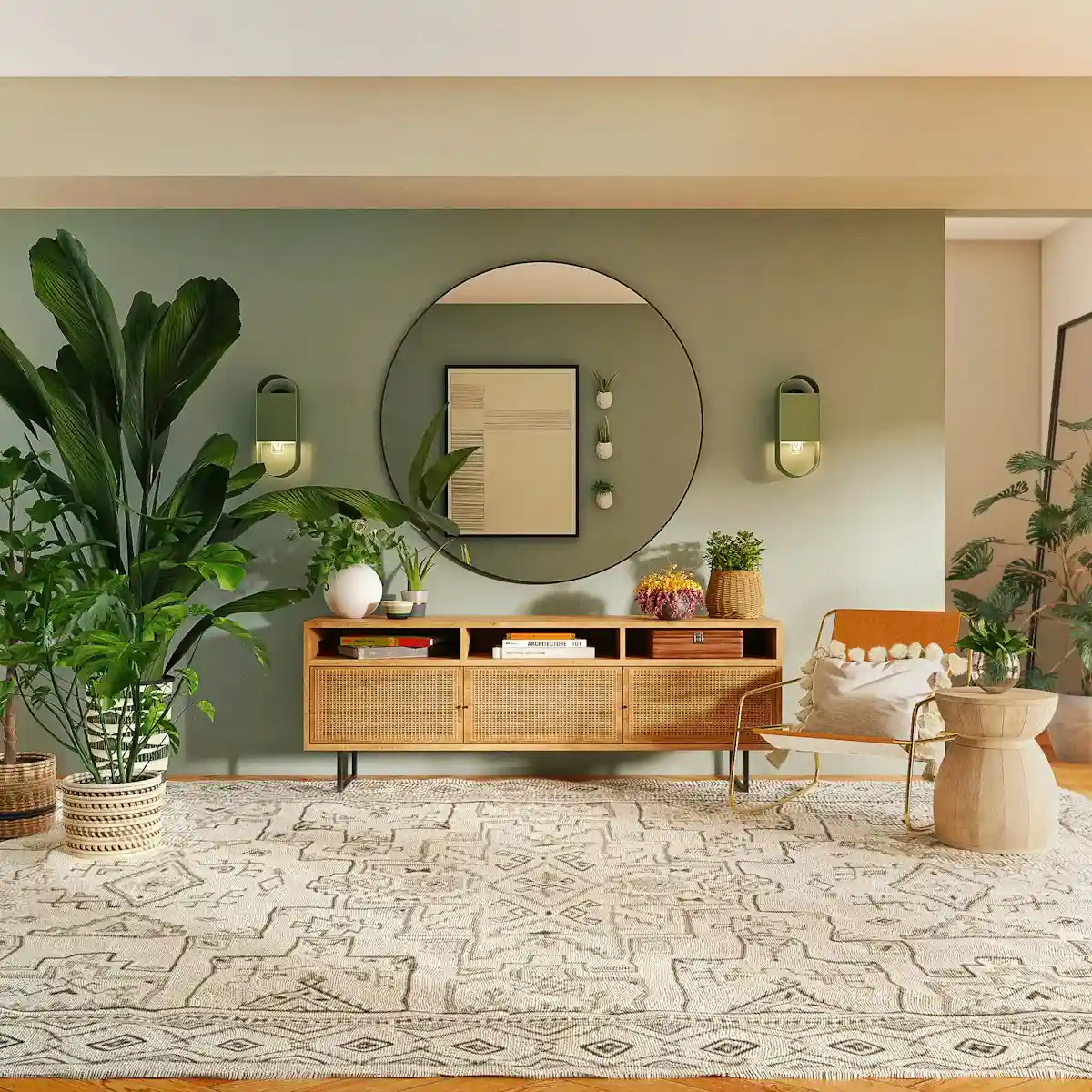
Secure the base of the leaning mirror with dense non-slip rubber grip pads to prevent sliding on hardwood or tile floors. In the evening, place a small cordless candle or low-profile uplight at the base of the mirror. The glass reflection doubles the perceived light source. This secondary reflection creates an expansive illusion of depth behind the frame.
Strategic Wall Finishes and Light Reflectance Value (LRV)
Wall paint sheen and Light Reflectance Value (LRV) directly control how much light your corner fixtures amplify. Standard flat builder-grade paint absorbs up to sixty percent of incoming light rays. This absorption dulls your fixture output.
Light Reflectance Value measures the percentage of light a paint color reflects on a scale from zero (pure black) to one hundred (pure white). In rooms with dark corners, choose wall colors with an LRV rating of sixty-two or higher. Soft warm whites, pale greiges, and light creamy ivories bounce ambient photons across the room effectively.
Paint sheen also alters bounce characteristics. Flat or matte paint scatters light in all directions. This texture softens harsh lines but absorbs some light output. An eggshell or satin finish introduces microscopic surface sheen. This soft luster bounces directional uplighting across the corner ceiling without mirror glare. Repainting a single dark corner accent wall in a high-LRV eggshell hue makes better use of your lighting.
Frequently Asked Questions About Brightening Dark Corners
What is the easiest way to light a dark corner without an outlet?
The easiest method is using rechargeable battery-powered LED bulbs inside a wall sconce, or placing a cordless USB-C table lamp on a corner stand. These fixtures provide warm, dimmable light for eight to twelve hours without extension cords or electrical work.
How many lumens do you need to brighten a dark room corner?
You need three hundred to six hundred lumens of warm white light to balance shadows in an average corner. For reading nooks, select six hundred to eight hundred lumens with dimming controls for late-night relaxation.
Where should you place an uplight in a dark room corner?
Place an uplight on the floor six to twelve inches behind a large indoor houseplant or armchair. Angle the canister upward at a forty-five-degree tilt to bounce soft, diffuse light across the corner drywall and ceiling.
Can a mirror brighten a dark room corner?
Yes, angling a full-length mirror diagonally at forty-five degrees across the corner catches natural daylight from opposing windows. This diagonal placement redirects light into shadowy areas. The bounce creates the optical illusion of an additional window.
What color light bulb should you use for dark corners?
Always use warm white twenty-seven hundred kelvin (2700K) LED bulbs with a Color Rendering Index above ninety. Warm light softens harsh contrast gradients and flatters natural wooden furniture and textiles.
What houseplants grow best in dark room corners?
Cast Iron plants, ZZ plants, and Snake plants thrive in low-light environments. Their broad, broad foliage catches upward lighting beams. This foliage projects bold botanical silhouettes across corner walls.