Picture Hanging Wire Sag vs Dual D-Rings: 5 Tests Compared
Reader Disclosure: This post contains affiliate links. If you buy through them, we may earn a commission at no extra cost to you. We only recommend hardware tested for craftsmanship, load capacity, and long-term durability.
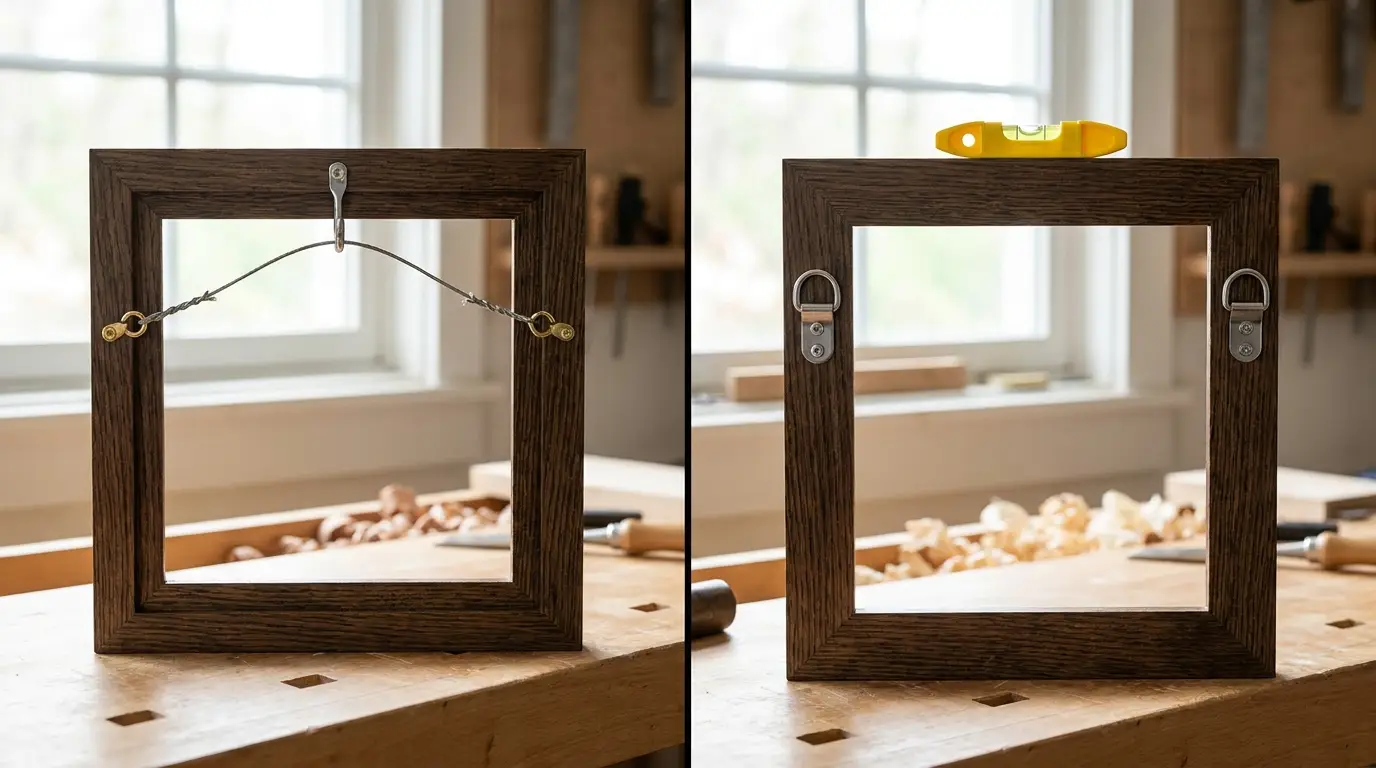
Hanging framed artwork with traditional picture wire almost always ends in frustration. Within weeks of hanging, braided wire stretches under weight, slips across the wall hook, and leaves your frames tilting noticeably askew. Upgrading to dual D-rings installed directly onto two level wall anchors eliminates tilt, halves the load on your drywall, and removes the inward tension that ruins wooden frame joints.
If you have ever found yourself nudging a picture frame straight every time someone closes a door nearby, the hanging hardware is the culprit. Wire relies on a single apex point where gravity and friction work against you. Below, we break down the engineering reality across five head-to-head performance tests and provide a complete conversion guide to keep your wall art level permanently.
Before installing hooks or pre-drilling mounting holes, check your frame dimensions and artwork weight with our Picture Wire Hanging Calculator to calculate exact hardware ratings and spacing points.
The 5 Head-to-Head Tests: Picture Wire vs. Dual D-Rings
To understand why professional framers avoid hanging wire for heavy art, we evaluated both systems across five structural benchmarks: rotational drift, corner joint stress, wall flushness, anchor load distribution, and installation precision.
Test 1: Vibration and Rotational Drift (Why Frames Tilt)
A single picture wire resting on a center hook acts as a mechanical pendulum. The wire contacts the hook at one small friction point. Normal household vibrations from foot traffic, slamming doors, or HVAC airflow cause the wire to slide micro-fractions of an inch along the hook lip. Because friction prevents the wire from self-centering, each shift leaves the frame resting at a 2-degree to 5-degree tilt.
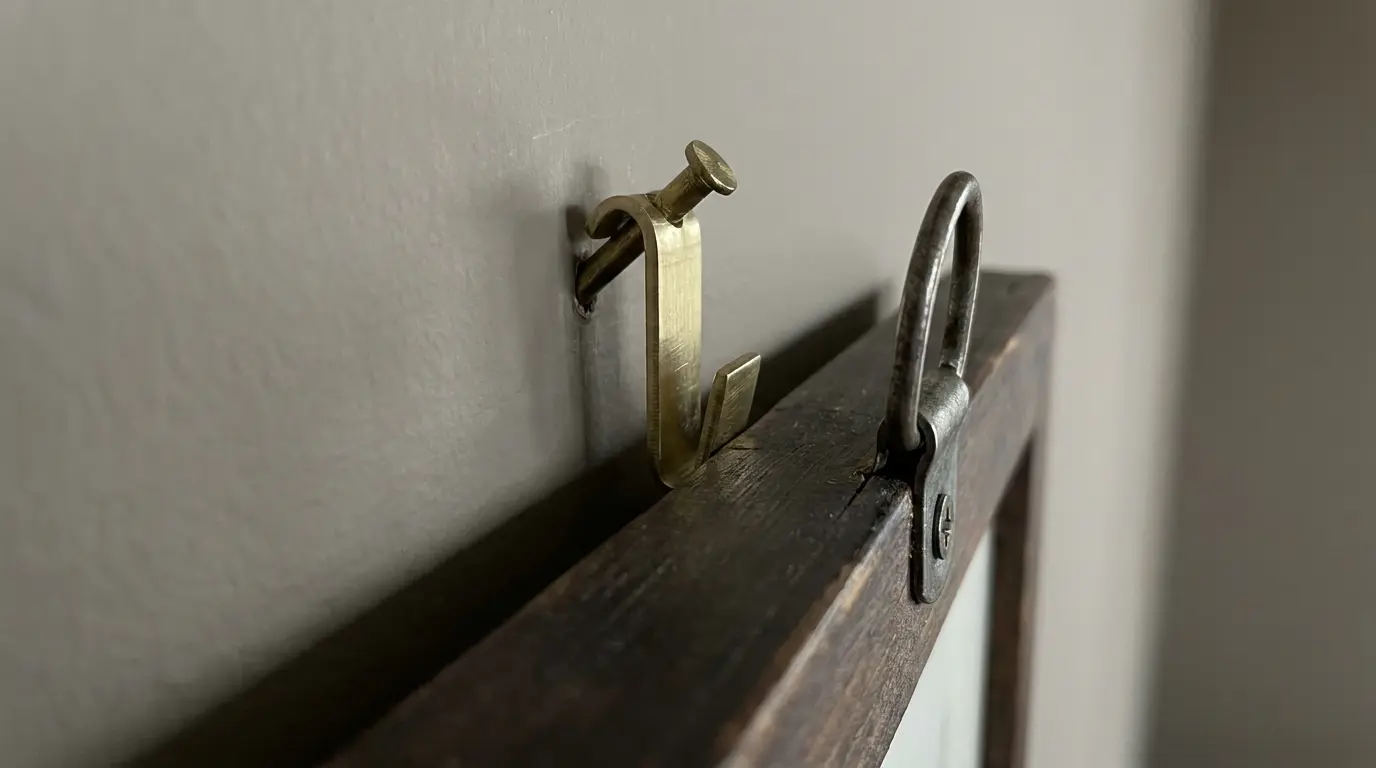
Dual D-rings hook directly onto two independent wall fasteners spaced 12 to 24 inches apart. Because the frame hangs from two fixed, rigid points rather than a sliding loop, rotational movement is physically locked out. Even in high-traffic hallways, frames mounted on dual D-rings remain plumb year after year.
Test 2: Inward Tensile Stress and Frame Corner Damage
The most dangerous drawback of picture wire is lateral inward tension. When wire is strung tightly across the back of a frame and loaded, physics dictates that the tension vector splits into vertical and horizontal components. At typical wire angles (around 30 to 45 degrees), the inward horizontal pull can equal or exceed the total weight of the artwork.
For solid hardwood moldings, this force may only cause subtle bowing. But on soft pine, MDF, or antique frames, inward pull places continuous tension on the top 45-degree miter joints. Over time, wood glue fatigues, staples back out, and corner seams split open. Dual D-rings transfer 100 percent of the frame’s weight directly downward along the vertical side rails as pure vertical shear, exerting zero inward stress on the corner miters.
Test 3: Wall Flushness and Forward Top-Tilt
Because picture wire needs slack to reach above the hook, framers attach screw eyes two to three inches below the top rail. As the wire pulls up toward the center hook, it pulls the upper rail away from the wall. This leaves the top of the frame leaning forward into the room by 1.5 to 2.5 inches, catching overhead glare and casting awkward shadows beneath the bottom rail.
Dual D-rings mount flat against the back face of the side rails, usually positioned roughly one-third down the frame height. Because the steel rings sit directly over wall hooks with minimal projection, the frame rests flush against your wall surface from top to bottom.
Test 4: Dynamic Anchor Load and Drywall Stress
When you hang a 30-pound mirror from a single wall anchor using wire, that lone fastener carries all 30 pounds of dead load, plus dynamic forces when cleaned or bumped. If that anchor loosens in standard 1/2-inch drywall, the entire piece crashes down.
Dual D-rings split the load exactly in half: two anchors carry 15 pounds each. This cuts shear stress on drywall fasteners by 50 percent, allowing two standard brass picture hooks to hold heavy framed prints securely without requiring heavy toggle bolts. If you are hanging on historic lath, review our guide on how to hang pictures on plaster walls without cracking to choose appropriate anchors for brittle wall finishes.
Test 5: Measuring and Leveling Accuracy
Homeowners often default to wire because it feels forgiving: you tap in one nail, hang the wire, and tilt it level by hand. But wire continues to stretch under tension, meaning your carefully placed frame drops half an inch over its first six months.
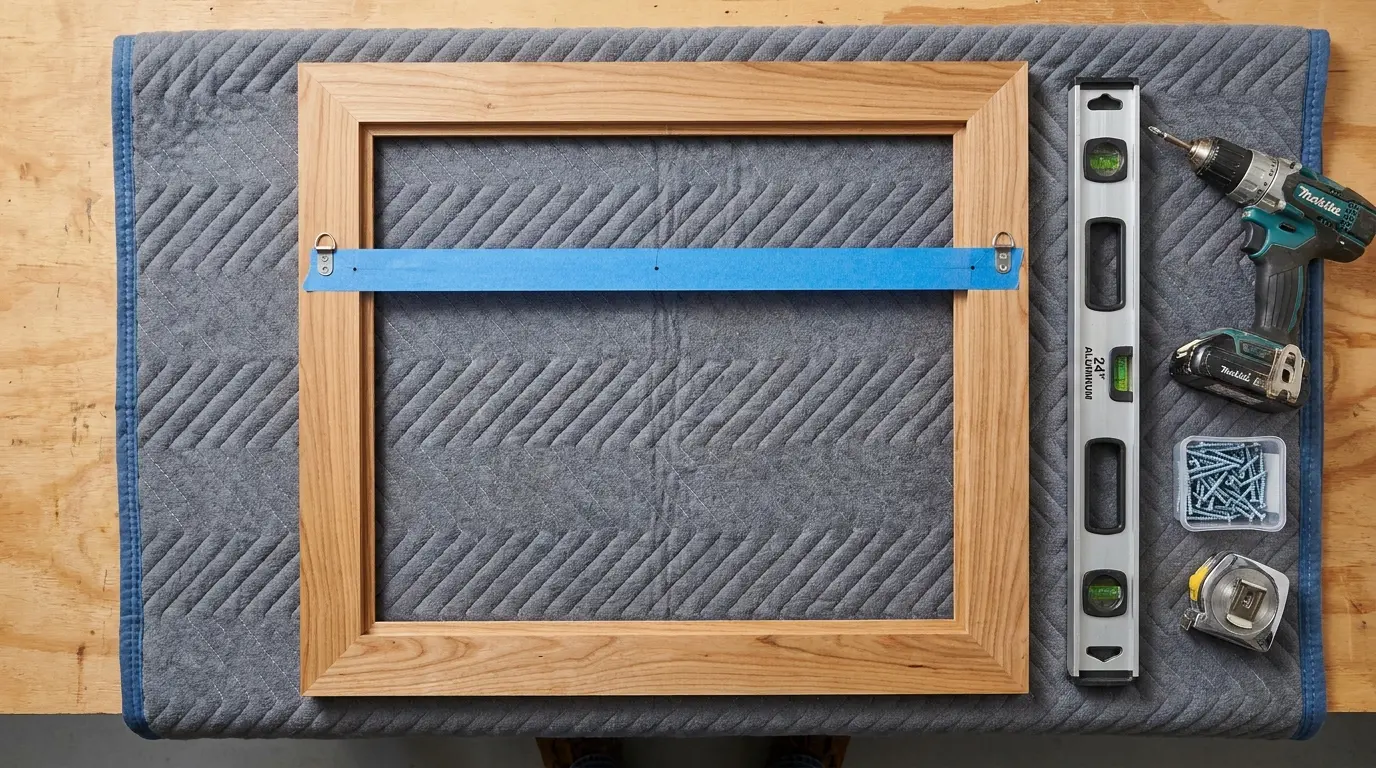
Dual D-rings require precise initial measuring. If one wall hook sits 1/8 inch higher than the other, the error is immediately visible. Fortunately, using the blue painter’s tape transfer technique outlined below removes measuring guesswork entirely, giving you dead-level results on your first attempt.
Step-by-Step Guide: Converting Wired Frames to Dual D-Rings
Swapping old picture wire for heavy-duty steel strap D-rings takes about fifteen minutes per frame. You need a drill, a 1/16-inch drill bit, a screwdriver, 1/2-inch #6 pan-head wood screws, and a tape measure.
- Clear the workspace and strip old hardware: Place the picture frame face-down on a clean blanket or padded surface to protect the glass and moulding. Cut the braided wire with wire cutters and unscrew the old eyelets using pliers. If the old screw holes sit near your new mounting position, insert a wooden toothpick dipped in wood glue and trim it flush to restore wood fiber density.
- Mark the one-third mounting height: Measure the total vertical height of your frame. Calculate one-third of that measurement down from the top edge along both vertical side rails. Mark both points lightly in pencil on the flat rear surface of the wooden molding.
- Pre-drill shallow pilot holes: Wrap a piece of masking tape around your 1/16-inch drill bit at 3/8-inch depth to serve as a safety stop. Drill pilot holes into the side rails, taking care not to drill through the front decorative face of the frame. Never drive screws into the MDF or cardboard backing sheet; always anchor into the solid wood perimeter.
- Fasten the D-rings securely: Position the D-ring straps with the ring loops pointing upward toward the top of the frame. Fasten using #6 half-inch pan-head screws until snug against the steel strap plate.
- Transfer hook coordinates with painter’s tape: Stick a length of blue painter’s tape across the back of the frame, covering both D-ring loops. With a pencil, mark the exact top apex of each ring loop on the tape. Peel the tape off, place it on the wall, check it with a 24-inch bubble level, and drive your picture hooks straight through the marked points. Peel the tape away cleanly and set your art in place.
When to Upgrade to an Interlocking French Cleat
While dual D-rings handle artwork up to 50 pounds with ease, oversized antique mirrors, solid hardwood panels, and heavy framed quilts weighing 50 to 150 pounds benefit from an extruded aluminum French cleat.
A French cleat consists of two interlocking 45-degree aluminum brackets. One bracket screws to the rear top rail of the frame, while the matching bracket secures to wall studs with 2.5-inch wood screws. When seated together, the interlocking bevels lock the piece flush against the wall, distribute weight across multiple wall studs, and allow you to slide the frame left or right to fine-tune centerlines without drilling new holes.
Picture Hanging Hardware Comparison Matrix
Use the comparison matrix below to match your frame dimensions, weight, and wall construction with the appropriate mounting system:
| Hardware Style | Max Safe Weight | Leveling Stability | Drywall Stress | Best Frame Type |
|---|---|---|---|---|
| Single Wire on One Hook | Under 15 lbs | Low (pivots from drafts) | High shear on 1 point | Small desktop prints under 12 inches |
| Braided Wire on Dual Hooks | 15 to 25 lbs | Moderate (slips over time) | Shared between 2 hooks | Medium poster frames with narrow rails |
| Dual D-Rings Direct to Hooks | 25 to 50 lbs | Exceptional (locked plumb) | Even 50/50 load split | Large framed canvases and art prints |
| Heavy Steel Strap Hangers | 35 to 70 lbs | Exceptional (3-screw plates) | Even load across anchors | Heavy wood moldings with glass glaze |
| Interlocking Aluminum French Cleat | 50 to 150 lbs | Flawless (rigid interlocking rail) | Direct stud connection | Large mirrors and oversized art panels |
When selecting hardware, explore load-tested steel strap hangers and commercial D-ring sets on Amazon to review dimensional specifications and screw gauge ratings.
If you are planning a multi-frame display, coordinate your layout by reviewing our guide on how far apart to hang triptych canvas art sets over sofas, or explore corner gallery wall layout ideas for tight spaces to balance visual spacing across adjoining walls. If you prefer to avoid wall holes altogether, consider styling picture ledge shelves with layered frames.
Five Costly Art Hanging Mistakes to Avoid
Professional art handlers and framing specialists frequently encounter these five installation errors when repairing damaged art or loose drywall anchors:
- Using wire across heavy plate glass mirrors: Mirror glass adds significant weight without adding structural stiffness to the frame. Wire pulls inward on the frame stiles, twisting the frame until the corner miter joints open up under stress. Always hang heavy mirrors directly from dual D-rings or French cleats.
- Relying on standard plastic ribbed drywall plugs: Basic conical plastic expansion plugs pull straight out of gypsum wallboard under dynamic loads. For wall art over 20 pounds not anchored into studs, use threaded metal self-drilling anchors or steel hollow-wall toggle bolts.
- Screwing hardware into backing boards: Never drive D-ring mounting screws into cardboard, foam core, or thin MDF backer sheets. The fastener threads will strip under light loads. Fasten hardware exclusively into the solid perimeter wood moulding.
- Skipping silicone corner bumpers: Hanging frames directly against drywall without bumper pads traps moisture, scuffs wall paint, and allows frames to rattle during vibration. Place self-adhesive silicone or rubber bumpers on the bottom two corners of every frame.
- Using adhesive strips on glass-glazed art: Sticky adhesive strips lose grip as indoor humidity and temperature fluctuate, releasing heavy frames without warning. Limit adhesive strips to lightweight unframed posters weighing under three pounds.
Frequently Asked Questions About Picture Wire vs D-Rings
Is it better to hang pictures with wire or D-rings?
Dual D-rings are far superior to wire for any frame weighing over 15 pounds. D-rings lock the frame permanently level, divide the weight equally between two wall anchors, keep the piece flush against the wall, and eliminate inward lateral tension that pulls frame miter corners apart.
Why does my picture keep tilting on the wall?
Pictures hung from a single wire pivot on a central fulcrum point. Closing doors, foot traffic, and drafts nudge the wire across the hook lip. Because friction prevents the wire from returning to dead center, the frame stays crooked until adjusted manually. Dual D-rings eliminate this central pivot entirely.
Where should D-rings be placed on a picture frame?
Mount D-rings one-third of the way down from the top edge along the vertical side rails. This positioning keeps the frame’s center of gravity balanced, prevents the top edge from tilting forward into the room, and ensures the artwork hangs flat against your wall.
How much weight can picture hanging wire safely hold?
Standard braided steel picture wire holds between 10 and 30 pounds, but continuous tension stretches the wire coils and exerts dangerous inward pulling forces on the frame’s wooden joints. For framed art and mirrors weighing over 25 pounds, professional framing guidelines recommend direct dual D-rings or an interlocking French cleat.
How do you mark two hooks for D-rings accurately?
Apply blue painter’s tape across the back of the frame spanning both D-ring loops. Mark the top contact point of each ring with a pen. Transfer the tape to your wall, align it with a bubble level, and drive your picture hanging hooks directly through the pencil marks before peeling the tape off.
Final Installation Checklist for Level Wall Art
- Weigh your framed artwork on a digital scale to verify the true load before selecting wall hardware.
- Select dual D-rings or heavy steel strap hangers for any piece exceeding fifteen pounds.
- Mount D-rings one-third down the vertical side rails, fastening into solid wood moldings with #6 pan-head screws.
- Use the painter’s tape transfer method and a 24-inch bubble level to mark accurate hook coordinates on the wall.
- Drive two wall hooks at a 45-degree downward nail angle to maximize fastener shear strength.
- Affix clear silicone bumper pads to the bottom frame corners to ensure airflow and protect drywall finishes.
Applying these professional framing principles ensures your valuable artwork remains secure, sits completely flush, and stays permanently level on your walls.