How High to Hang Pendant Lights Over a Kitchen Island (The 30-36 Inch Rule)
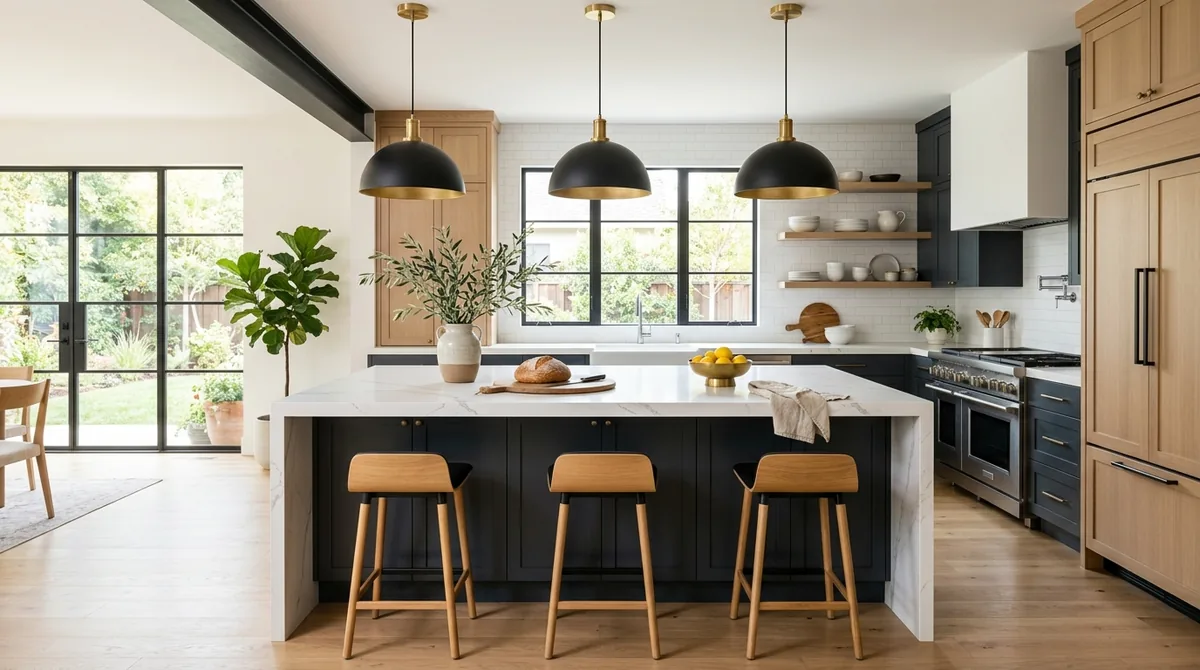
Pendant lights should be hung so that the bottom rim of the fixture sits between 30 and 36 inches above the surface of your kitchen island countertop, which translates to 66 to 72 inches from the finished floor on a standard 36-inch counter. For ceilings taller than 8 feet, add 3 inches of hanging height for every additional foot of ceiling height to maintain balanced sightlines.
In this guide, you will learn the exact mathematical formula for spacing two versus three pendants, how to prevent harsh glare in your eyes while chopping vegetables, shade diameter guidelines based on island length, and smart dimmer switches to control your kitchen ambiance.
Quick Comparison: Kitchen Island Pendant Height & Spacing Standards
Achieving harmonious kitchen lighting requires coordinating vertical drop heights with horizontal spacing intervals across your countertop.
| Measurement / Zone | Designer Standard Rule | Practical Minimum | Practical Maximum | Purpose & Architectural Goal | Amazon Lighting Gear |
|---|---|---|---|---|---|
| Countertop to Fixture | 30 to 36 inches | 28 inches (Low-profile glass) | 40 inches (Taller ceilings) | Eye-level sightline clarity across room | Matte Black Dome Pendants |
| Pendant-to-Pendant Gap | 24 to 30 inches center-to-center | 20 inches (Small mini pendants) | 36 inches (Oversized lanterns) | Eliminates overlapping shadows and dark spots | Seeded Glass Mini Pendants |
| Counter Edge Margin | 12 to 15 inches from ends | 10 inches | 18 inches | Prevents visual crowding at counter ends | Lutron Caseta Smart Dimmer |
| Ceiling Height Adjustment | +3 inches per extra foot above 8 ft | Base 30 inches at 8 ft | 42 inches at 12-ft ceiling | Matches vertical room volume seamlessly | Dimmable Warm LED Bulbs |
Calculate Your Island Pendant Spacing in Seconds
Every kitchen island has custom dimensions that dictate whether two large statements or three slender mini pendants look best. Use our free interactive calculator to find your exact hanging heights and drill points:
🛠️ Interactive Tool Spotlight
Calculate exact pendant drop heights and center-to-center fixture spacing for your kitchen island dimensions before cutting wiring or drilling ceiling drywall.
The Sightline Test: Why the 30 to 36-Inch Window Matters
The 30 to 36-inch hanging window is engineered around standard human standing heights and kitchen counter ergonomics.
Standard kitchen counters stand 36 inches tall. When an adult between 5 feet 4 inches and 6 feet tall stands at the counter prepping food, their standing eye level falls between 60 and 68 inches above the floor.
Hanging pendants with their bottom rim at 66 to 72 inches from the floor (30 to 36 inches above the counter) achieves two critical sightline goals:
- Unobstructed Conversation: When you stand behind the island talking to family seated on bar stools or across the room in the living room, the pendant shades sit slightly above your direct line of sight. You make effortless eye contact without leaning or ducking around dangling fixtures.
- Zero Direct Bulb Glare: Because the shade sits at or slightly above eye level, the interior bulb is shielded from your normal gaze while casting a focused cone of illumination downward onto cutting boards and serving trays.
If you hang pendants lower than 30 inches, tall family members will bump their foreheads when leaning over to slice bread. If you hang them higher than 36 inches on an 8-foot ceiling, the exposed bulbs will blind anyone seated on island counter stools.
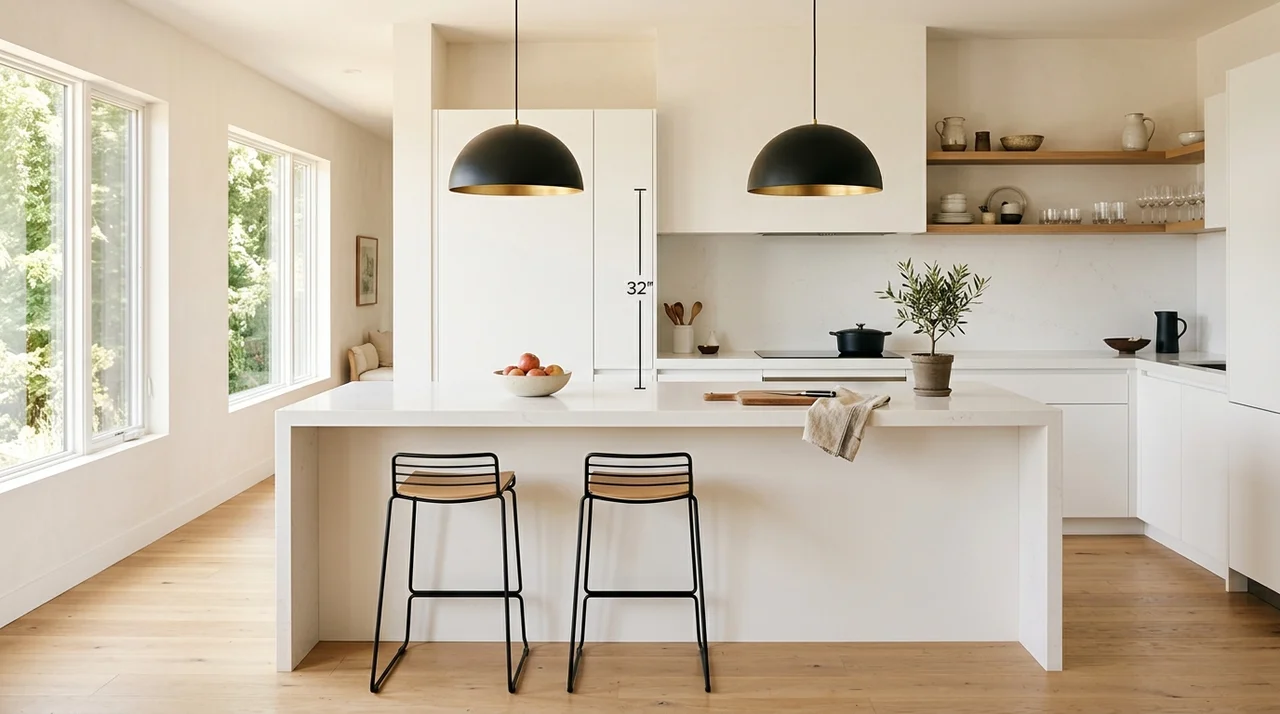
Tall Ceilings: The 3-Inch Scale Formula
If your kitchen features 9, 10, 11, or 12-foot ceilings, hanging your pendants at the standard 30-inch mark will make the fixtures look like tiny fishing lures dangling on excessively long cords.
To maintain architectural harmony in tall spaces, follow the 3-inch per foot formula:
- 8-Foot Ceiling (Baseline): Hang 30 to 34 inches above countertop.
- 9-Foot Ceiling: Add 3 inches; hang 33 to 37 inches above countertop.
- 10-Foot Ceiling: Add 6 inches; hang 36 to 40 inches above countertop.
- 12-Foot Vaulted Ceiling: Add 10 to 12 inches; hang 40 to 44 inches above countertop.
When dealing with two-story or soaring cathedral ceilings, choose larger fixture diameters (such as 14 to 18-inch lanterns or woven domes) and use rigid downrods rather than thin vinyl electrical wires. Rigid metal stems prevent air currents from ceiling fans or HVAC vents from swaying the lights.
How Many Pendants Do You Need? (Two vs. Three Rule)
Deciding between two or three pendant lights depends strictly on your kitchen island length and the physical diameter of your selected shades.
The Standard Island Sizing Rule
- Islands Under 6 Feet (48 to 71 Inches): Install two pendant lights. Three pendants on an island under six feet will crowd the ceiling, creating visual clutter and casting competing, harsh shadows.
- Islands Between 6 and 9 Feet (72 to 108 Inches): Install three smaller pendants (8 to 12-inch diameter) OR two large statement pendants (14 to 18-inch diameter).
- Islands Over 10 Feet (120+ Inches): Install three to four generous pendants, or two substantial multi-tier linear fixtures.
The Equal Spacing Mathematical Formula
To calculate the exact center-to-center spacing for three pendants across any island:
- Determine Inset Margin: Set your two outer pendants 12 to 15 inches inward from the counter edges. (For an 84-inch island, two 14-inch insets leave 56 inches of center span).
- Divide Remaining Span by Number of Gaps: Three pendants create two equal gaps. Divide 56 inches by 2 to get 28 inches.
- Result: Your pendants should be spaced exactly 28 inches apart center-to-center, with the outer lights centered 14 inches from each end.
Choosing the Right Shade Material: Task vs. Ambient Light
The material of your pendant shades dictates how light is dispersed throughout your kitchen.
- Metal Dome Pendants (Opaque Downlight): Spun brass, copper, and matte black steel pendants direct 100 percent of their light downward onto the island. This produces outstanding task illumination for slicing, plating, and reading recipes, but leaves upper ceilings dimmer. Metal shades work best in kitchens with plenty of auxiliary recessed ceiling can lights.
- Clear or Seeded Glass Pendants (Omnidirectional): Clear glass globes allow light to cast 360 degrees, brightening the entire kitchen volume. However, because the bare bulb is visible, you must use attractive vintage Edison-style LED filament bulbs and keep a smart dimmer installed to avoid painful glare.
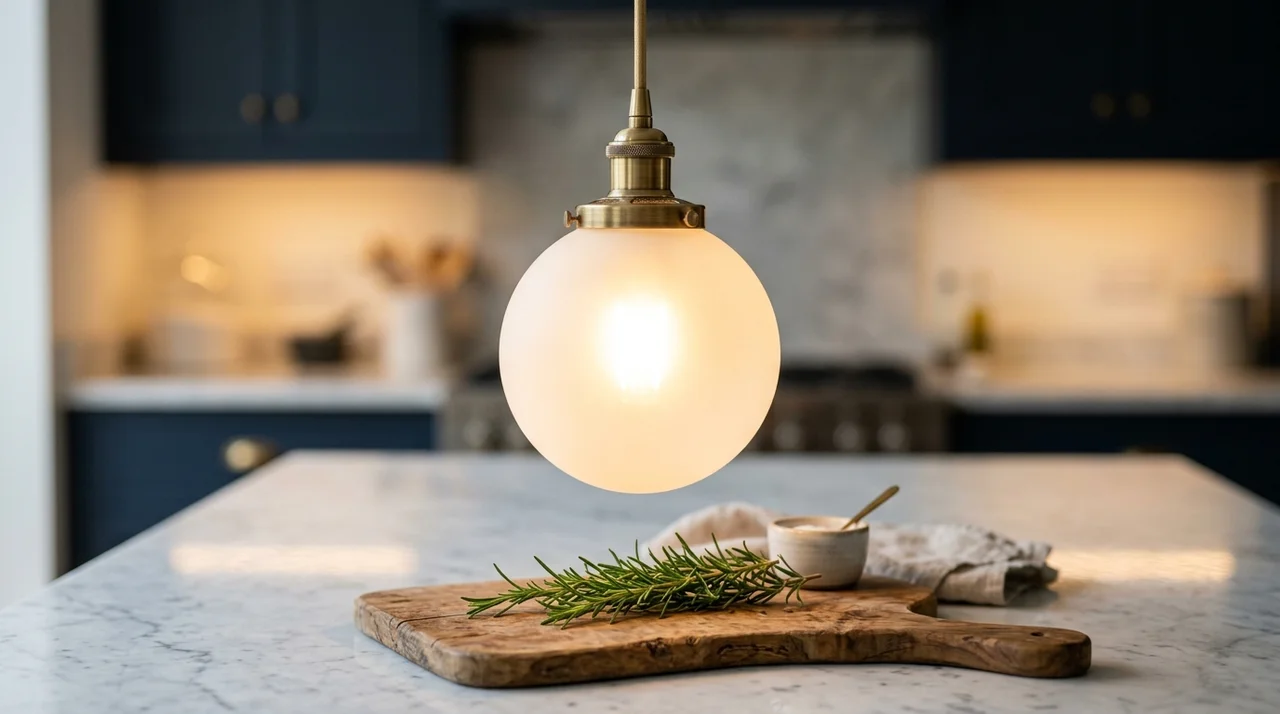
- White Frosted Glass or Opal Pendants (Diffused Glow): Opal glass is the designer favorite. It softens harsh diode points into a warm, milky, glare-free luminescence while directing generous light down to the counter.
- Woven Rattan or Cane Pendants (Organic Texture): Open weave natural materials project playful, organic shadow patterns across ceilings, ideal for coastal, organic modern, and Scandinavian kitchens.
Smart Dimming and Bulb Kelvin Temperature
Kitchen island pendants should never operate on a standard on/off mechanical toggle switch. The kitchen island functions as a high-intensity food preparation zone during cooking, but transitions into an intimate cocktail and dining table when entertaining guests.
Install a Lutron Caseta Smart Dimmer to adjust light levels effortlessly from 100 percent brightness while chopping onions down to a soft 20 percent glow for midnight dessert.
Pair your dimmers with 2700K to 3000K warm white LED bulbs:
- 3000K Warm White: Best for modern kitchens with crisp white shaker cabinets, chrome hardware, and white quartz counters, keeping whites clean and vibrant without yellowing.
- 2700K Soft Amber: Best for traditional, farmhouse, or wood-toned kitchens with honey oak or walnut cabinets, delivering a cozy candlelight atmosphere.
- Look for a Color Rendering Index (CRI) of 90 or higher on bulb packaging so fresh meats, produce, and cooked dishes display their true, natural, appetizing colors.
Frequently Asked Questions
What if my island has a cooktop or sink in the center?
If your kitchen island features a center cooktop with a downdraft vent or a central prep sink, hang your pendant lights on the higher end of the spectrum (34 to 36 inches above counter). This keeps hot cooking grease splatter off glass shades and protects fixtures from water splashes while maintaining clear sightlines across the food prep area.
Can you use a linear chandelier instead of individual pendants?
Yes, a single linear multi-light chandelier or horizontal suspension fixture is a sleek alternative to two or three separate pendants. Linear fixtures require only a single ceiling electrical junction box, saving substantial electrician rewiring costs while providing evenly balanced illumination across long rectangular islands.
How far should island pendants be from the edge of the counter?
The outer edge of your pendant shades should sit at least 6 inches inside the outer edge of the countertop, with the fixture center hanging 12 to 15 inches from the island perimeter. This prevents tall diners seated at counter ends from accidentally brushing their shoulders against the shades when standing up.
Should kitchen island pendants match the dining room chandelier?
Your kitchen island pendants do not need to match your dining room chandelier identically, but they must coordinate in style and metal finish. If your dining room features a bold black iron fixture, choose kitchen island pendants with matte black stems and subtle brass or glass accents to create visual harmony across an open-concept floor plan.
Can one person install kitchen island pendants safely?
While hanging a lightweight mini pendant can be accomplished by an experienced DIYer, installing multiple fixtures over an island is easiest with two people. One person supports the fixture weight while the other connects electrical wire nuts and mounts the ceiling canopy. Always turn off power at the main breaker box before handling household electrical wiring.
Conclusion & Next Steps in Kitchen Lighting Design
Hanging kitchen island pendants between 30 and 36 inches above your counter balances functional task lighting with comfortable room sightlines. Measure your counter height, calculate equal center-to-center spans, and install a quality dimmer switch to elevate your kitchen ambiance.
To continue perfecting your home lighting layout, explore our related guides: