Bathroom Vanity Lighting Size: 5 Mirror Ratio Rules
Reader Disclosure: This post contains affiliate links. If you buy through them, we may earn a commission at no extra cost to you. We only recommend items tested for clean craftsmanship and authentic durability.
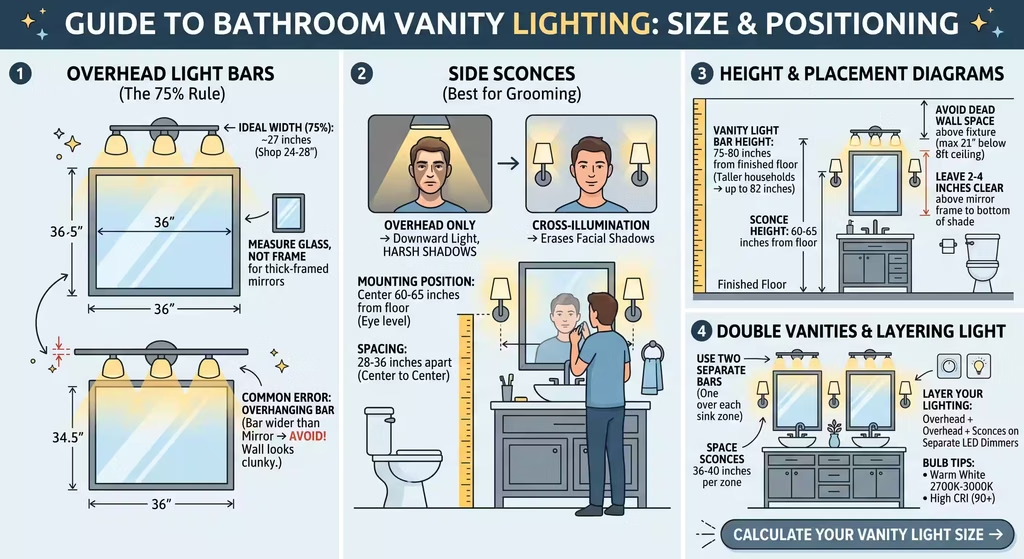
Your vanity light bar should span roughly 75 percent of your mirror width and mount 75 to 80 inches above the finished floor. Side sconces deliver better results than any overhead bar: mount them 60 to 65 inches from the floor, spaced 28 to 36 inches apart, and facial shadows disappear completely.
Most homeowners get this wrong in two ways. First, they buy a light bar wider than the mirror, and the fixture overhangs both sides making the wall look clunky. Second, they install a single overhead bar and spend months complaining about dark hollows under their eyes. Neither error requires rewiring to fix.
Before you purchase any fixture or schedule an electrician, run your mirror and vanity measurements through our Vanity Light Calculator to confirm the exact fixture width, mount height, and lumen output for your specific bathroom.
The 75-Percent Width Rule for Vanity Light Bars
Your overhead vanity bar should measure 75 percent of your mirror width. On a 36-inch mirror, that puts you at a 27-inch fixture, so you shop for bars in the 24-to-28-inch range. The bar must stay narrower than both the mirror and the vanity cabinet below it. The moment a fixture widens past the mirror frame, the wall reads as top-heavy and visually unstable.
Reddit’s r/InteriorDesign surfaces this error constantly. One user renovating a 48-inch double sink bought a 42-inch bar for a 36-inch mirror and the wall felt cramped. The fix cost nothing: return the oversize bar, buy the correctly proportioned fixture. The math works the same for a powder room pedestal or a primary bath double vanity.
Exact Width Math for Every Common Vanity Size
These calculations apply to standard residential vanity widths. Measure your actual mirror width with a tape measure before ordering, because mirrors and cabinets frequently differ by two to four inches from labeled dimensions.
- 24-inch vanity, 20-inch mirror: Buy a 14-to-16-inch light bar.
- 30-inch vanity, 24-inch mirror: Buy an 18-inch light bar.
- 36-inch vanity, 30-inch mirror: Buy a 22-to-24-inch light bar.
- 48-inch vanity, 40-inch mirror: Buy a 28-to-32-inch light bar.
- 60-inch double vanity, dual 24-inch mirrors: Install two separate 18-inch bars, one centered over each sink. One long bar spanning both mirrors looks cheap and unbalanced.
How Mirror Frame Thickness Changes Your Math
A thick decorative frame (two inches or wider on each side) narrows the reflective glass surface even though the labeled mirror width includes the frame. A 36-inch framed mirror with two-inch frame rails has only 32 inches of actual glass. Apply the 75-percent rule to the glass width, not the frame width. This shifts your target bar to roughly 24 inches instead of 27 inches, and the result looks far cleaner on the wall.
Frameless mirrors have no adjustment: use the full labeled width for your calculation. Medicine cabinets with integrated mirrors present a different situation: mount a separate bar fixture above the cabinet, sized to 75 percent of the cabinet door width.
Mount Height: Exactly Where to Position a Vanity Light Bar
Mount your overhead vanity bar 75 to 80 inches above the finished floor, centered horizontally over the mirror. Keep two to four inches of clear space between the top edge of the mirror frame and the bottom of the fixture shade. Less than two inches and the light bleeds downward into the mirror glass and creates glare. More than four inches and the fixture looks disconnected from the mirror below it.
Most bathrooms have an 8-foot ceiling, so a 75-to-80-inch mount height lands 16 to 21 inches below the ceiling line. That spacing looks balanced. If your bathroom has 9-foot ceilings, raise the bar to 82 inches maximum to maintain the visual connection with the mirror below without leaving too much dead wall space above.
Adjusting Height for Tall Household Members
If anyone in the household stands over six feet tall, raise the light bar to 80 inches from the floor. The mirror itself should hang with its center at 57 to 65 inches from the floor, depending on the household’s average eye level. Taller users need the center higher, closer to 63 to 65 inches. The bar then follows: place it two to four inches above the mirror’s top edge, which usually lands it at 78 to 82 inches from the floor.
Never compromise ceiling clearance for fixture height. If your ceiling sits at 84 inches (a 7-foot ceiling common in older homes), keep the bar at 75 inches maximum. A bar too close to a low ceiling creates an oppressive, dim atmosphere despite the wattage.
Rough-In Planning Before Drywall Goes Up
If you renovate before drywall installation, finalize your vanity cabinet height, countertop thickness, mirror frame dimensions, and expected fixture size before the electrician cuts the junction box. Moving a rough-in box after drywall costs $150 to $400 in patch labor per box. Mark the box location at 78 inches from the subfloor (add 0.75 inch for finish flooring), then confirm it centers horizontally over the planned vanity centerline.
Side Sconces Versus Overhead Bars: Which Eliminates Facial Shadows
Side sconces win for grooming accuracy. An overhead bar projects light downward, and downward light throws harsh shadows into every hollow on your face: under your eyes, along your nose, under your chin. Side sconces mounted at eye level project light horizontally across your face from both directions simultaneously. Cross-illumination fills those shadows and gives you an accurate view of your skin for shaving, makeup, or inspecting blemishes.
Hollywood vanity mirrors work on this exact principle. The bulbs run around the full mirror perimeter, projecting light from every angle. You replicate the same effect at lower cost by flanking a standard mirror with two matching sconces.
Exact Sconce Height and Spacing for Shadow-Free Results
Mount side sconces with their center at 60 to 65 inches above the finished floor. For most adults, this aligns the light source with eye level, which sits between 60 and 66 inches depending on height. Space the two sconces 28 to 36 inches apart, measuring center-to-center. This puts each sconce approximately 14 to 18 inches from the mirror’s centerline, which matches average shoulder width and delivers balanced left-right illumination.
On a double vanity, space sconces 36 to 40 inches apart. For very wide mirrors exceeding 60 inches, add a center sconce between the two flanking fixtures at the same 60-to-65-inch mount height. Three sconces on a 72-inch double vanity look intentional and cover the full illumination zone.
Combining Overhead and Side Lighting for Layered Bathroom Ambiance
You get the best grooming results by running both an overhead bar and flanking sconces on separate dimmer circuits. Set the sconces to full brightness for morning grooming tasks, then dim the overhead bar to 30 percent for ambient warmth during a bath or evening wind-down. Both circuits together deliver 3,000 to 4,500 lumens, which matches boutique hotel bathroom lighting levels.
Wire each circuit to its own single-pole LED-compatible dimmer switch. Standard rotary dimmers flicker with LED drivers; specify a leading-edge or trailing-edge electronic dimmer rated for the LED fixture’s driver type. The fixture packaging lists the compatible dimmer type, usually a four-digit model code for Lutron or Leviton switches.
Color Temperature and CRI for Accurate Skin Tone Rendering
Choose LED bulbs rated 2700K to 3000K with a Color Rendering Index of 90 or above. The 2700K-to-3000K range produces warm white light that mimics late-morning natural sunlight, the same light condition your eyes use as a reference for natural skin color. A CRI below 80 distorts reds and pinks, which means your foundation shade looks accurate in the bathroom but wrong everywhere else.
Avoid 4000K and 5000K bulbs in bathroom vanity fixtures. At 4000K, the light reads as cool white with a slight blue-green cast that drains warmth from skin, highlights every pore, and makes eye circles look darker than they are. At 5000K (daylight), the effect worsens to a clinical fluorescent appearance. Both temperatures work well in kitchens and task areas, but they fail at vanity mirrors.
Lumen Output by Vanity Size
Lumens measure total light output, and vanity lighting needs depend directly on the size of the mirror and the number of people using the space. Under-lit vanities create the same shadow problem as a single overhead bar, regardless of color temperature. Use these output targets:
- 24-to-30-inch single vanity: Target 1,200 to 1,600 total lumens.
- 36-inch single vanity: Target 1,600 to 2,000 total lumens.
- 48-inch single vanity: Target 2,000 to 2,500 total lumens.
- 60-to-72-inch double vanity: Target 3,000 to 4,000 total lumens across all fixtures.
Split total lumens across multiple fixtures. Two 800-lumen sconces plus a 600-lumen overhead bar total 2,200 lumens for a 36-inch vanity, which sits comfortably in the target zone. Single high-wattage overhead bars often produce 2,000 lumens but deliver it all from one direction, which explains why they feel harsh despite the high output number.
Vanity Light Sizing and Placement Quick-Reference Matrix
Use this matrix as a field reference when shopping for fixtures. Cross your vanity cabinet width with the remaining columns to confirm fixture width, mount height, sconce spacing, and total lumen targets in one pass.
| Vanity Cabinet Width. | Ideal Light Bar Width. | Mount Height (Floor to Bar). | Sconce Spacing (Center to Center). | Total Lumens Target. |
|---|---|---|---|---|
| 24 to 30 inches. | 14 to 18 inches. | 75 to 77 inches. | 28 to 30 inches. | 1,200 to 1,600 lumens. |
| 36 inches. | 22 to 24 inches. | 75 to 78 inches. | 30 to 32 inches. | 1,600 to 2,000 lumens. |
| 48 inches. | 28 to 32 inches. | 76 to 80 inches. | 34 to 38 inches. | 2,000 to 2,500 lumens. |
| 60 to 72 inches (double). | Dual 18-to-24-inch bars. | 78 to 80 inches. | 36 to 40 inches per sink zone. | 3,000 to 4,000 lumens. |
For any bathroom layout where the mirror width, vanity cabinet, and ceiling height all differ from standard dimensions, enter your actual measurements in the Vanity Light Calculator for a customized output that accounts for your specific geometry.
When shopping for fixtures with verified CRI ratings, frosted glass shades, and appropriate junction box brackets, compare verified options on Amazon to review customer dimensions, wiring notes, and current pricing.
Five Common Installation Mistakes That Ruin Vanity Lighting
Hundreds of r/HomeDecorating and r/femalelivingspace posts document the same five errors. Each is preventable with a tape measure and ten minutes of planning.
Bar mounted too high. A bar at 84 inches or above breaks its visual connection to the mirror. The light aims forward at the countertop instead of across your face.
Bar wider than the mirror. Two inches of overhang on each side makes the wall look amateur. When the exact 75-percent target size is unavailable, go slightly narrower.
Bare-bulb fixtures without diffusers. Exposed Edison or candelabra bulbs create point-source glare at eye level. Squinting and poor shadow control follow. Choose frosted glass or milky acrylic shades.
Wrong dimmer switch. Standard incandescent dimmers cause LED drivers to buzz or flicker. Install a dedicated LED trailing-edge dimmer for each circuit.
Undersized junction box. A 15-pound light bar needs a 35-pound-rated box. Standard plastic round boxes max out at five to ten pounds. An oversized fixture on a weak box loosens screws and creates an electrical hazard.
For lighting layout guidance beyond the vanity, explore our Lighting Design and Fixtures guides covering fixture placement for every room type.
Frequently Asked Questions About Bathroom Vanity Lighting
Should a vanity light be wider than the bathroom mirror?
No. A vanity light bar should measure roughly 75 percent of the mirror width and stay narrower than both the mirror and the cabinet below. Any fixture wider than the mirror frame creates visual top-heaviness and makes the vanity wall look disproportionate and unbalanced.
What is the correct height to mount a vanity light over a mirror?
Mount an overhead vanity bar 75 to 80 inches above the finished floor. Leave a two-to-four-inch gap between the mirror frame’s top and the fixture shade. In bathrooms with 9-foot ceilings, position the bar at 82 inches to prevent dead wall space from appearing between the fixture and the ceiling.
Why are side sconces better than overhead vanity light bars?
Flanking sconces at 60 to 65 inches high project horizontal light from both sides of your face at once. This cross-illumination erases the under-eye and chin shadows that downward overhead bars create. Accurate shaving, makeup, and skin checks all require that even horizontal light source.
What color temperature is best for bathroom vanity bulbs?
Use warm white LED bulbs rated 2700K to 3000K with a minimum CRI of 90. This range accurately renders skin tones, matches natural morning light, and avoids the blue-cast distortion of 4000K or 5000K daylight bulbs that wash out color and make facial features look harsher than they are.
How many lumens do you need for bathroom vanity lighting?
A 36-inch single vanity needs 1,600 to 2,000 lumens in total. A 60-to-72-inch double vanity requires 3,000 to 4,000 lumens spread across every fixture. Use side sconces and an overhead bar on separate dimmers to split that output and eliminate shadows.
Final Checklist Before You Install
Measure mirror glass width, not frame width. Multiply by 0.75 and buy within two inches of that number. Confirm your junction box handles 35 pounds. Specify 2700K to 3000K bulbs with CRI 90 or above. Wire both light circuits to dedicated LED-compatible dimmers. Mount the bar two to four inches above the mirror top.
These six checks take 20 minutes and prevent years of bad shadows, glare, and disproportionate fixtures. Do them before any screw goes in the wall.