Fast Furniture vs. Solid Wood: Why Secondhand Furniture is the Ultimate Decor Investment
Reader Disclosure: This post contains affiliate links. If you buy through them, we may earn a commission at no extra cost to you. We only recommend furniture restoration supplies and pieces tested for genuine durability and clean craftsmanship.
Solid wood furniture lasts between 50 and 100 years, while flat-pack fast furniture made from particleboard typically fails within three to five years. Buying secondhand solid wood gives you heirloom timber, classic joinery, and zero off-gassing at roughly the same price point as brand-new disposable veneer.
In this guide, you will learn the exact lifespan differences between materials, how to spot authentic solid timber at thrift stores, the hidden indoor air quality risks of cheap resin glues, and how restoring vintage pieces saves thousands of dollars over your decorating lifetime.
Quick Comparison: Fast Furniture vs. Secondhand Solid Wood
Fast furniture offers instant gratification at low initial checkout prices, but secondhand solid wood provides four times the lifetime value, superior repairability, and zero landfill waste.
| Feature / Metric | Flat-Pack Fast Furniture (MDF/PB) | Secondhand Solid Hardwood | Vintage Restored Pieces |
|---|---|---|---|
| Average Lifespan | 3 to 5 years | 50 to 100+ years | 75+ years |
| Primary Material | Sawdust and urea-formaldehyde resin | Kiln-dried oak, maple, walnut, cherry | Aged natural timber |
| Joinery Style | Plastic cam-locks and metal pins | Dovetail, mortise-and-tenon | Hand-cut wood joinery |
| Moisture Resistance | Swells permanently upon water contact | Resurfaced with wax, oil, or sanding | Highly stable seasoned grain |
| Indoor VOC Off-Gassing | High initial VOCs from glue resins | Zero off-gassing (fully seasoned) | Zero off-gassing |
| Moving Durability | Loosens after one to two moves | Can be disassembled or moved repeatedly | Extremely sturdy joints |
| Resale Value Retention | Near 0% after 2 years | 60% to 120% of purchase price | Appreciates over time |
Calculate the True Lifetime Cost Before You Buy
Fast furniture seems cheap on day one, but repeated replacements drain your budget and fill local transfer stations with synthetic trash. Use our free interactive calculator to compare the long-term replacement cycles and environmental footprint between cheap flat-pack pieces and secondhand heirloom wood:
- Financial Lifecycle Analysis: Compares 20-year cumulative replacement costs against single vintage investments
- Avoided Landfill Waste: Estimates kilograms of particleboard saved from municipal incinerators and dumps
- Resale Equity Projection: Calculates estimated asset value retention on authentic hardwood pieces
The Real Lifespan of MDF and Particleboard
Medium-density fiberboard and particleboard have an average functional lifespan of 36 to 60 months under ordinary household use. These engineered wood products consist of wood shavings, sawdust, and synthetic adhesive resins compressed under high heat. While they produce flat, uniform panels that fit neatly inside flat boxes, their physical structure cannot handle dynamic mechanical stress or humidity swings.
The weakest link in fast furniture is the cam-lock fastening system. When you tighten a metal cam-lock into a pre-drilled particleboard core, the zinc pin anchors into compressed wood dust. Over months of everyday use, pulling open drawers or sliding a media cabinet across the rug exerts lateral force on these joints. The crumbly core slowly loosens around the pin, causing wobbling that cannot be fixed by retightening.
Moisture damage creates immediate and irreversible failure in flat-pack furniture. If a glass of water spills on a laminated particleboard nightstand, water seeps past the thin edge-banding within minutes. The wood fibers inside absorb the moisture and swell by 30 to 50 percent of their original thickness. Unlike solid wood, which can be dried, scraped, and sanded smooth, swollen particleboard loses all structural cohesion and permanently bulges.
Fast furniture is designed as a one-way product. Disassembling a budget desk or wardrobe to move apartments usually cracks the screw holes and tears out the cam-lock housings. Most moving companies even decline insurance coverage for pressed particleboard items because they frequently collapse in transit.
Why Secondhand Solid Wood Is Built to Last Centuries
Authentic hardwood furniture lasts over 100 years because it is crafted from dense, fibrous cellular timber using mechanical wood-to-wood joinery. Tree species such as white oak, hard maple, American black walnut, and black cherry develop tight growth rings that resist gouges, heavy weight, and everyday knocks.
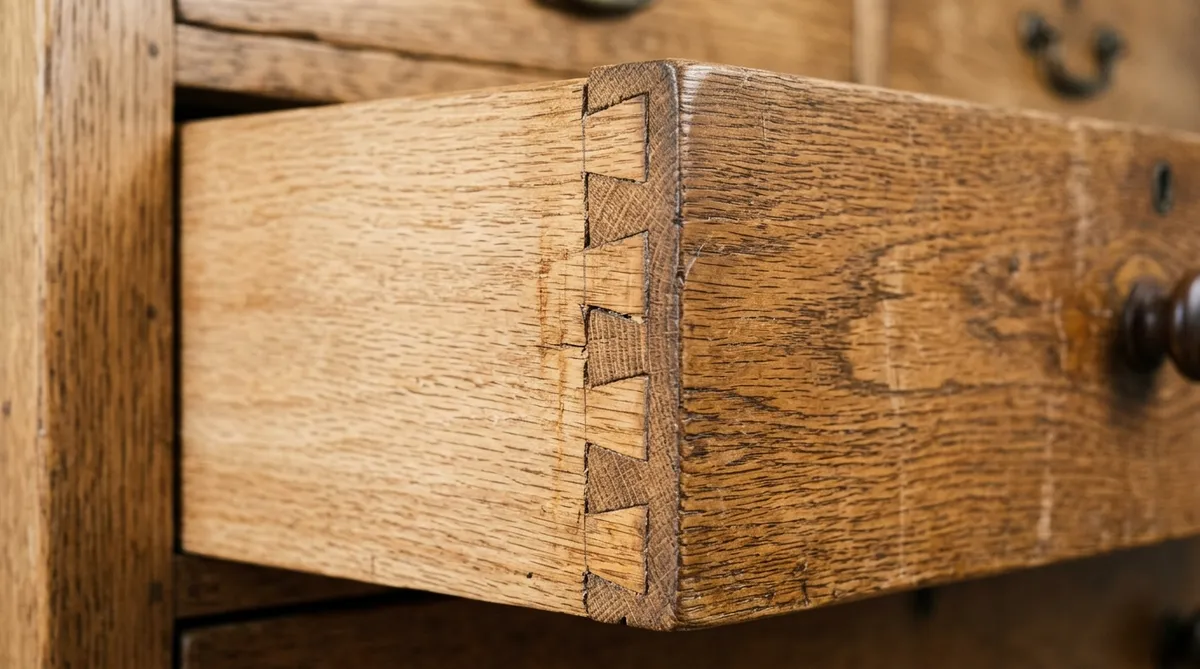
The durability of vintage furniture comes down to traditional cabinetmaking techniques:
- Dovetail Joints: Interlocking wedge-shaped fingers hold drawer sides to drawer fronts without relying on hardware. When you pull open a heavy drawer packed with sweaters, the tensile force locks the dovetails tighter together.
- Mortise and Tenon Framing: A square wooden peg (the tenon) inserts deeply into a precisely routed cavity (the mortise) in the adjoining leg or rail. When secured with hide glue or wooden dowels, this joint withstands decades of leaning and shifting.
- Corner Blocking: Quality vintage dressers and tables feature triangular solid wood blocks screwed and glued underneath each corner. This prevents twisting and maintains rigidity across four points of contact.
- Solid Backing Panels: Where fast furniture uses thin folded cardboard tacked with staples, vintage pieces use solid wood slats or thick plywood backs that stabilize the outer frame.
Surface scuffs on solid wood buff out easily with fine steel wool or wax polish. Rather than deteriorating, natural timber develops a rich patina over decades of everyday use.
The Indoor Air Quality Risk of Fast Furniture
Fast furniture releases volatile organic compounds into your indoor air for two to five years after assembly because manufacturers use synthetic resin glues containing urea-formaldehyde. In sealed modern apartments with limited ventilation, these airborne chemicals accumulate in bedrooms and living rooms where you spend the majority of your day.
Formaldehyde is an industrial adhesive agent classified as a known human respiratory irritant. When you unbox a new flat-pack bookcase, that pungent chemical odor is the off-gassing of excess solvent resins curing through the unfinished edges of the boards. In warm weather or humid rooms, the rate of chemical emissions increases substantially.
Secondhand solid wood eliminates this indoor air hazard completely. Any original surface varnishes or shellacs cured decades ago, leaving the timber completely inert. When you bring a thrifted 1960s dresser or an antique pine farmhouse table into your bedroom, you introduce zero toxic off-gassing into your breathing zone.
How to Inspect Secondhand Furniture Like a Professional
Spotting real hardwood at thrift shops, estate sales, and online marketplaces requires checking five physical checkpoints rather than trusting the seller description.
1. Check the Drawer Joinery
Open drawers to inspect corner joinery. Interlocking dovetails signal authentic artisan construction, whereas plastic clips or staples indicate mass manufacturing.
2. Inspect the Weight and Balance
Solid wood is significantly heavier and more bottom-heavy than hollow particleboard or honeycomb paperboard. Lift one end of the sideboard or coffee table. A genuine oak or walnut credenza feels dense, solid, and immovable. If a massive six-drawer dresser lifts effortlessly with one hand, it is constructed from thin veneer or lightweight composite board.
3. Trace the Wood Grain Across Corners
Follow a distinct grain line across the flat top surface of a dining table or nightstand right to the side edge. On genuine solid wood, the grain pattern runs continuously over the edge and translates into the end grain on the side. If the grain pattern abruptly terminates at a plastic edge-strip or looks like a printed digital photograph with repeating pixel patterns, it is laminate.
4. Examine the Underside and Unfinished Back
Crawl underneath the piece with your phone flashlight and look at the bottom surface. Authentic vintage furniture has raw, unplaned wood underneath with visible saw marks and natural color variations. If the underside is smooth white paper, raw brown composite shavings, or particleboard matrix, skip the purchase.
5. Inspect the Hardware and Drawer Runners
Quality vintage dressers slide on centered wooden guide tracks waxed smooth with paraffin, rather than stamped sheet-metal ball-bearing runners. Look at the handles and pulls. Cast brass, forged iron, or carved solid wood knobs indicate thoughtful construction. You can always elevate a thrifted find by swapping worn pulls for solid brushed brass hardware.
4 Easy Steps to Clean and Restore Vintage Wood at Home
Restoring a thrifted wooden treasure does not require professional workshop machinery or hazardous chemical strippers. You can bring dry, faded wood back to lustrous life in one afternoon using gentle, safe supplies.
- Deep Clean Away Decades of Grime: Mix two tablespoons of plant-based dish soap into a bowl of warm water. Dip a soft microfiber rag into the suds, wring it nearly dry, and wipe along the wood grain to remove skin oils and built-up dust without soaking the timber. Immediately dry the surface with a clean microfiber towel.
- Dissolve Water Rings and Minor Blemishes: For white moisture rings or surface haze, apply a small dab of Howard Restor-A-Finish to extra-fine 0000 steel wool or a soft cotton cloth. Buff gently in the direction of the wood grain until the cloudiness clears.
- Feed the Dried Timber with Natural Oils: Vintage wood dries out after decades in climate-controlled indoor air. Rub a generous coat of Howard Feed-N-Wax Beeswax & Orange Oil over all exterior surfaces. Let the conditioning oils soak into the timber for twenty minutes to restore moisture.
- Buff to a Lustrous Protective Sheen: Take a clean microfiber cloth and vigorously buff the wood surface until the waxy residue disappears, leaving behind a smooth, water-repellent satin luster that repels dust and preserves the patina.
The Financial Math: Fast Furniture vs. Solid Wood Over 20 Years
Investing in secondhand solid wood creates immense financial savings over a twenty-year horizon because you only buy the item once.
Consider a standard living room media credenza. A budget flat-pack TV console costs approximately $280 online. Because the thin top begins sagging under television weight and the cam-lock joints loosen during moves, most households replace that unit every four years. Over twenty years, you purchase five separate consoles, spending $1,400 in merchandise, plus countless hours of frustration assembling flat boxes with allen wrenches.
Now consider buying a 1960s mid-century solid walnut credenza on Facebook Marketplace or at a local vintage consignment shop for $350. You spend $25 on natural restoration wax and new brass hardware. Twenty years later, that walnut piece remains sturdy, functional, and beautiful. If you ever choose to redecorate, you can resell that exact walnut credenza for $500 to $800, because vintage mid-century furniture appreciates in value as authentic old-growth hardwood becomes rarer.
Secondhand furniture is the only decor category where your purchase operates as a liquid financial asset rather than guaranteed household waste.
Frequently Asked Questions
Can you fix water-damaged particleboard furniture?
No, water damage to particleboard cannot be reversed because the compressed wood fibers permanently swell and lose their structural bond once wet. While you can lightly sand the bubbled surface and apply paint, the inner core remains structurally weak and will continue to flake. For wet areas like bathrooms and entryways, always choose solid wood or exterior-grade plywood.
How do I get cigarette or musty odors out of vintage wood furniture?
To remove stubborn odors from vintage wood, clean the entire piece inside and out with a 50/50 mixture of distilled white vinegar and warm water, then leave the drawers open in direct outdoor sunlight for four hours. Sunlight naturally breaks down odor-causing mold spores. You can also place bowls of activated charcoal or dry coffee grounds inside closed drawers for 48 hours to absorb remaining smells.
Is vintage furniture safe from lead paint?
Vintage clear-varnished or stained hardwood furniture does not contain lead, because lead was primarily used as a pigment in opaque colored paints manufactured prior to 1978. If you purchase a painted antique piece with peeling layers, test the surface with an EPA-recognized rapid lead test swab before sanding, or seal the existing paint with a non-toxic clear topcoat.
What wood species are the most durable for active family homes?
White oak, hard rock maple, ash, and hickory are the most durable solid wood species for busy family homes with children and pets. These hardwoods rank high on the Janka hardness scale, meaning they strongly resist claw scratches, toy drops, and heavy everyday impact compared to softer woods like pine, cedar, or poplar.
Does buying secondhand furniture really reduce carbon emissions?
Yes, purchasing secondhand solid wood reduces household carbon emissions by eliminating the harvesting, industrial resin synthesis, overseas freight shipping, and cardboard packaging required for new flat-pack items. Studies indicate that choosing a pre-owned vintage dresser prevents roughly 50 to 80 kilograms of greenhouse gas emissions compared to manufacturing a new flat-pack equivalent.
Conclusion & Next Steps in Sustainable Decor
Choosing vintage solid wood over disposable flat-pack furniture transforms your home into a healthier, more character-rich sanctuary while saving money. Start small by checking local thrift shops or online listings for small side tables and nightstands where solid hardwood joinery shines.
To expand your sustainable living space, explore our related guides: