Outdoor Sconce Sizing Guide: 5 Porch Light Rules
Reader Disclosure: This post contains affiliate links. If you buy through them, we may earn a commission at no extra cost to you. We only recommend items tested for clean craftsmanship and authentic durability.
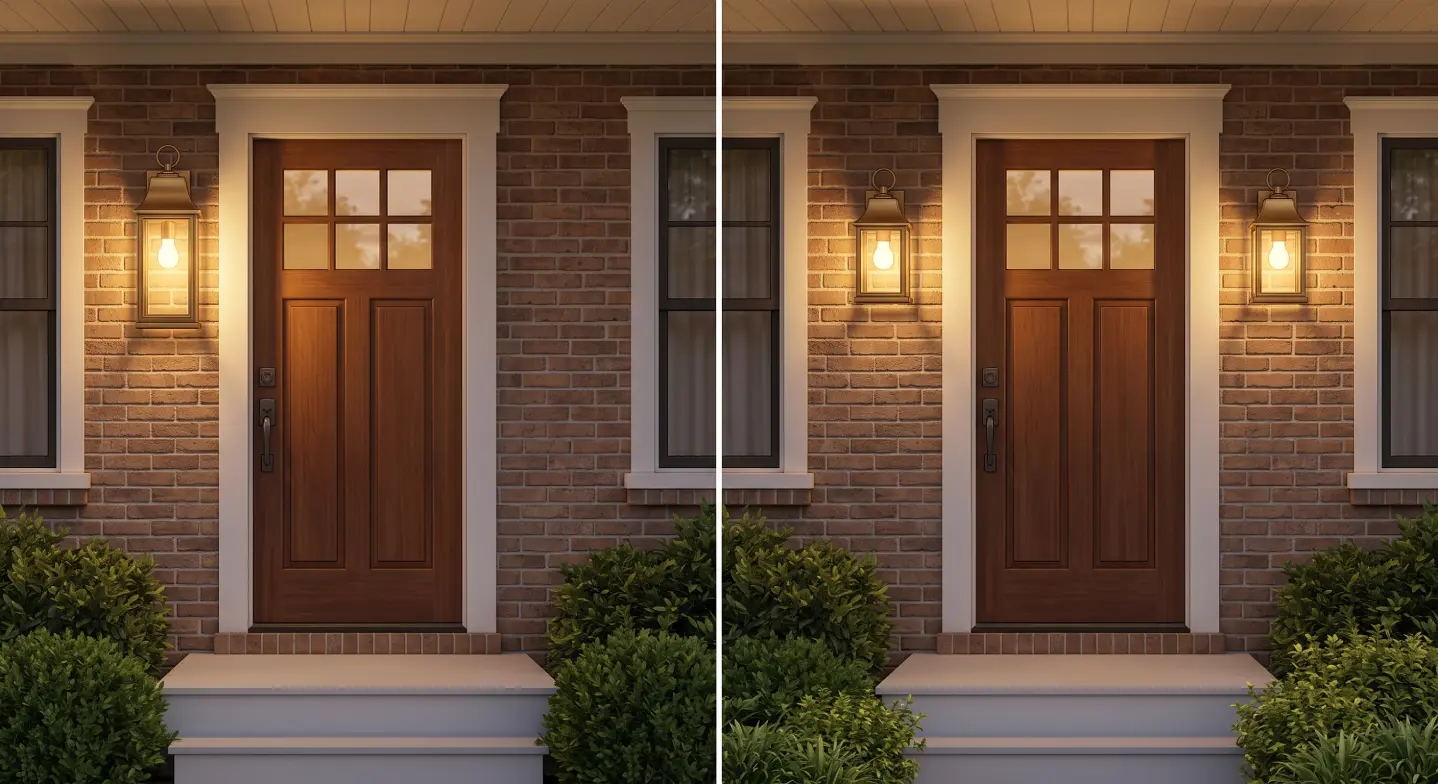
A single outdoor sconce should measure one-third of your front door height. Two flanking lanterns should each measure one-fourth of door height. Mount both configurations with the bulb center at 65 to 67 inches above the finished porch floor so the light sits at standing eye level and illuminates visitor faces properly.
The most common porch lighting error is buying fixtures that are far too small. An 8-inch builder-grade lantern beside an 80-inch front door looks like a nightlight. From the street, viewing distance cuts perceived fixture size roughly in half, so a 10-inch lantern that looks adequate on the shelf reads as a dot on the wall from 30 feet away. Size up confidently.
Before you order any fixture, enter your door height and porch dimensions into our Outdoor Sconce Calculator to confirm the exact lantern height, mounting height, and lumen output for your specific entry configuration.
The One-Third and One-Fourth Sizing Rules Explained
Use one-third the door height for a single sconce and one-fourth the door height for a matched pair. These proportions come from classical architectural theory and hold up consistently across every door style from simple craftsman to grand Georgian columns. They work because the eye reads fixture height relative to door height, not relative to absolute inches.
On r/HomeDecorating, the recurring complaint from homeowners who ignored this rule is identical: “I thought the lantern looked huge at the store, but it disappears against the house.” That is the street-distance effect. At 25 to 30 feet, your eye loses detail and perceives height at roughly half its actual value. A 20-inch lantern reads as a 10-inch lantern from the curb. Factor this in before you finalize the order.
Exact Lantern Heights for Standard and Tall Doors
Measure your door from threshold to the top of the door slab, not the top of the door frame. Frame trim adds two to four inches and skews the ratio. Apply the calculation to the door slab height only.
- 80-inch door, single sconce: Target 26 to 27 inches tall (one-third of 80). Shop in the 24-to-28-inch range.
- 80-inch door, paired sconces: Target 20 inches tall (one-fourth of 80). Shop in the 18-to-22-inch range.
- 96-inch door, single sconce: Target 32 inches tall (one-third of 96). Shop in the 28-to-34-inch range.
- 96-inch door, paired sconces: Target 24 inches tall (one-fourth of 96). Shop in the 22-to-26-inch range.
- Double doors (80 inches each leaf): Skip single-sconce placement entirely. Install matched pairs at one-fourth ratio, 20 to 22 inches, one flanking each door edge.
Grand Entries with Transoms and Sidelights
When a transom window sits above the door, measure from the threshold to the top of the door slab only. Do not include the transom height in your ratio calculation. The lantern proportions to the operational door, not to the full glass assembly. Sidelights do not change the sizing formula either, but they do create additional wall width that makes undersized lanterns look even smaller. On a full sidelight entry assembly, increase the lantern height by one size step: if the formula gives you 22 inches, buy 24 to 26 inches.
Mounting Height: The 65-to-67-Inch Eye-Level Standard
Mount your exterior sconce so the center of the bulb sits 65 to 67 inches above the finished porch floor. This height aligns the light with average adult eye level (64 to 68 inches), so the fixture illuminates visitor faces directly instead of casting light down onto the top of their head or upward into the porch soffit.
The center of the bulb is not the same as the top or bottom of the fixture. Measure from the floor to the midpoint of the lantern body where the bulb socket sits. On most wall lanterns, this midpoint falls two to four inches below the top of the fixture housing. Mark the junction box location accordingly before you call the electrician.
Measuring from Porch Floor, Not Step Landing
Always measure from the finished porch deck surface at the door threshold. If your entry has three steps leading up from a lower landing, the reference point is still the porch deck at the door, not the lowest step. Using the step landing as your reference moves the fixture too low, which creates glare for anyone walking up the stairs and leaves the door hardware in shadow.
Homes with raised porches more than two steps above grade should consider adding step lights on the stair risers as a separate circuit. This prevents the porch sconce from needing to cover too much vertical distance and avoids the tripping hazard of a completely dark stair run.
Clearance from Porch Ceiling and Roof Overhang
The top of your lantern must clear the porch ceiling beam or soffit by at least six inches. On a standard 8-foot porch ceiling, mounting the fixture at 66 inches puts the top of a 24-inch lantern at 78 inches from the floor, with 18 inches of clearance above. That works. On a lower 7-foot porch ceiling (84 inches), the same fixture tops out at 78 inches with only 6 inches of clearance, which sits at the minimum limit. Drop the mount to 64 inches or switch to a shorter 18-inch fixture.
Single Sconce Placement: Always the Handle Side
Install a single porch sconce on the handle and lockset side of the door. Visitors naturally look toward the handle to knock, ring the doorbell, and find the keyhole. A sconce on the hinge side illuminates the door’s hinges while leaving the lockset in shadow, which forces guests to fumble for the bell in the dark. Every electrician who wires entry lighting knows this rule, and most still ask the homeowner which side before cutting the junction box opening.
If your front door is centered between two sidelights and no single side is obviously the handle side from curb view, install a pair. A centered front door with one off-center sconce always looks like a mistake, regardless of how well-sized the fixture is.

Spacing Paired Sconces from the Door Casing
When you install two flanking sconces, keep each fixture 8 to 12 inches from the outer edge of the door casing. Less than 8 inches and the lantern crowds the door frame, making the entry look narrow. More than 12 inches and the fixture loses its visual connection to the door and reads as a random wall lamp.
On homes with wide sidelights, place the sconce on the outer edge of the sidelight trim, not between the sidelight and the door casing. Centering the fixture on the full sidelight panel width, rather than between the panels, gives the entry a symmetrical, purposeful look from the street.
Weatherproofing Ratings: Wet vs Damp-Rated Fixtures
All exterior porch sconces directly exposed to rain require a UL wet-location rating. Damp-rated fixtures work only under a fully covered porch where rain never reaches the fixture wall. If your porch has an overhang shallower than 18 inches or the fixture wall faces the prevailing wind direction, treat it as an exposed wet location and buy wet-rated accordingly.
Wet-rated fixtures include sealed interior gaskets, corrosion-resistant hardware, and drainage weep holes at the base of the glass chamber. Damp-rated fixtures lack these features. Installing a damp-rated fixture in a wet location voids the UL listing, voids the manufacturer warranty, and creates a shock hazard when water infiltrates the socket housing over a season or two.
Material Choices for Coastal and Humid Climates
Salt air destroys painted aluminum and zinc alloy fixtures within two to three seasons. In coastal zones within five miles of tidal water, use solid cast brass, copper, or marine-grade 316 stainless steel. These metals form a natural patina that protects the base metal from further corrosion. Unlacquered solid brass develops a warm brown patina over two to three years, which suits craftsman and colonial entry styles well.
In non-coastal humid climates (the Gulf Coast, Pacific Northwest, Florida interior), powder-coated cast aluminum works well if the coating is at least 60 microns thick. Thin budget powder coats chip within a year of seasonal thermal cycling. Check the fixture spec sheet for coating thickness before you buy.
Bulb Type and Color Temperature for Entry Lighting
Use warm white LED bulbs rated 2700K for all entry sconces. Cool white 4000K bulbs give the porch a commercial gas-station look and drain warmth from the entry’s architectural details. Choose bulbs with a CRI of 80 or above so the lantern renders the front door color, brick, and stone faithfully at night. For fixtures in sealed glass chambers, confirm the bulb’s maximum ambient temperature rating matches the fixture’s enclosed operating temperature, typically listed on the fixture spec sheet as “suitable for enclosed fixtures.”
Porch Sconce Sizing Quick-Reference Chart
Use this chart as a field reference when shopping. Match your door height and configuration to the recommended fixture height, mount height, and lumen output in a single pass.
| Door Height and Configuration. | Single Sconce Height (1/3 Rule). | Paired Sconce Height (1/4 Rule). | Bulb Center Mount Height. | Target Lumens Per Fixture. |
|---|---|---|---|---|
| 80-inch standard single door. | 24 to 28 inches. | 18 to 22 inches. | 65 to 67 inches. | 800 to 1,200 lumens. |
| 96-inch tall single door. | 28 to 34 inches. | 22 to 26 inches. | 66 to 68 inches. | 1,000 to 1,400 lumens. |
| Double doors, 80-inch each. | Not recommended. | 20 to 24 inches each. | 65 to 67 inches. | 1,200 to 1,600 lumens each. |
| Grand entry with transom and sidelights. | 28 to 34 inches (statement). | 24 to 30 inches each. | 66 to 68 inches. | 1,200 to 1,800 lumens each. |
For custom entry configurations where door height, sidelight width, and porch ceiling all combine to complicate the sizing decision, enter your exact dimensions into the Outdoor Sconce Calculator for a precise fixture height recommendation.
Browse wet-rated brass and cast-aluminum entry lanterns in the correct size ranges on Amazon to compare customer dimensions, finish reviews, and current pricing.
Five Porch Sconce Mistakes That Kill Curb Appeal
Reddit’s r/HomeDecorating and r/femalelivingspace threads document five porch lighting errors over and over. Each one is preventable before any fixture ships.
Fixture too small. An 8-to-10-inch lantern beside a standard door looks like a builder leftover from 1990. Go to at least 18 inches for a single 80-inch door. At 24 to 28 inches, the entry commands attention from the street.
Wrong side for a single sconce. Mounting on the hinge side casts shadow across the lockset and keyhole. Always choose the handle side. Rewiring after drywall closes costs $300 to $600 in labor.
Damp-rated fixture in a wet location. A damp-rated lantern on an exposed wall corrodes from the inside out. Water infiltrates the socket housing and creates a shock hazard within one to two seasons. Check the rating label before installation.
Too bright, wrong color temperature. A 2,000-lumen clear-glass fixture at 5000K turns the porch into a parking lot. Use 800 to 1,200 lumens at 2700K with a frosted or seeded glass diffuser for a welcoming warm glow.
Sconces too close to the door casing. Fixtures closer than six inches to the casing visually pinch the entry and look cramped from the street. Keep at least 8 inches of clear siding between the casing edge and the lantern body.
For related fixture placement rules covering garage carriage lights, entryway ceiling fixtures, and outdoor pathway lighting, explore the full Lighting Design and Fixtures guide series.
Frequently Asked Questions About Outdoor Porch Sconces
How big should a front porch light be compared to the door?
A single outdoor sconce should stand one-third of the door height. Two paired flanking lanterns should each measure one-fourth of door height. On a standard 80-inch door, that means a 24-to-28-inch single lantern or a matched pair of 18-to-22-inch fixtures.
What height should outdoor porch sconces be mounted?
Mount the fixture so the bulb center sits 65 to 67 inches above the finished porch floor. This aligns the light source with adult eye level, illuminating visitor faces and door hardware directly without casting downward shadows on steps or throwing glare upward into the soffit.
Which side of the front door should a single sconce go on?
Always mount a single exterior sconce on the handle and lockset side of the door. The keyhole, deadbolt, and doorbell all sit on that side. Placing the light opposite the handle leaves guests fumbling for the lock in shadow every time they arrive after dark.
What is the difference between damp-rated and wet-rated outdoor fixtures?
Damp-rated fixtures handle covered porches where direct rain never hits the fixture. Wet-rated fixtures have sealed gaskets, waterproof wiring, and drainage channels that handle direct rainfall. Any exposed exterior wall facing wind-driven rain requires a wet-location UL rating, not a damp rating.
How many lumens do front porch outdoor sconces need?
Entry sconces should deliver 800 to 1,200 lumens each at 2700K with a frosted or seeded glass diffuser. Fixtures above 1,500 lumens create blinding glare that impairs night vision on porch steps. Paired sconces together should total 1,600 to 2,400 lumens across the full entry width.
Final Checklist Before Your Electrician Arrives
Measure your door slab height (not frame height). Divide by three for a single fixture or by four for a pair. Confirm the fixture is wet-rated if any exposed wall faces rain. Mark the junction box center at 66 inches from the porch deck. Choose 2700K LED bulbs rated for enclosed fixtures. Keep 8 to 12 inches of clearance from the door casing to the lantern body.
These steps take 15 minutes with a tape measure and prevent the two most expensive mistakes: ordering the wrong size and cutting the junction box on the wrong side of the door.